
Published November 13, 2026 03:41AM
Yoga Journal’s archives series is a curated collection of articles originally published in past issues beginning in 1975. This article about Sun Salutations first appeared in the September-October 1990 issue of Yoga Journal.
Much of our life is spent beginning and completing cycles. All around us, this process repeats itself in thousands of forms. Some cycles, like the dramatic transformations that sweep away the familiar in our city landscapes, happen so swiftly that we may find it difficult to adjust. Other cycles, like a current of water slowly dissolving a rock in its path, occur so slowly that we can’t perceive the change moment to moment. All life is folding and unfolding, arising and returning, defying and surrendering, being born and dying.
Like an internal tide, this cosmic ebb and flow pulsates in every cell of the body.
Our human communion with this cosmic rhythm can be felt most profoundly in our breathing. As we awaken to the cyclic movement of the breath, we realize that all physical movement is born from it. When movement is connected to the life rhythms within and around us, it arises from the breath, is given form and direction through it, and attains a smooth, rounded quality that is impossible without it.
But most of us, especially those who live and practice yoga in an urban setting, have little opportunity to experience the vibrancy of life as it expresses itself through us. The heartbeat of the Earth is barely palpable under layers of asphalt and concrete or from the 40th floor of our workplace. The sun, moon, and stars may be hidden by clouds of pollution. We may rarely feel the comforting presence of a tree or hear the sound of an ocean wave-we may not have touched the earth with our bare feet for months. We can easily forget that our lives are braided within the natural cycles of nature, because we are largely disconnected from what the Native Americans call Mother Earth and Father Sky.
One of the best-known yoga practices, Suryanamaskar—Salute to the Sun, most commonly known as Sun Salutation—gives us an opportunity to reacquaint ourselves with the Earth and sky through the symbolic movements of expansion and surrender. Sun Salutation is practiced as one continuous flowing motion, like a sacred mantra for the body, loaded with alchemical potential, whose result is inner stillness. Through these symbolic movements, we honor the incredible gift of life that Earth and sky afford us. We make ourselves available to experience our connectedness to life around us and life as it expresses itself through us. The practice of Sun Salutation is a conscious enactment or reminder of our place in the universe.
How to Breathe in Sun Salutation
Traditionally, Sun Salutation is practiced with a predetermined breathing pattern.
Different hatha yoga systems have developed their own versions of the salutation, each with its own approach to the breath. In the variations presented here, I’ve made some suggestions about when to inhale or exhale in coordination with the movements, but these are meant only as suggestions and not as rigid rules.
Most opening, rising, or expanding movements are performed on the inhalation, while most closing, descending, or folding movements are performed on the exhalation. In my personal practice, however, I’ve found it much more exciting to explore what happens when I stop giving the body orders about when to breathe, then watch how the breath pattern arises spontaneously out of the body’s innate intelligence. For instance, some movements seem to require more than one breath, and the breath pattern can shift with the speed of the cycle.
At the beginning of your practice, you may feel like spending a minute or more in each position, breathing naturally as you warm the body and gradually reducing your time in each position with each successive cycle. Experiment with your own breathing patterns to find what feels comfortable for you.
In this article, we’ll first focus on practicing simple movements in two of the basic positions of Sun Salutation— Mountain Pose (Tadasana) and Downward-Facing Dog (Adho Mukha Svanasana). You’ll mimic the movement of the breath by practicing exaggerated folding, unfolding, relaxing, and expanding movements.
The Foundations of Sun Salutation
These movements demonstrate how the breath can help you connect your body weight to the Earth and how you can tap into the naturally expansive nature of the breath to move energy up through the body. These deceptively simple movements are the foundation for a more dynamic practice of Sun Salutations.
Mountain Pose
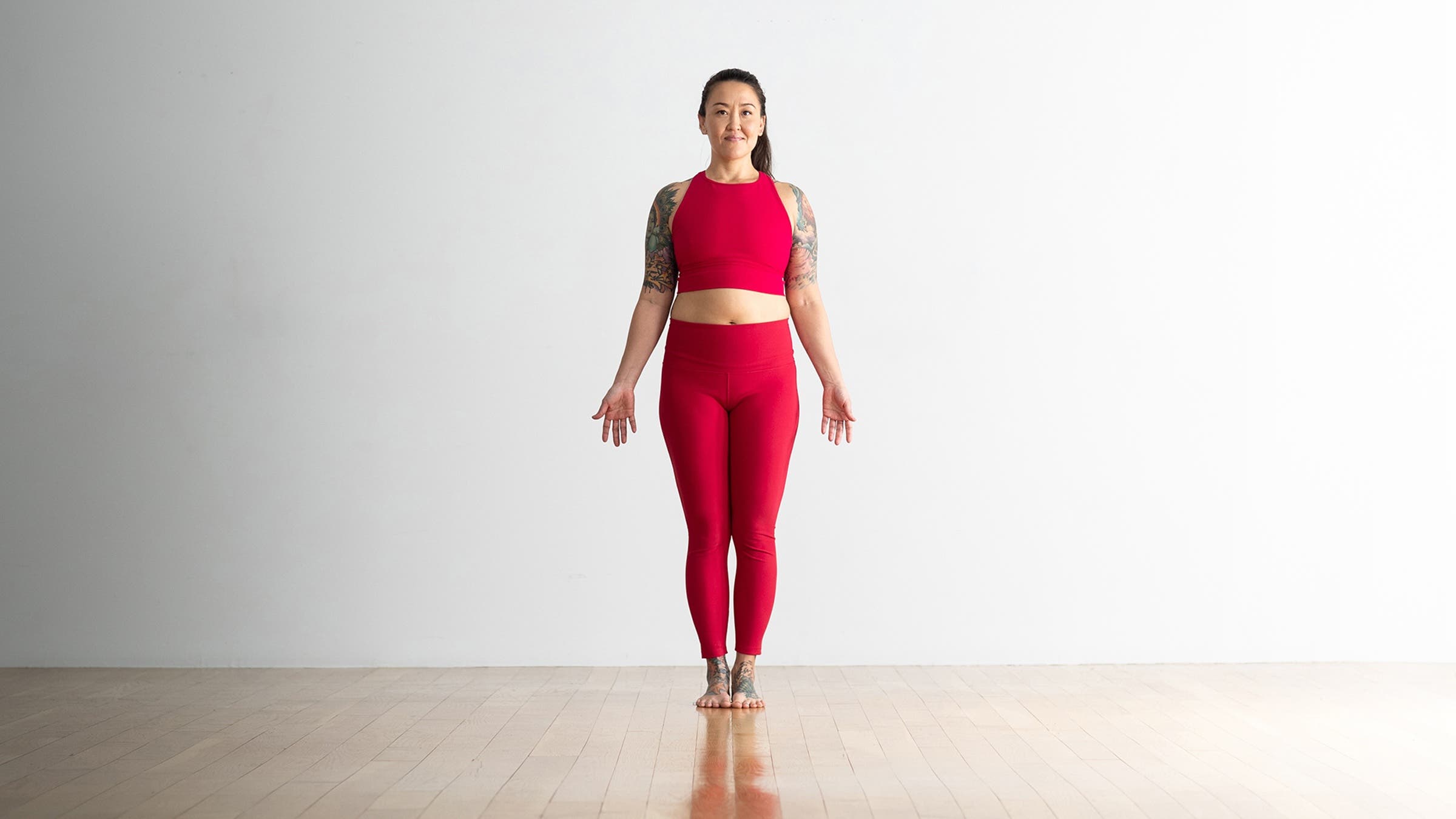
Stand with your feet hip-width apart. Become aware of your breathing, noticing how the breath expands out from the center of your body to touch the skin of your belly, your rib cage, and the chest. As you become more aware, begin to feel the “echo” of your breath in other parts of your body.
Can you feel how the lower back slightly arches as you inhale and slightly flattens as you exhale? Let it happen—there is nothing you need to do to create this movement, which naturally occurs with every cycle of the breath. If you can’t feel any movement, notice whether you are blocking the breath by holding the belly tight or squeezing the buttocks. Relax these areas and see what happens. On your inhalation, can you feel the breath swell into the shoulders, slightly broadening them?
Standing Forward Bend
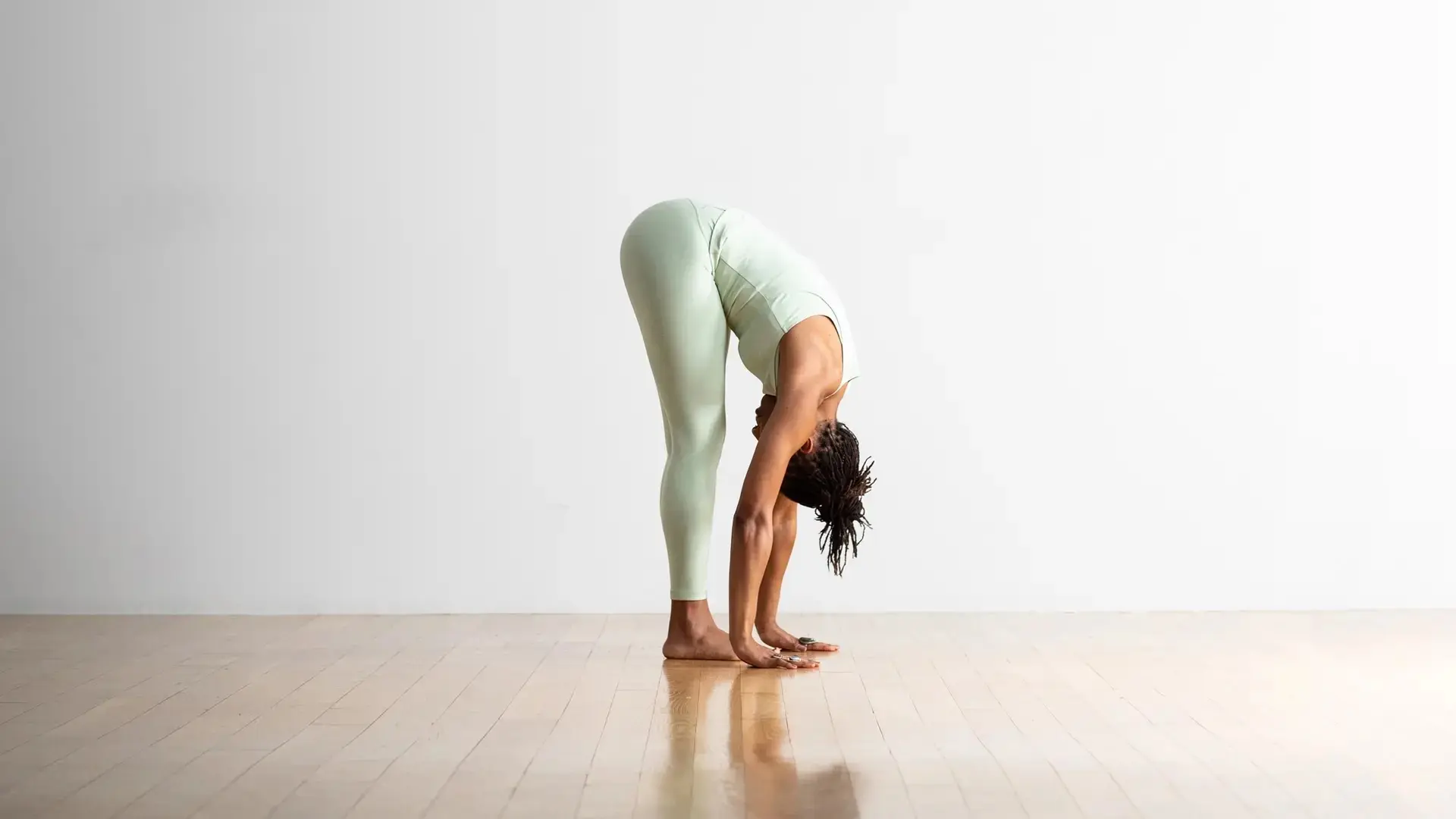
On the next exhalation, let your body fold, creasing at your knees and hips and letting your spine round in Standing Forward Bend. Let the head hang and your arms turn inward. As you relax your muscles, feel the weight of your body surrender itself to the Earth.
As you inhale, press your feet down so your legs begin to straighten. As you continue pressing down, your legs will straighten completely, and your pelvis, spine, chest, neck, and head will unfold sequentially until you are standing upright in Mountain Pose again. Try not to interfere with this process by forcibly straightening your spine or raising your head with your neck muscles. Instead, let the downward force of your feet pressing into the ground rebound up through your body with minimal muscular effort.
Alternate between folding on the exhalation and unfolding on the inhalation, letting the movements be quite large at first. As you begin to feel your movement connect you to the Earth and the sky, gradually let the movements become smaller and smaller. When the folding and unfolding movements become minute, simply let yourself stand in Mountain Pose. As you stand “still” it may feel like you are continuing to move, as if the body were a large, pulsing amoeba. Great! You’ve begun to tap into the way the breath naturally moves within the body.
Downward-Facing Dog Pose
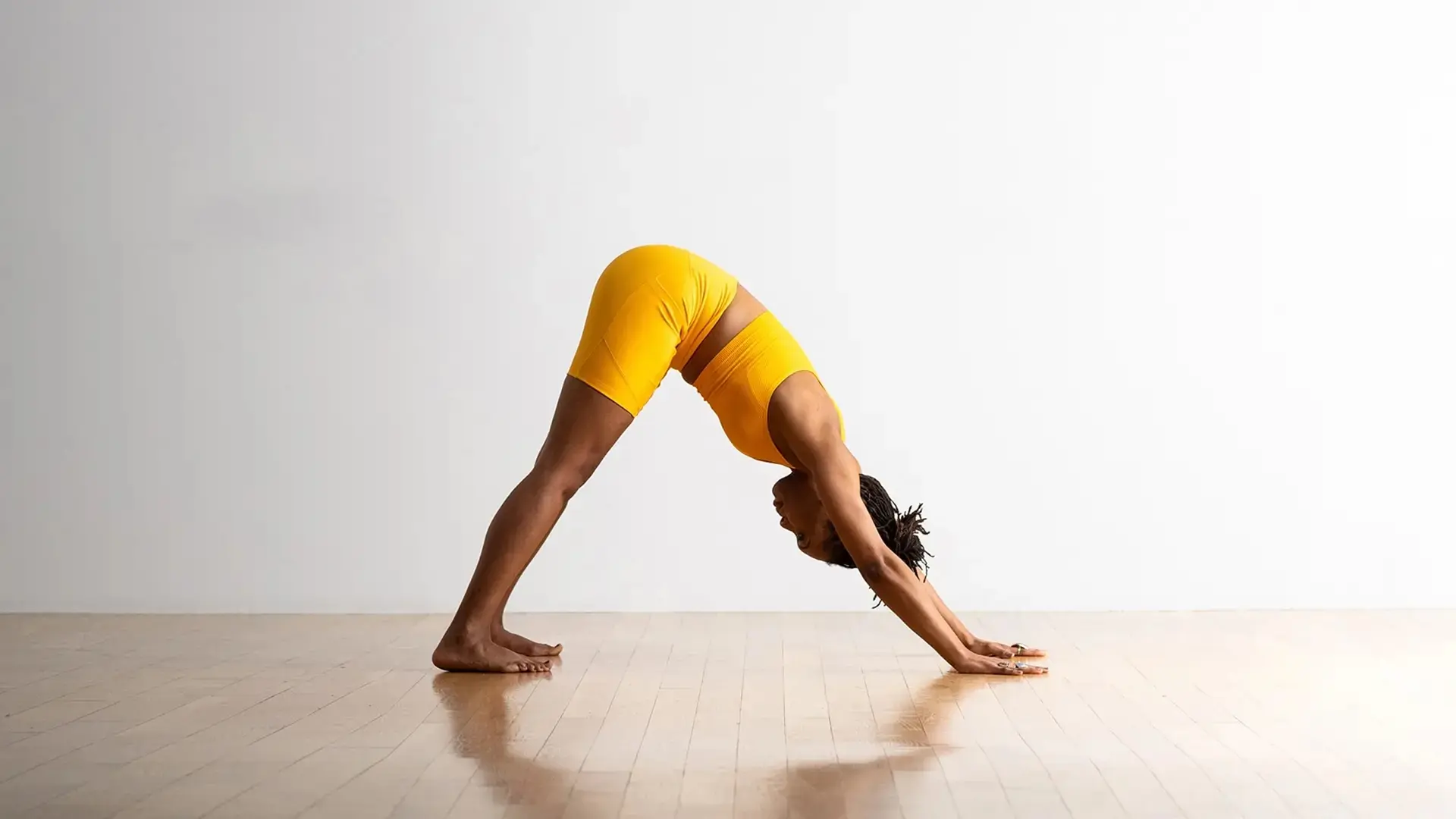
Kneel on all fours on a non-slippery surface (such as a hardwood floor or a “sticky” yoga mat), with your hands directly below your shoulders and your knees below your hips. Feel the transitions between your inhalations and your exhalations, noticing how the shape of your spine changes with each breath.
Turn your toes under and, as you inhale, push with your feet, driving your spine forward until the weight of the chest comes to rest over the hands. As you exhale, push the hands firmly into the ground and drive the spine back until the buttocks are resting on the heels. Maintaining awareness of the breath, continue the movement, pushing the body forward with the feet and backward with the hands. As you came forward, did you notice how the curve of the spine spontaneously deepened? As you moved backward, did you notice how the spine rounded? If you don’t feel these movements in the spine, you may be unconsciously gripping the belly, buttock, or back muscles. Relax these areas and observe what happens.
On your next inhalation, press the floor away with your hands and begin to unfold your knees, coming into Downward-Facing Dog Pose. As you exhale, let the elbows and knees bend, but don’t bring them all the way to the floor. Feel your weight pressing your hands and feet to the ground. As you inhale, gradually begin to push the floor away, first straightening the arms, then lengthening the spine, and finally unfolding the legs. Continue to alternate between folding and unfolding, exhaling and inhaling, gradually letting the movements become smaller. As you approach stillness, can you feel the echo of these movements? Whenever you feel as if you are just “holding” the pose, or when the muscles feel rigid and unbreathing, let the elbows and knees fold and use breath and movement to gradually work back to a still yet dynamic position.
Sun Salutation Variations
The postures within the Sun Salutation cycle require considerable arm, leg, and upper body strength. When this strength is lacking, the cycle can put great pressure on the spinal column.
As you practice the Sun Salutation cycle, focus not only on each position, but on the transitional movements that link each posture to the next. The attention that you give each moment is the key to sustaining an unbroken, flowing rhythm within the cycle. When you look at a ticking clock, you probably notice the moments when the hand moves to the next second marker. We know that time is indeed passing between the incremental movements of the clock hand, but it does not have the same significance for us. If you stop in each position, the Sun Salutation cycle will take on a mechanical quality, just like the clock ticking from marker to marker. Your challenge is to take each position to its full expression but not to linger, so that you give every moment the same importance.
As soon as you have completed one movement, move slowly on to the next, so the whole cycle has a fluid rhythmic quality. Imagining that you are moving against resistance or under water might help you get this flowing feeling.