
Published March 12, 2026 09:23AM
Yoga Journal’s archives series is a curated collection of articles originally published in past issues beginning in 1975. This article first appeared in the September-October 1991 issue of Yoga Journal.
This seated twist draws our attention inward, helping us sense the core structures of our body—and the essential nature of our soul in nature. In autumn, another cycle of seasons nears completion. Trees and other vegetation begin to lose their leaves, and we see once again the essential structure of the trunks and branches beneath. Lower temperatures and shorter days prompt us to spend more time inside.
Human life follows a similar rhythm. Similarly, in the autumn of our lives the task is to turn inwards, focus on essentials, and come to terms with our innermost nature.
In India, this period of life was traditionally dedicated to the study of yoga. A young person was expected to mature, adopt a trade, and become a householder. Only when the children were raised was a person free to leave home and family and become a sadhu, or seeker of truth. In this search, the possessions and habits of worldly life were gradually stripped off, to be replaced by divine inspiration.
Benefits of Marichyasana III and Other Twists
Marichyasana III is one of four asanas named for Marichi, a mythological Hindu sage. In some texts, Marichi’s father is listed as one of the seven great sages, or rishis, of antiquity. Thus the title “Marichyasana” connotes wisdom that goes back for generations.
A twist is a fitting pose to represent the archetype of the sage. For me, all twists strongly evoke the spirit of autumn, the season of sagely maturity. In a well-performed twist, we are drawn into communion with our core, just as a tree’s life force is drawn back toward the roots in late fall. If only the shoulders and head twist, the action is incomplete; the twisting motion must derive from the base of the spine and include each vertebra.
When we perform Marichyasana III (or any twist, for that matter), we sense our skeleton, just as we see the trunk and branches of a tree in late autumn. The pose strips off the non-essentials, allowing us to feel our core structure. It’s a good pose to practice when we feel drawn away from our center into the frenzy of external events, and it’s an ideal, if challenging, asana for extraverted people who find it difficult to turn within.
Seeing the core of our structure, we may also see its flaws. If there is unevenness in one area, collapse in another, rigidity in a third, we may trust this pose to point out those characteristics. Only when the entire spine is able to lengthen maximally can we experience the essence of Marichyasana III. Because the carriage must become very erect in the pose, its practitioner emanates a dignified, regal air.
Like all twists, this asana squeezes the abdominal organs, flushing away what is not essential to our metabolic function. As impurities are released, people may experience nausea or belching while practicing twists; they also may find them helpful in relieving constipation. Consequently, twists can be useful after eating and drinking.
Marichyasana III may also flush out pent-up emotions, particularly anger. In both Chinese and Ayurvedic medicine, anger is said to be associated with the liver. The squeezing and stimulation of the liver may be the cause for the angry feelings some practitioners report during intense practice of twists.
Backbends and twists are polar opposites. In a well-performed twist, we are drawn into communion with our core, just as a tree’s life force is drawn back toward its roots in late fall. Backbends are dramatic poses; they bring our inner life up to the surface. In twists, all the intensity is on the inside, while the surface may appear quite calm.
For this reason, the fiery backbending poses are a fitting complement to the inner-directed twists. Backbends warm the spinal column and its surrounding musculature and open the chest in preparation for twists. Twisting asanas cool down and neutralize the spine after intense practice of backbends. These two groups of asanas teach us the merging of inner and outer; the practice of each contributes to the other.
How to Practice Marichyasana III
Benefits
- Brings flexibility to the spinal column Teaches the spine to lengthen evenly
- Benefits the abdominal organs
- Draws concentration inward
Contraindications
- This pose must not be practiced during pregnancy, since it would compress the fetus.
- Students with back problems should seek the help of an experienced teacher and begin with the variation shown in Figure 1.
The most important instruction in any twisting pose is to lengthen the spine. The skull and tailbone should feel as though they were connected by one long elastic band, which evenly stretches to lift and rotate the skull. Often, it feels instead as if the skull and tailbone were separated by a series of concrete blocks that move at different rates.
For many of us, lengthening the spine is more difficult when we sit with the legs straight out than when we stand up.
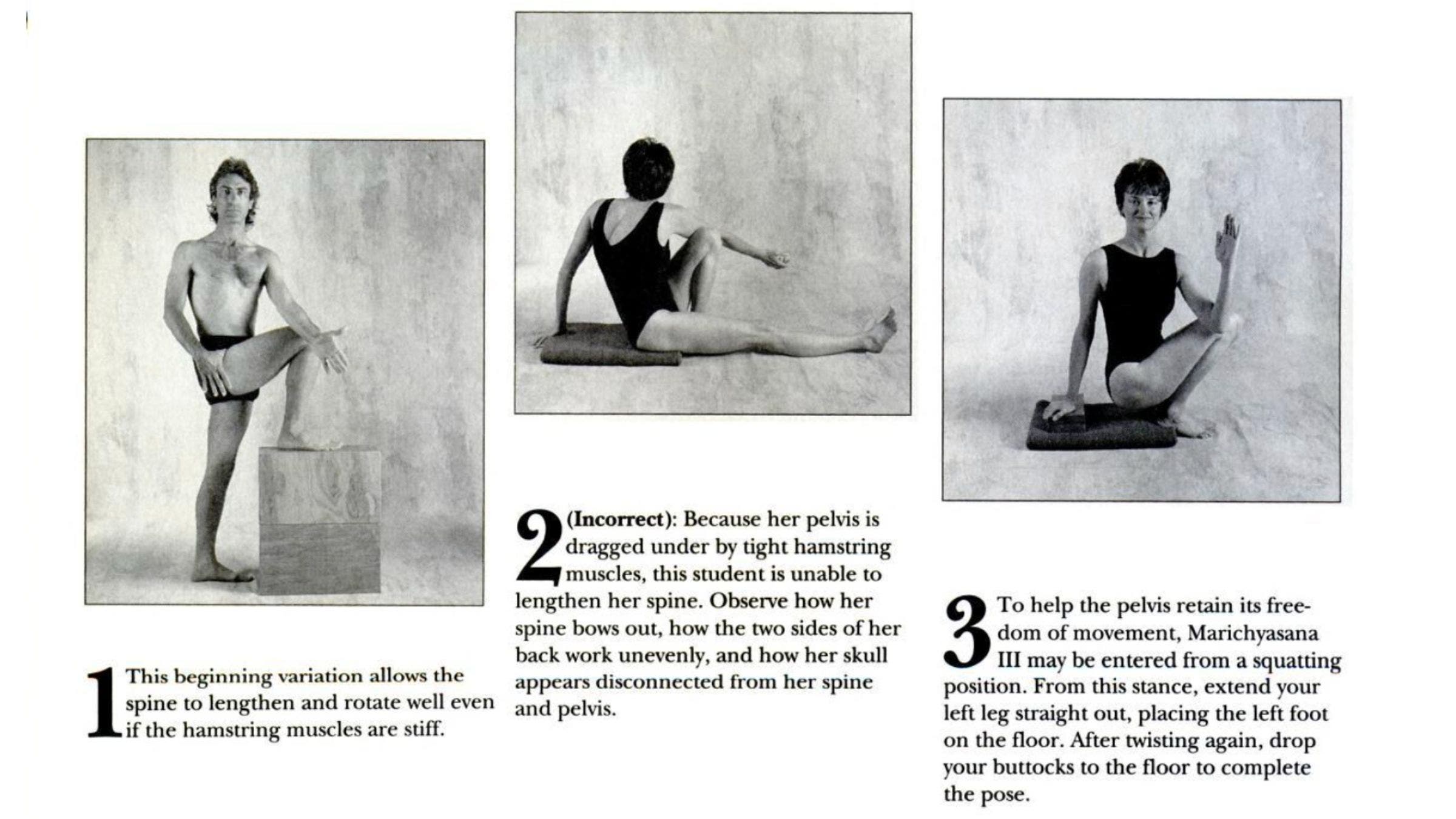
Thus, it can be helpful to begin by practicing a standing variation of Marichyasana III. Stand facing a low table (or other prop such as a chair or stool). Elevate your right foot on the table. The right knee should be at approximately the height of the right hip. Then cross your left arm over your right knee (Figure 1). The right side of the pelvis has a tendency to move up and forward when the foot is elevated; bring the right hand to the crease of the hip to press it down and back.
Now twist as if to look over your right shoulder. If you do this action casually, you will feel the twist mostly in the muscles of the low back and neck. Instead, before you begin to twist, let the spine lengthen; try to grow several inches!
Then imagine a clockwise spiraling motion that begins at the base of the spine. Let this movement move up through each vertebra until it reaches the skull. The shoulders and head don’t twist on their own, but receive an action initiated lower down.
Twists grow slowly over time; don’t assume you’ve completed your pose in the first few seconds. Stay in the pose, lengthening the spine with each inhalation. With each exhalation, allow another spiraling wave to move from the base to the top of the spinal column. Check to make sure your right hip is still held down. Notice if the spiral wave appears to be blocked in any spinal segment; if so, lengthen the spine still more in that area. Then release and repeat the pose on the second side.
Continuing students: Figure 2 illustrates the challenge we face in attempting a seated twist. Although the model is attempting to twist, her pelvis is tugged under by tight hamstring muscles. With the base of her spine pulled forward, her middle back rounds to compensate. It would be hard for this student to get any sense of lifting or extending the spine; her tailbone doesn’t seem connected to her skull.
If you’ve ever felt like this miserable student, you may find it valuable to come into Marichyasana III from a squatting position (Figure 3). This variation allows the pelvis to remain off the ground and the knees to remain bent until the spine has had a chance to extend. To practice this variation, squat on the ground with the big toes touching. If you find squatting difficult, place a folded blanket under the heels. The height of the blanket will compensate for short Achilles tendons.
Place your right hand on the ground behind you (or on a book or a block if you can’t reach the ground). Cross the left elbow over the right knee. Now move as though to press the navel against the thighs. As you perform this motion, the pelvis should tilt so the hipbones rock forward and the sitting bones extend backward. From this foundation, let the pose develop. With each inhalation, consciously lift the skull to lengthen the spine. With each exhalation, rotate further toward the right. As the spine twists, the head will naturally turn to look over the right shoulder.
Leaving the right leg in position and maintaining the spinal length and twist, stretch the left leg out, straightening the left knee and resting the left heel on the ground. To complete the pose, maintain the forward rotation of the pelvis, then lightly let the buttocks drop down to touch the blanket. As you drop the buttocks to the floor, the arm will slide down the leg so the armpit comes closer to the knee. Hold the pose, trying to keep a sense of lightness and length in the spine. Release and perform the pose on the second side.
Having learned how to rotate the pelvis forward and extend the spine in Marichyasana III, now try coming into the pose in the classical way. Sit on the ground with the legs stretched out in front of you. You may place a folded blanket under the buttocks, or even sit on a block, to help the pelvis tilt forward.
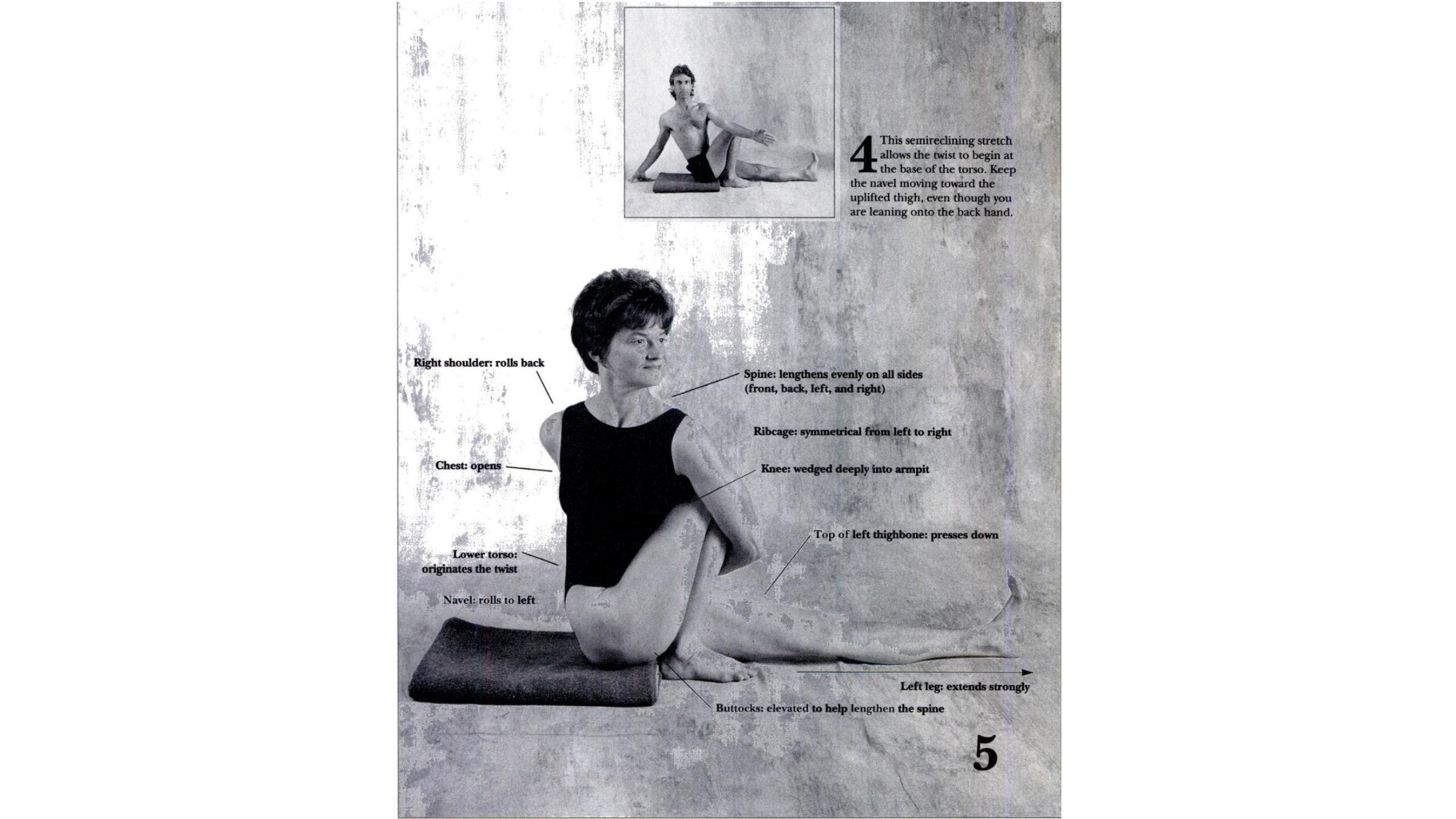
Bend the right knee and draw the right foot toward the right buttock. To maximize the twist in the lower spine, place the right hand somewhat behind you, cross the left elbow over the right knee, and lean on the back hand (Figure 4).
Even though you’re leaning back, don’t let the navel cave back toward the spine. Rather, tilt the pelvis forward and continue to lift the navel as though to press it against the right thigh. Then twist toward the right.
In the half-reclining position shown in Figure 4, it’s easier to originate the twist from the very base of the torso; you may even observe diagonal wrinkles across your T-shirt as it stretches across your abdomen. In this position, the abdominal organs are massaged, and the twist reaches down into the less-mobile lumbar vertebrae. Conversely, when the twist is initiated with the torso upright, it’s all too easy for the belly to get locked up against the right thigh, thus confining the twist to the shoulders and head.
Now that you’ve brought the twist down to the base of the torso, maintain that twist while you slide the right hand back toward the buttocks, thus returning the torso to its full upright position.
Look over the right shoulder as you stretch out through the ball of the left big toe; feel a diagonal extension through the entire body. Since there’s a strong tendency to block or harden the breath in twists, consciously make your breath smooth, soft, and relaxed. Check to make sure you’re breathing evenly into both lungs. Then repeat the pose on the second side.
From each thoracic vertebra in the back body exits a pair of ribs, one extending to the right side of the spine, the other to the left. In all the twisting variations, become aware of the position of your spinal column and of each pair of ribs. While twisting to the right, we tend to raise the entire right half of the ribcage toward the ceiling and spread the right side ribs away from each other.
Conversely, we tend to drop the left half of the ribcage toward the ground so that those ribs squash into each other. The left back ribs and the right side ribs protrude outward and press against the skin.
As a result of this incorrect action, each pair of ribs slants at an angle to the ground.
The deep work of Marichyasana Ill is to bring each pair of ribs parallel to the ground and to its neighboring ribs. If we’re twisting toward the right, we must consciously lift and elongate the left back body, drawing more breath into the left lung. By actively pressing the right buttock into the ground, we allow the right ribcage to descend as well. Finally, the left back ribs must move inward toward the front body as the right shoulder rolls round to complete the twist. (This way of working may prove valuable for those with mild to moderate scoliosis, i.e., lateral curvature of the spine.)
Experienced students: Twists ripen with successive repetitions. While I was studying at the Iyengar Institute in India, we often began with beginning variations of basic twists, repeating each twist four or more times on each side. Gradually, additional actions were added, until we arrived at difficult variations of more advanced twists.
Start with all the beginning variations described in the sections above. As the body warms and the spine loosens, slide the armpit ever deeper down the uplifted leg. On a final repetition, complete the pose. Twisting to the right, slide the left arm still farther forward, then bend the elbow and bring the arm behind you.
Reach around to grasp the left hand with the right (Figure 5). Hold the pose with even breathing, then repeat on the second side. Joining the hands together is not the biggest challenge in the completed pose, though that alone may appear difficult.
Rather, the challenge is to do so while maintaining the balanced action of the spine and back ribs described earlier. To find symmetry in a fundamentally asymmetrical position, we must reach inside ourselves, learning the nature of our deepest supporting column, the spine itself.
To come into our full upright position, the accumulated imbalances of a lifetime must be corrected. Hence, this pose requires patience and might well be mastered only late in life. It is a pose that evokes the majesty of a hundred-year-old oak in late November, nakedly displaying the gnarled shape of its trunk and branches.
This is an abridged version of the original article written by Carol Cavanaugh.