
Stretch your body. Quiet your mind.
(Photo: Polina Tankilevitch | Pexels | Design in Canva by Laura Harold)
Published July 30, 2026 06:35AM
Yoga Journal’s archives series is a curated collection of articles originally published in past issues beginning in 1975. This article about Triang Mukhaikapada Paschimottanasana first appeared in the September-October 1983 issue of Yoga Journal.
The translation of this asana is triang, meaning three parts of a limb, i.e., the foot, knee and buttock; mukhaikapada, meaning mukha or face; eka or one, and pada—leg or foot. Paschimottanasana is an intensive stretch to the west or back of the body. The entire name translates as “the forward bend involving the three parts of the limb in which the face touches one extended leg.” In this asana, a simpler forward bend is made more difficult, and the body and mind are taught to maintain poise in the midst of that difficulty.
The pose requires flexibility in the hamstrings in the back of the straight leg thigh and flexibility in the hip sockets. The straight leg is in a neutral position, although a slight internal rotation is suggested. But the bent leg hip joint is in a very different position. When one bends the knee and places the foot next to the buttock, the hip joint is internally rotated; one of the challenges of the pose is to try to bring that thigh back to the neutral position, i.e., to lessen the rotation.
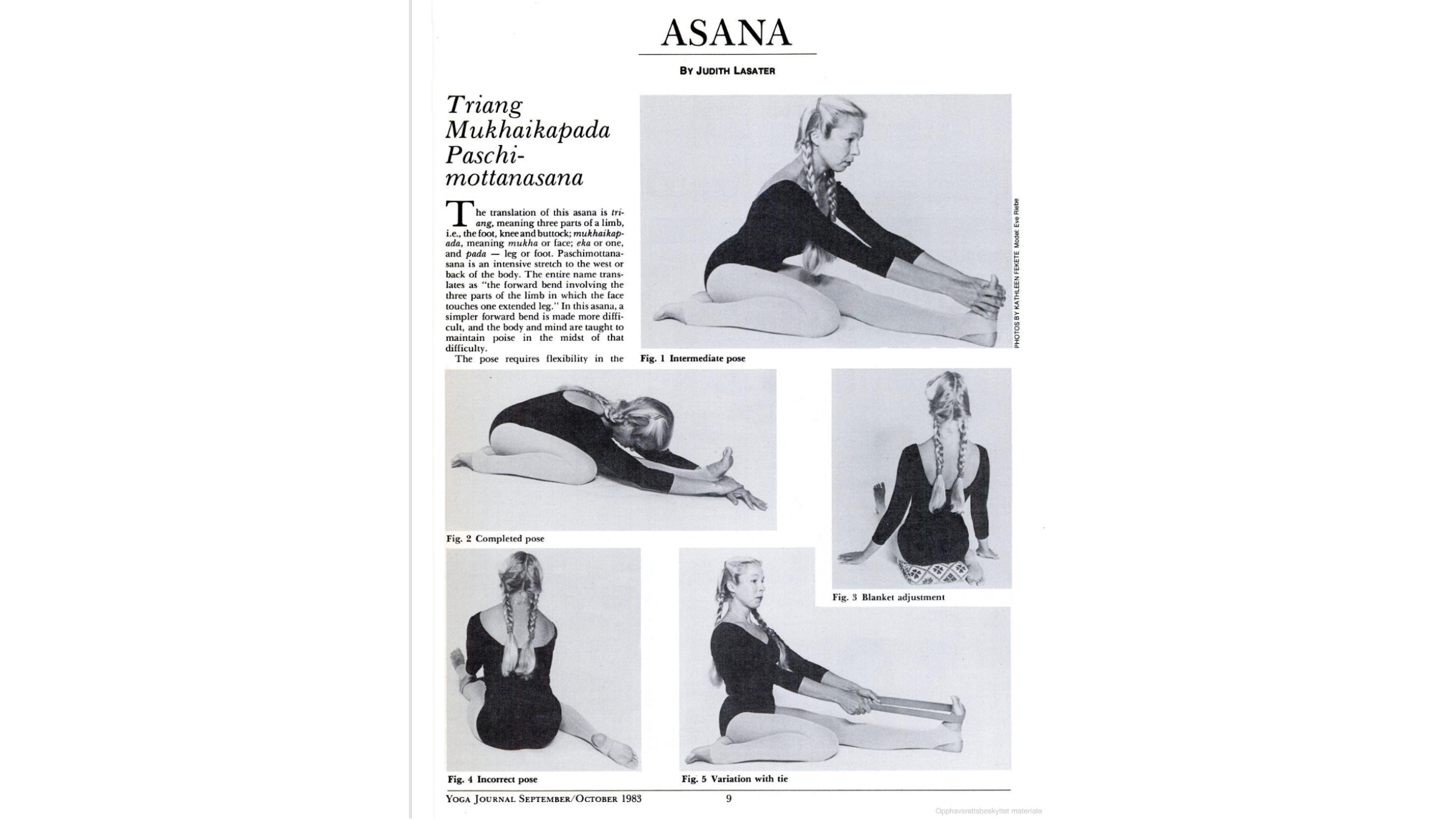
There are several reasons why it is difficult to do this. First, the foot of the bent knee may not be flexible enough to lie in a straight line; it may have too high an arch or the ankle may be stiff. Thus, the foot keeps the knee from bending evenly and too much rotation is forced at the hip. This rotation may also be caused by tightness in the internal rotators of the hip. In Figure 4, the student is falling to the left side because she has internally rotated the right hip joint and is unable to sit equally on both buttocks. She is now attempting to externally rotate the pelvis on the femur (thigh bone). The femur is held in internal rotation and she is moving the pelvis toward a position of external rotation of the right hip, i.e., trying to sit on the right buttock.
Because her internal rotators are tight, they will not allow the opposite hip action, external rotation.
Another reason the student was unable to sit evenly in the pose could be tight hamstrings in the straight leg, which would prevent her from coming to a full upright sitting position, throwing her off to the side.
Why is it important to prevent the body from shifting off-center in this asana? The shift is detrimental to the stretch of the spine. It can be observed in Figure 4 that as the student continues to bend forward, the vertebral column will become more and more twisted to one side. Thus, the spinal stretch will become more and more twisted to one side; in addition, the abdominal organs and the lungs will not receive equal stimulation. To avoid leaning, the student may insert a folded blanket, as in Figure 3.
The blanket may be inserted under both buttocks to take pressure off the bent leg foot, or it may be inserted under only the buttock of the straight leg, minimizing the tendency to lean toward that side.
Floor sitting poses are often difficult for Westerners who have spent their lives sitting in chairs. For them, this pose can be beneficially practiced without attempting to bend forward. The pose in Figure 2 is only recommended for the more supple student who understands the necessity of moving from the pelvis and not overstretching the spinal column.
Like all forward bending asanas, Triang Mukhaikapada Paschimottanasana is quieting to the mind and body. It does not require the strength of an arm balance but rather the inner strength of will to hold the pose even when it is difficult for the legs and hips. This strength of will must not be confused with an aggressive pushing of the body beyond its limits. The latter is practicing the asana with a goal of “achieving the pose” and often results in injury.
Instead, inner strength of will means a fine balance between letting go of the rigidity that keeps one from expressing the beauty of the pose, while maintaining the one-pointed concentration necessary to refuse to move in the face of discomfort.
A large part of this discomfort is not physical. It is the mental and emotional discomfort that comes from confronting one’s limitations, one’s restrictions, one’s shortcomings and weaknesses. Actually, it is the recognition on a deep level that one is finite and imperfect. This is the discomfort that yoga is attempting to produce in the practitioner. For it is only when one confronts limitations that one seeks for something beyond. Thus, a fruitful asana practice allows one to feel the discomfort of limitation in order to transcend it.
How to Practice
Begin by sitting on the floor with the legs straight in front and the spinal column erect. Bend one leg back and place the foot next to the buttock. Make sure the sole of the foot is facing upward, not backward, as this could place too much strain on the inner knee of that limb. It may enhance the practice of the pose to pull the outer calf muscle of the bent leg slightly out to the side to free the bending of the knee.
Take a moment to observe the new sitting position. Both buttocks should be placed evenly on the floor; it this is not possible, insert a blanket under one or both buttocks until this is achieved (see Figure 3). Beginners may find just sitting in this position to be enough work; if the lower spine is well-lifted, the student may place a tie around the foot of the straight leg and allow the spine to lift up before gradually bending slightly forward (Figure 5). This is an action of the hips, and the spine should remain soft and long. As soon as the spine bulges out in the back, the forward bend has been hurried. The more advanced student can bend further and further forward (Figure 2), being careful to keep the spine free and the action concentrated in the hips.
Hold the pose for several breaths, depending on ability. Repeat to the same side, then reverse the legs. Be sure to adjust the blanket each time the pose is attempted—one side of the body may be much tighter than the other. Check the basic sitting position before deciding how much blanket to insert.
According to B.K.S. Iyengar in Light on Yoga, benefits of the pose include help for flat and over-arched feet, stimulation to the abdominal organs, and reduction in swelling of the legs.