
Published August 14, 2026 10:58AM
Yoga Journal’s archives series is a curated collection of articles originally published in past issues beginning in 1975. This article about Tree Pose (Vrkasana) first appeared in the January-February 1989 issue of Yoga Journal.
Whether we practice Hatha Yoga or sit in meditation, we begin by challenging the limits of our physical endurance and capacity in order to penetrate our psychological resistances and fears. This aspect of spiritual practice is known as tapas. In yogic philosophy, tapas is considered one of the five niyamas (duties or observances) which constitute the second limb of yoga. According to Patanjali’s Yoga Sutras (II.1), three of these five niyamas are essential for the beginner in establishing a yoga practice—tapas (“austerity,” or “self-discipline”), svadhyaya (self-study), and ishvara pranidhana (surrender to the divine).
The meaning of the word tapas is probably derived from the process of refining away the impurities in gold by the heat of a furnace. Thus, B.K.S. Iyengar asserts, “Tapas is usually translated as ‘austerity, but its meaning is belter expressed as ‘burning desire.’ It is a burning desire to cleanse every cell of our body and every cell of our senses, so that the senses and the body may be made permanently pure and healthy…”
It is in this spirit that Iyengar also refers to Hatha Yoga as “the science of will.” From a purely physical point of view, we can understand how holding a posture develops self-discipline and strengthens the will.
As Mabel Todd observes in The Thinking Body: “Walking, as we all know, is easier and less fatiguing than standing, since the process of losing our balance and quickly recovering it causes less strain than the effort to keep our very flexible, delicately poised mechanism in one position. In standing there are actually many more small movements of more small parts cooperating. We must, moreover, impose our wills upon our bodies, since the attempt to stand still is not ‘natural’ and must be directed consciously.”
In balancing poses, the effort of will is much greater, because any doubt, any apprehension, any wavering of attention, immediately triggers physical collapse. When a class of beginners performs Vrksasana, it is not the standing leg that gives way first, but the mind.
Once the mind becomes cloudy or hesitant, the arms begin to waver, the shoulders lose their confidence, and soon the whole tree topples in a storm of self-doubt.
The physical support for Vrksasana comes mainly from the inner thighs. If the inner thigh muscles, the adductors, are weak or inactive, the pelvis drops down on the thighbone of the standing leg and forces the weight toward the outside edge of the foot, making the balance very precarious. It is therefore helpful to develop some strength and awareness of the inner thighs before practicing Vrksasana.
How to Practice Tree Pose in Yoga
Stand in Tadasana (Mountain Pose) with a wooden block placed lengthwise between the thighs. Do not squeeze the thighbones into the block, but rather think of lengthening the inner thigh muscles along the surface of the block, from the groins to the inner knees. As your inner thighs lengthen, feel how the lower abdomen becomes firm, and how the front of the lumbar spine begins to lift. The inner thigh muscles, by helping to activate the deep muscles of the abdomen (the iliopsoas muscles), provide crucial support for the weight of the spine.
If your balance is unsteady in Vrksasana, you may want to use the wall for support, as in Figure 2. Stand in Tadasana with your feet together and heels about an inch from the wall, so that the buttocks rest lightly on the wall and the shoulder girdle balances directly over the pelvis. Do not pull the shoulders back onto the wall, because this movement makes the spine dig sharply into the back and causes the lower ribs to protrude. Instead, bring your awareness to the lower back ribs, just above the waist area, and as you lengthen the inner thighs downward, allow the back ribcage to broaden and lift toward the ceiling.
Now shift the weight onto the left foot, turn the right thigh out, and lift the right knee high into the air, until you can take hold of the right ankle without rolling the shoulders forward or losing the lift of the spine. Then place the right heel on the inner left thigh, as near to the groin as possible, and adjust the foot so that the toes point directly down and the metatarsals come into contact with the inner thigh muscle just above the inner left knee. Lengthen the inner left thigh against the foot to lift the spine, just as you did in Tadasana with the block between the legs.
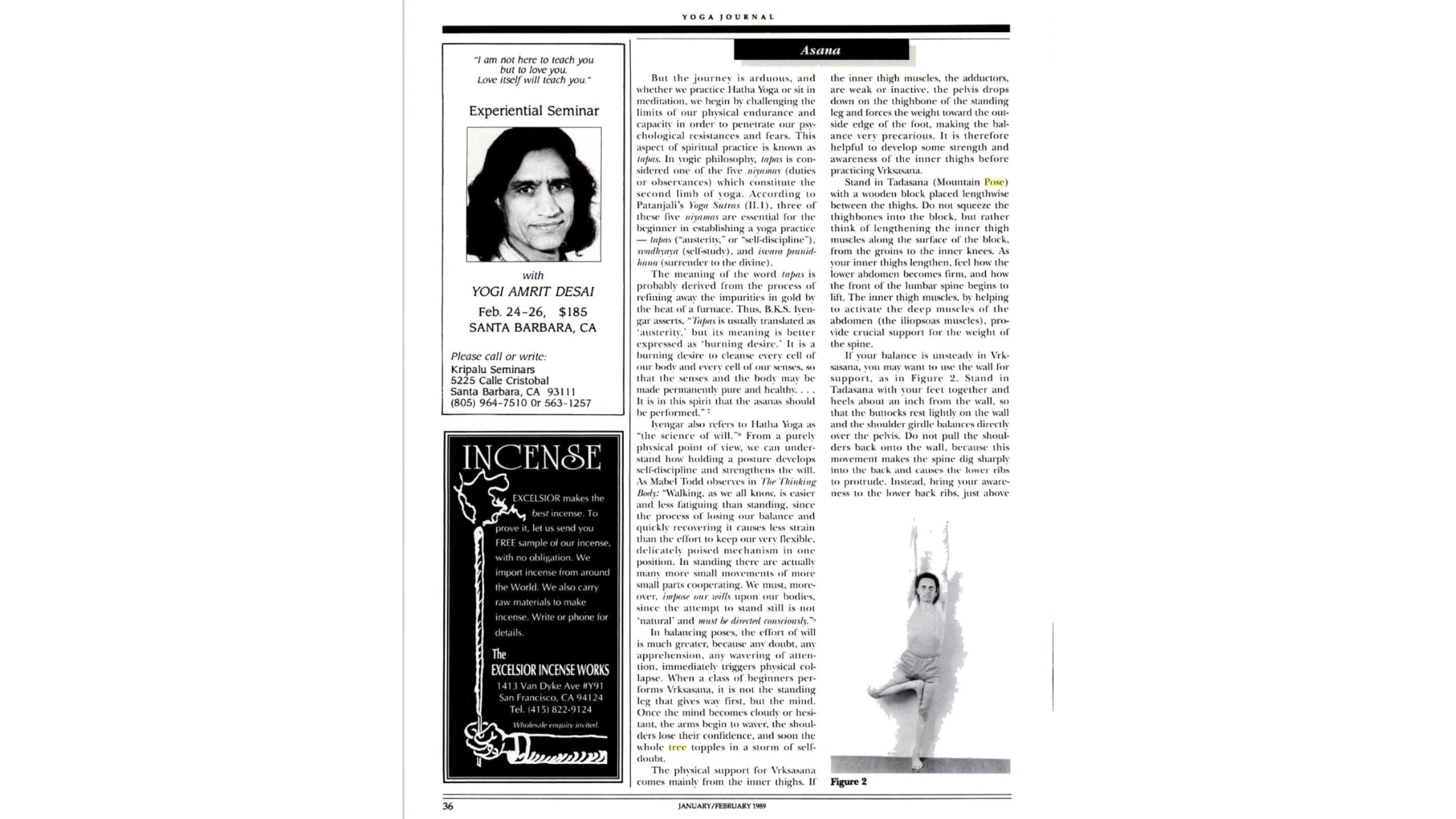
When the right foot is in position, extend the arms overhead, palms facing each other, and once again broaden and lift the back ribcage as you stretch the arms from the bottom tips of the shoulder blades to the fingertips. Feel that the back ribcage is in the same relation to the wall as when you stood in Tadasana.
Hold this position for several breaths, then repeat on the other side.
Tree Pose (Vrksasana) Variation
Here is another version of Vrksasana, also using the support of the wall, that teaches the correct action of the bent leg. First stand in Tadasana with your right side toward the wall and your feet about 15 inches from the wall.
Then, keeping the pelvis steady, turn your right thigh out and lift your right knee into the air, taking hold of the ankle. Place the right foot high on the inner left thigh, and let the right knee rest on the wall—about two or three inches forward of the line of the pelvis.
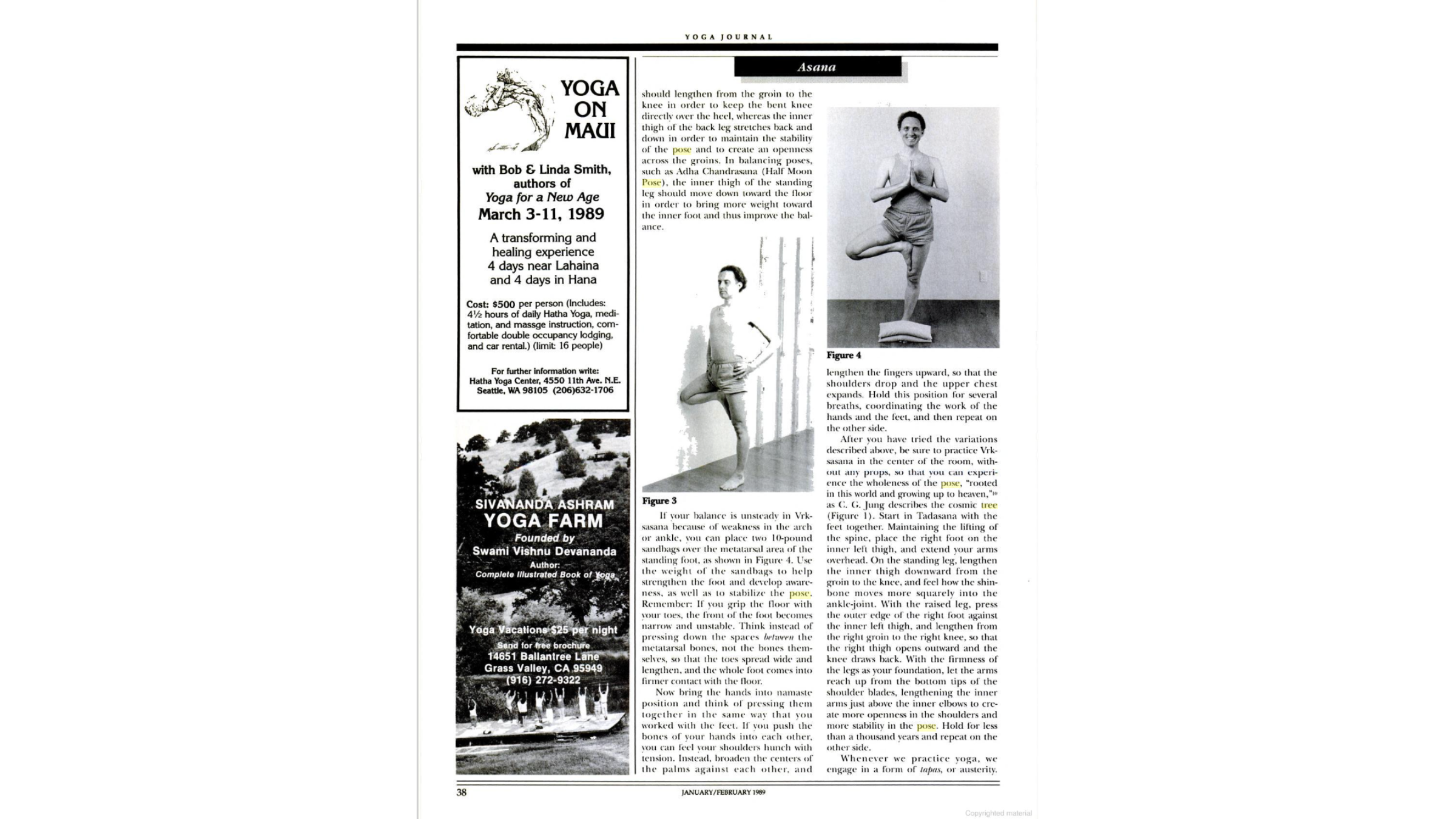
(If you place the knee too far back on the wall, the pelvis tilts forward and the lumbar spine is compressed.) Now bring your hands onto the hipbones as in Figure 3. Observe how the right side of the pelvis drops back and down when the legs are inactive. Then press the right knee into the wall, lengthening the inner right thigh, and feel how the right side of the pelvis lifts forward and up. To complete the pose. extend the arms overhead, palms facing. Firm the inner left thigh against the right foot, as you continue to press the right knee into the wall and lift the spine. Hold for several breaths, then repeat on the other side.
The movement of the inner thighs that we learn here in Vrksasana can be applied to all other standing poses. In bent-knee poses, such as Virabhadrasana (Warrior Pose) Il and Utthita Parsvakonasana (Extended Side Angle Pose), the inner thigh of the front leg should lengthen from the groin to the knee in order to keep the bent knee directly over the heel, whereas the inner thigh of the back leg stretches back and down in order to maintain the stability of the pose and to create an openness across the groins.
In balancing poses, such as Adha Chandrasana (Half Moon Pose), the inner thigh of the standing leg should move down toward the floor in order to bring more weight toward the inner foot and thus improve the bal-ance.
If your balance is unsteady in Vrksasana because of weakness in the arch or ankle, you can place two 10-pound sandbags over the metatarsal area of the standing foot, as shown in Figure 4. Use the weight of the sandbags to help strengthen the foot and develop awareness, as well as to stabilize the pose.
Remember: If you grip the floor with your toes, the front of the foot becomes narrow and unstable. Think instead of pressing down the spaces between the metatarsal bones, not the bones themselves, so that the toes spread wide and lengthen, and the whole foot comes into firmer contact with the floor.
Now bring the hands into namaste position and think of pressing them together in the same way that you worked with the feet. If you push the bones of your hands into each other, you can feel your shoulders hunch with tension. Instead, broaden the centers of the palms against each other, and lengthen the fingers upward, so that the shoulders drop and the upper chest expands. Hold this position for several breaths, coordinating the work of the hands and the feet, and then repeat on the other side.
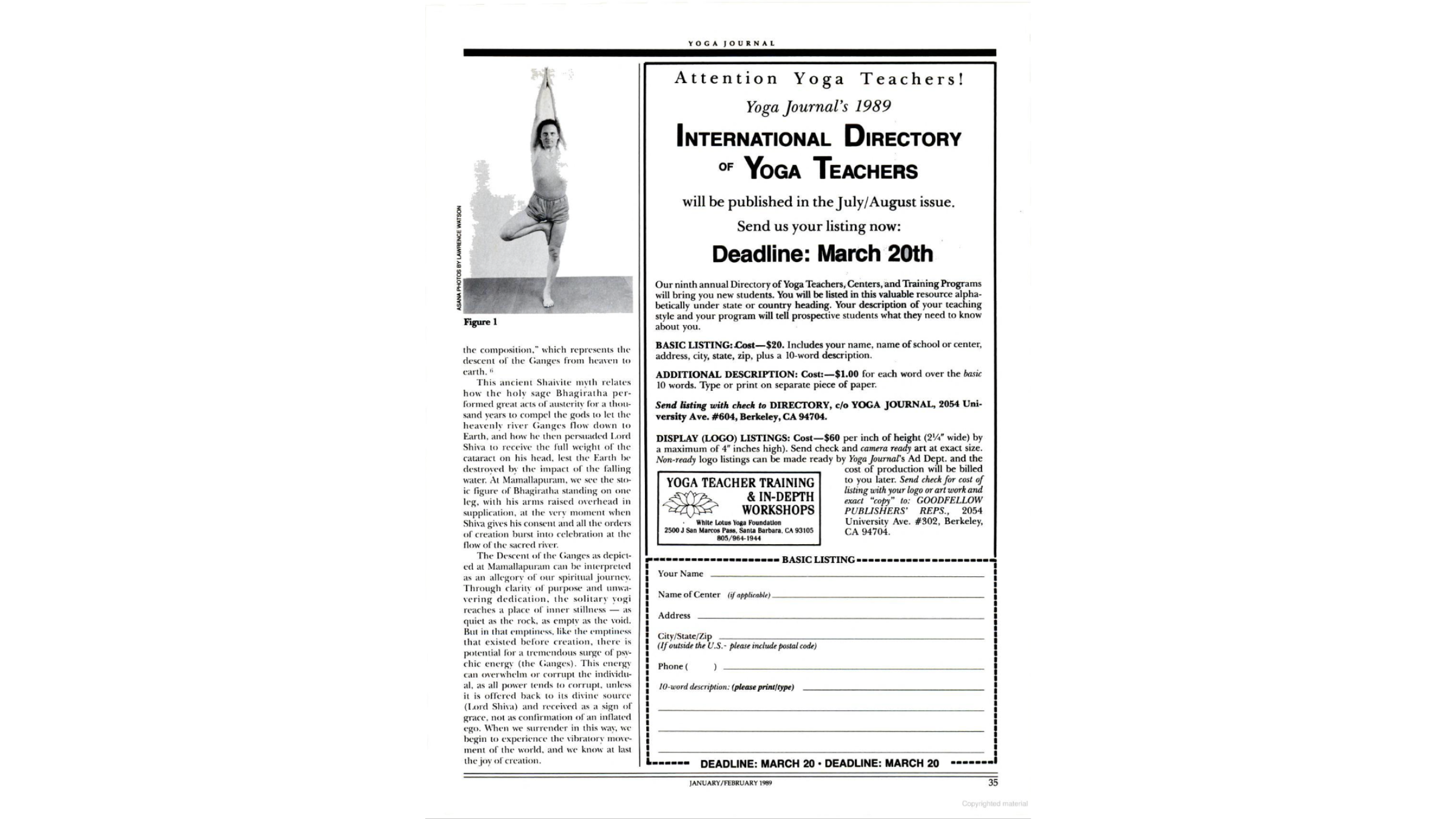
After you have tried the variations described above, be sure to practice Vrksasana in the center of the room, without any props, so that you can experience the wholeness of the pose, “rooted in this world and growing up to heaven,” as C. G. Jung describes the cosmic tree (Figure 1).
Start in Tadasana with the feet together. Maintaining the lifting of the spine, place the right foot on the inner left thigh, and extend your arms overhead. On the standing leg, lengthen the inner thigh downward from the groin to the knee, and feel how the shinbone moves more squarely into the ankle joint.
With the raised leg, press the outer edge of the right foot against the inner left thigh, and lengthen from the right groin to the right knee, so that the right thigh opens outward and the knee draws back. With the firmness of the legs as your foundation, let the arms reach up from the bottom tips of the shoulder blades, lengthening the inner arms just above the inner elbows to create more openness in the shoulders and more stability in the pose. Hold for less than a thousand years and repeat on the other side.
Whenever we practice yoga, we engage in a form of tapas, or austerity. For most of us, this kind of discipline is not a hardship, but a refuge, and the things we renounce are the things we no longer need—the clutter and the complication, the things that distract us from discovering our true nature. Ultimately, the real purpose of austerity is not to punish ourselves, but to nourish ourselves; not to stifle our outer senses, but to open inwardly to the flow of energy, grace, and joy.