
Published September 9, 2026 05:55AM
In Yoga Journal’s Archives series, we share a curated collection of articles originally published in past issues beginning in 1975. This article about Triangle or Extended Three-Angle Pose (Utthita Trikonasana) first appeared in the January-February 1988 issue of Yoga Journal. Find more of our Archives here.
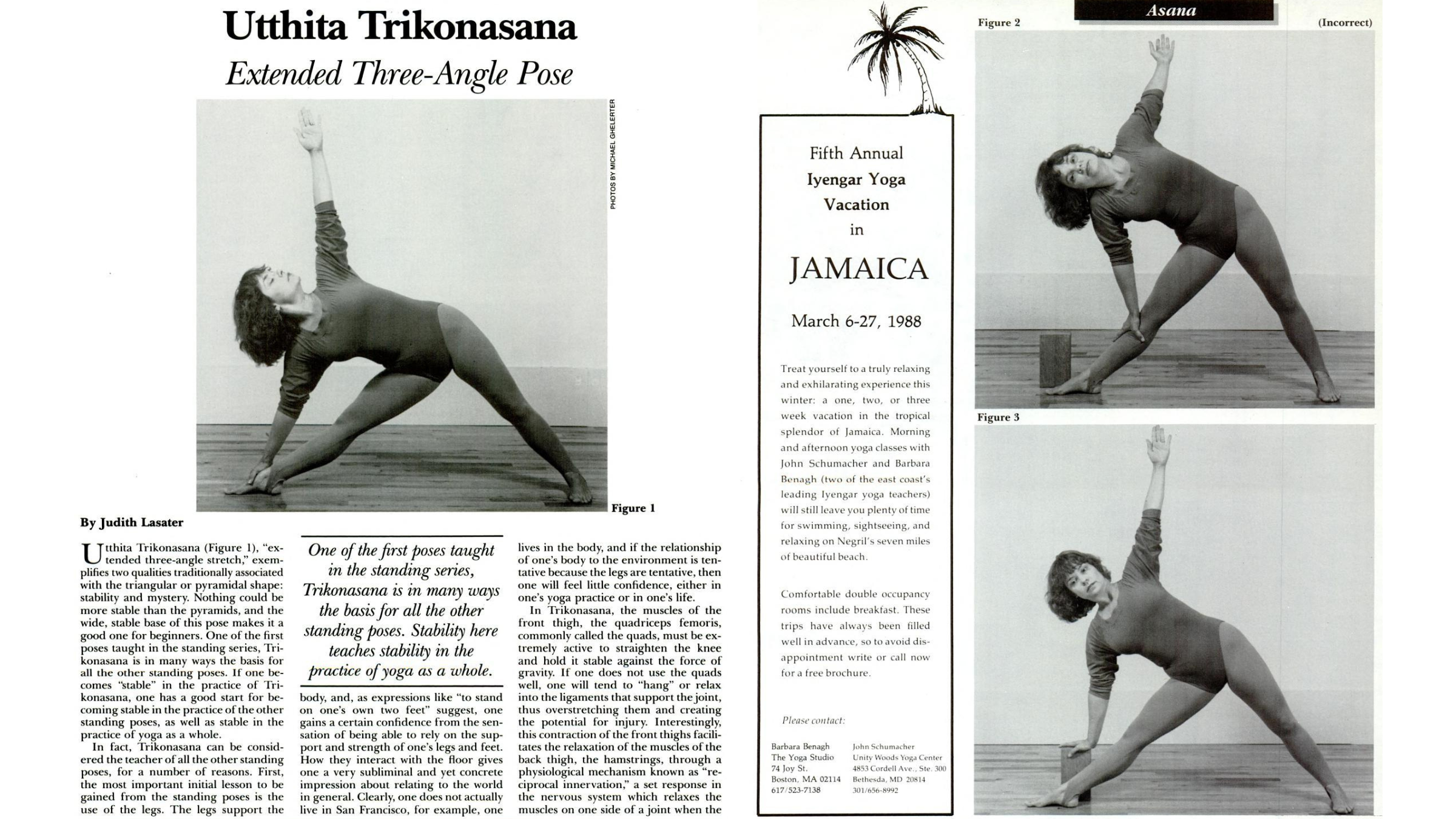
Extended Triangle Pose (Utthita Trikoasana, Figure 1) exemplifies two qualities traditionally associated with the triangular or pyramidal shape: stability and mystery. Nothing could be more stable than the pyramids, and the wide, stable base of this pose makes it a good one for beginners.
If one becomes “stable” in the practice of Triangle, one has a good start for becoming stable in the practice of the other standing poses, as well as stable in the practice of yoga as a whole.
In fact, Triangle Pose can be considered the teacher of all the other standing poses, for a number of reasons.
3 Lessons of Triangle Pose
One of the first poses taught in the standing series, Extended Triangle Pose is in many ways the basis for all the other standing poses.
1. Use Your Legs
The most important initial lesson to be gained from the standing poses is the use of the legs. The legs support the body, and, as expressions like “to stand on one’s own two feet” suggest, one gains a certain confidence from the sensation of being able to rely on the support and strength of one’s legs and feet.
How they interact with the floor gives one a very subliminal and yet concrete impression about relating to the world in general. Clearly, one does not actually live in San Francisco, for example, one lives in the body, and if the relationship of one’s body to the environment is tentative because the legs are tentative, then one will feel little confidence, either in one’s yoga practice or in one’s life.
In Triangle Pose, the muscles of the front thigh, the quadriceps femoris, commonly called the quads, must be extremely active to straighten the knee and hold it stable against the force of gravity. If one does not use the quads well, one will tend to “hang” or relax into the ligaments that support the joint, thus overstretching them and creating the potential for injury. Interestingly, this contraction of the front thighs facilitates the relaxation of the muscles of the back thigh, the hamstrings, through a physiological mechanism known as “reciprocal innervation,” a set response in the nervous system which relaxes the muscles on one side of a joint when the muscles on the other side are contracting. (This response can be overridden, as when the joint is held stable.)
Triangle teaches us that when one learns stability first, freedom will naturally follow.
2. Move from Your Hips
Another way in which Triangle Pose is the teacher for all the other standing poses is that it teaches one to move from the hip joints rather than from the spine, or vertebral column. Triangle is not a sidebend; it is a pose of freedom in the hips. When one bends from the hips, the spine receives less tension, and the mind thus becomes more inwardly drawn.
This is one of the primary lessons of yoga: As long as there is external agitation in the body, in the senses, on the surface, the mind will be drawn to that agitation. When, on the other hand, the body and senses are undisturbed, the mind is drawn spontaneously and inexorably toward the consciousness within. Even beginning students can start to feel this internal focus as they practice Triangle. If they learn this lesson well, they are on their way to understanding a great deal about the other standing poses, as well as the wider philosophical basis of yoga as a discipline.
3. It’s All Connected
Another interesting way in which Triangle can be considered the teacher of the other standing poses is that it teaches the student how to move in many ways at once, while realizing that all movement comes from the center. In Triangle Pose, the back leg is strongly connected with “intelligence” to the ground and is moving back, while the front leg is rolling out and moving away from the back leg. The underside of the trunk is rolling forward, while the top of the trunk is rolling back. The lower arm reaches down, while the upper arm is released upward. The student is made to feel in his or her own body the polarities of the pose and the balance that results from an awareness that all movement comes from the center; balance cannot be created, it can only be experienced. When the student learns to open from the center, from the heart of the pose, the intelligence of the pose flows harmoniously in all direc-tions, creating a sense of balance and stillness in the midst of tremendous dy-namism. When the student can actually begin to feel this dynamism, the practice is becoming a truly internal one, and the asana has become the vehicle to a richer state of being. This is the purpose of yoga practice.
The lessons of Triangle Pose, both kinesiological and philosophical, can be applied to every other standing pose, thus enriching their practice and creating a sense of lightness and peace in the body.
The Mystery of Simplicity
But what about the “mystery” of the pyramidal shape? Indeed, Triangle is a mystery. The mystery of this asana, like any other art form, cannot be wholly explained in terms of the sum of its parts. One can analyze for years the exact action required for Triangle Pose, and all that knowledge can be nullified by two minutes of practice.
This point was brought home to me recently when I observed B.K.S. Iyengar demonstrating asanas at the yoga convention in Cambridge. I had last seen him give a demonstration in San Francisco in 1984, and I had wrongly assumed that this new demo would bear witness to another three years of aging.
Instead, I was amazed to discover that those three years had been a time of growth for Iyengar, a practitioner I thought had reached the pinnacle of yoga. His poses in Cambridge struck me as more beautiful, more whole, and more easy than ever. The lesson I learned from this is that we can never forget that practice is the core of understanding in yoga. Without a solid and regular practice, any intellectual insights gained from reading books or listening to teachers will remain shallow ones.
The ultimate mystery of Triangle Pose is that it works; it is a transformational tool that is efficacious regardless of personal be-lief, age, race, sex, or expertise. Triangle Pose, and the whole of yoga, is mysterious because it changes one profoundly, requiring only the dedication of practice.
For several years now, in the regular classes I teach, I have been simplifying my format. Less and less do I feel the need for “gimmicks” to capture students’ interest. Now I find that just yoga is necessary, and that we can just come into class and practice, without the need for too many words, too many instructions, too many discussions about any particular point. It is time for us all to get back to the simple and elegant understanding that practice brings. And Triangle is a wonderful place to start.
How to Practice Triangle Pose
Begin by finding a quiet, airy place. A wooden floor is best, as it prevents sliding. Place your feet a fairly wide distance apart. In Light on Yoga, Iyengar gives the distance for Triangle as three feet. Look in a mirror, or have a friend check the dimensions, so that the distance between your feet is at least as long as (if not longer than) the combined length of your trunk and head.
Turn your left foot in about half way, so that the toes face toward your right foot. Then turn your right foot out 90 degrees, pivoting on your heel, so that your foot faces directly to the right. The heel of your right foot should be in line with the inner arch of your left foot.
Stretch your arms to the side, with your shoulder, elbow, wrist, and middle finger in alignment. A common mistake at this point is to lift your shoulders with tension; become aware of this habit and eliminate it. Keeping the muscles of your front thigh active, as mentioned before, inhale, and, with the exhalation, stretch out to the side.
Care should be taken to move your pelvis back in the opposite direction from your arms. Stretching out continuously, move down toward the floor. This entire downward movement should be made on a single exhalation. Place your right hand on the shin or ankle or, in the case of more experienced practitioners, lightly on the floor. Hold the pose for several breaths, longer if you can, and repeat to the opposite side. (If the leg muscles are tight, try using a block as in Figure 3.)
6 Things to Remember in Triangle Pose
1. Watch the curvature of your spine, and avoid overarching. Sometimes students confuse opening the chest with overarching the back.
2. Be careful to drop your lower ribs so the spine is more or less horizontal. (Figure 2 is incorrect.) Remember, Triangle Pose is not a sidebend. Imagine you are doing the pose between two very narrow walls. Disallow any movement backward or forward.
3. As you open your chest toward the heavens, be careful not to overrotate your upper arm backward (Figure 2). Ke member that, in asana, each part of the body must work with a separate intelligence so the mind will feel as one.
4. Keep your diaphragm soft and pliable so the breath is unimpeded. Pranayama, the yogic art of breathing, begins with learning to relax, especially the diaphragm.
5. Turn your head from the back (of the head), as if the two large prominent bones behind the ears, the mastoid processes, were leading the movement. This will lengthen the back of your cervical spine (or neck). B.K.S. Iyengar suggests spreading the scapulae (shoulder blades) in the pose to help alleviate neck pain.
6. Finally, feel the pose as a whole. Notice the intelligence of the legs, the freedom of your spine, the softness of the breath, and the joy of the heart. Know that in practicing with awareness and align-ment, you are connecting yourself to yourself and to the wider art that is yoga.
The author gratefully acknowledges her teacher B.K.S. Iyengar and his book Light on Yoga in the writing of this article.