
Published October 18, 2026 03:33AM
In Yoga Journal’s Archives series, we share a curated collection of articles originally published in past issues beginning in 1975. This article about Tadasana (Mountain Pose) first appeared in the January-February 1990 issue of Yoga Journal. Find more of our Archives here.
As human beings, we find ourselves immersed in one of the most critical transition phases in the Earth’s evolution. Our technology now allows us to profoundly alter the state and direction of this evolution, and as all evidence from the natural world indicates, our technological intrusions can have a disastrous impact on the ecosystem and all life forms. These intrusions can also be experienced in the absence of harmony in our own internal ecosystem, the human body.
The historical mission of our times, to paraphrase “geologian” Thomas Berry, is to reinvent the human species so that our relationship with ourselves and all life forms is one of mutual enhancement rather than mutual destruction. We cannot afford to continue to stumble along in ecological ignorance. Our yoga practice and teaching must awaken us to communion with the larger planetary and cosmic processes that are available to help us restore harmony with nature.
The practice of Tadasana (Mountain Pose) in particular, and hatha yoga in general, is a penetrating exploration of the relationship between the human nervous system and the energy fields (gravitational and electromagnetic) of the Earth, the solar system, and the cosmos as a whole. Gravity is the ultimate cosmic force, the attractive glue that bonds the stars, planets, and galaxies into a unified, dynamic, evolving whole. All macrocosmic cycles, from the revolutions and rotations of the planets and moons to the spiraling dances of the stars and galaxies, are driven by the gravitational force. Gravity also fuels our planet, helping to drive the cycles of weather and geological transformation that have allowed the development and diversification of life forms and the flowering of the various ecosystems.
On an individual level, gravity plays a major role in all physiological processes. especially those of posture, circulation, and breathing. In our investigation of how gravity affects these processes, we can begin to discover and uproot the pathological distortions that have crept into our way of being on the Earth.
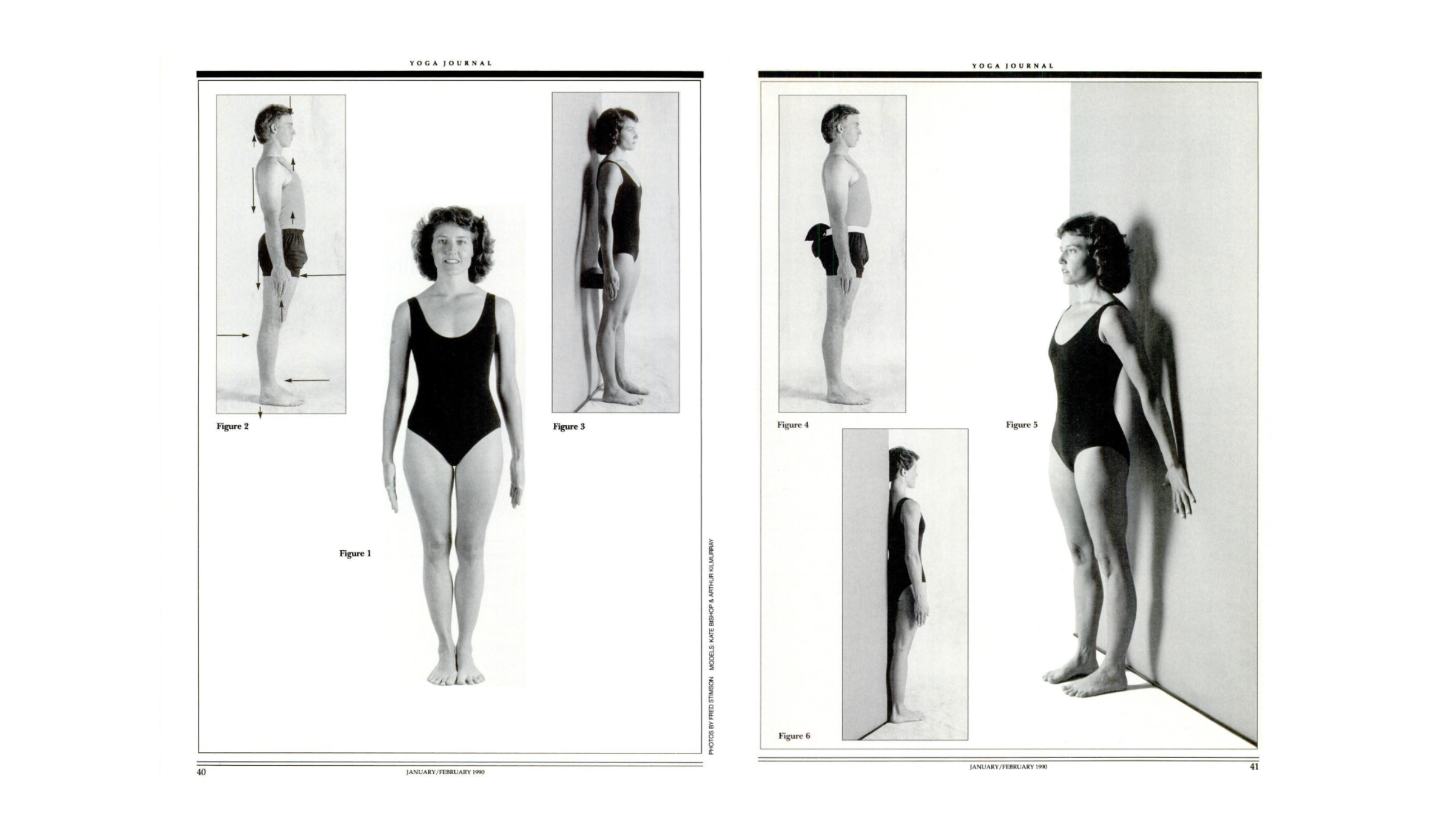
In Tadasana (Figure 1) we reestablish our identity with Mother Earth and have an opportunity to experience, explore, and critically reflect upon our relationship with Her. The most basic and fundamental of all the asanas (poses, the upright posture of Tadasana is a statement of the uniqueness of the human. No other creature has verticality as its primary posture. Grounded heel bones, extended hip joints, curved, upright spinal column, and the resultant explosive development of the frontal brain are the human contributions to the evolutionary process. But this frontal brain explosion has created a pathological side effect. The human species has forsaken communion with nature for a world of abstractions.
The human body is not a static phenomenon. Rather, it is a dynamic process with its own cycles and rhythms. The two most obvious rhythmic cycles are the pulse of the heartbeat and the rhythm of respiration. There is also a third fundamental rhythm that is less well known, but is really the secret to learning asana. This is the pulse of posture that occurs in the skeletal muscles.
The skeletal muscles play a major role in the maintenance of circulation in the body. To truly understand all the implications of this function, we should look at the entire circulatory process. The heart muscle provides the primary driving force for delivering blood to the cells and organs of the body. But this is only half the cycle; the fluids must return to the heart. As there is no organ like the heart to accomplish this task, nature takes advantage of three existing processes to do the work.
The first is gravity. The fluids from all regions above the heart drain along the gravitational gradient into the heart. (Inverted postures, extremely important in yoga practice, take advantage of gravity in this way.) The second is what is known as the respiratory pump. On an inhalation, the diaphragm and intercostal muscles work to expand the chest cavity, creating a partial vacuum to draw air into the lungs. This vacuum also works internally, drawing circulatory fluids toward the chest cavity and the heart. (Thus we see that the respiratory and circulatory rhythms are also interconnected.)
The third mechanism involves the contraction and release of the skeletal muscles in a pumping action. The venous blood and lymphatic vessels are equipped with a series of one-way valves that allow the circulatory fluids to move toward the heart with each contraction but prevent it from falling back. In this way, physical movement, with its muscular contraction and release, helps maintain the circulatory rhythm. In an exceedingly sedentary culture like ours, the absence of sustained movement can thus have obvious adverse effects on the circulatory system, greatly contributing to the major health problems of our times.
We can now begin to understand a little about the elusive connecting link between movement and the postural stillness of asana. Within the non-movement of any asana is the necessary and continuous pumping action of the skeletal muscles, the pulse of posture. Although the bones do not move when we remain in a pose, the muscles must continue to contract and release, and the respiratory rhythm must also continue to flow. In movement, these actions happen automatically, although they might not necessarily be harmoniously integrated.
Many schools of asana emphasize movement within the practice because of the importance of this pumping action. It is not so easy to be still and yet keep the muscles pumping and the breath flowing. Even more difficult is to integrate and harmonize the movements throughout the entire body. But this perfection of postural stillness is the connecting link between asana and meditation. The ability to maintain a harmonious integration of the circulatory, respiratory, and skeletal-muscular rhythms while keeping the bones still leads to the stillness of samadhi.
As Patanjali states in the Yoga Sutras (III:5), this integration of inner physiological rhythms with macrocosmic forces leads to the awakening of cosmic wisdom. How can our practice of Tadasana begin to move us in this direction? First, we must begin to understand how the human body has evolved and organized itself to create human presence. In her classic book The Thinking Body, Mabel Elsworth Todd provides a brilliant analysis of the human upright posture and simple movement. Describing the role of the tailbone in upright posture, she explains in great detail how the most efficient biomechanical support of the spinal column requires that the direction of the balancing forces be down the back of the body and up the front. The image she uses to create this experience is a dinosaur with a long, muscular tail.
The fundamentals of the vertebrate body structure evolved hundreds of millions of years ago with the fishes, and the basic muscular patterns for land-based posture evolved with the early amphibians and reptiles. The tailbone with its muscular support plays a major role in balance and movement because it integrates the lower and upper parts of the body, distributing consciousness evenly along the spine and clarifying the direction of the flow of muscular energy. How do fish move? They wiggle their tails to generate a wave that flows along the spinal column. The tyrannosaurus was able to learn a modified upright posture because its tail provided a counterbalancing force down and back, allowing the ventral or front side of the body to extend forward and up. Dogs, cats, monkeys, kangaroos, all have dynamic, expressive tails that assist in posture and movement.
In the human, the tailbone has shrunk to a mere vestige, while the skull has correspondingly expanded. Consciousness is no longer distributed evenly along the spinal column but tends to localize and concentrate in the skull. The coccyx has been relegated to the unconscious (kundalini is envisioned as a coiled serpent sleeping at the base of the spine), and the skeletal muscles, especially those of the spine, have become confused.
Most of us, when we are trying to maintain an upright position, whether sitting or standing, push the spinal muscles in and up into the body and hold them there. This runs counter to the evolutionary development of pulling back and down from the muscles while allowing the front body to move forward and up. Most of us don’t even distinguish between the back and front bodies, but rather confuse them into one jumbled mass.
To reconnect with our evolutionary heritage, we must use the spinal muscles as if we had a huge dinosaur tail that drew the back body down and backward and allowed the front body to release and extend forward and up. In the human, the legs and especially the heel bones have to make up for the missing tail, as they provide a stable platform on which the front and back portions of the spinal column can ride. (As your practice deepens, you will discover many subtle and some not-so-subtle connections between the coccyx and the heels.)
When the groins, the connecting link between the legs and the spine, are open, the legs and spinal column work together. Then the congestion and confusion of the muscles gives way to an increasing freedom of breath and circulation in the pelvic and abdominal regions. In yogic terminology, the apana vayu, or vital energy of the lower torso, begins to flow more freely. This is the starting point for the harmonious integration of the circulatory, respiratory, and musculoskeletal rhythms that leads to samadhi.
Most of us live with a concentration of energy and pressure in the head and a corresponding constriction in the lower torso, which disturbs the harmony of the rhythms and contributes to our imbalanced state of mind. If our practice of Tadasana can bring our consciousness backward and downward, into the coccyx and heels, into the unconscious storehouse of genetic memory where the intelligence of the body is waiting to be reawakened, then we will be moving toward a mutually enhancing relationship between ourselves and the Earth. The forces of the cosmos, which are always in harmony, can thus feed us with the wisdom needed to guide us in the coming decades of transformation.
How To Practice Tadasana (Mountain Pose)
There are two essential aspects to the practice of Tadasana—the spirit of the practice and the practical details. Because most yoga practice is done indoors, we rarely allow our feet to feel Mother Earth directly. Stand barefoot in the grass and feel the coolness, the moisture, the texture, the living quality of the grass. Stand barefoot at the beach, allowing the feet to explore the ever-changing sensations of pressure, temperature, and support. Whenever you find yourself out in nature, stand with the trees. Feel their presence, and learn from their stability, persistence, and patience. Observe animals and how they stand, and feel the wholeness of their presence. Vitalize all of your cells with the divine presence of nature.
From this divinely inspired state, we can look at some of the most common pathological patterns that humans perpetuate as they try to stand in a comfortable, upright position.
Feet
Because of shoes and the dictates of fashion, most of us have compressed, contorted feet and very poor arch support. The frontal arches, from the balls of the big toes to the balls of the little toes, have to widen and extend away from the center of the feet, and the two long arches, inner and outer, have to expand to distribute the body weight. The heel bones, which for most of us float, must be grounded, carrying the majority of the body’s weight through their centers into the earth.
Play with your feet. Massage them. Wake them up.
Knees
The knees are very vulnerable to hyperextension in standing. The pathological pattern is to hit back at the top of the shinbone into the ligaments and cartilage of the knee joint and hang the body weight on these soft tissue structures.
To correct this, the gastrocnemius muscle (upper calf) must lift up and support the back of the knee joint, without taking any weight from the heel bone. For this to happen, the soleus (lower calf) has to stretch dynamically. To extend the knee correctly, the quadriceps muscle group must actively lift up through the kneecap to the hip joint. The kneecap sits embedded in the knee, but no pressure is experienced on the ligaments or cartilage (Figure 2).
Hip Joints
The femur and pelvic bones play a dynamic role in maintaining a strong Tadasana.
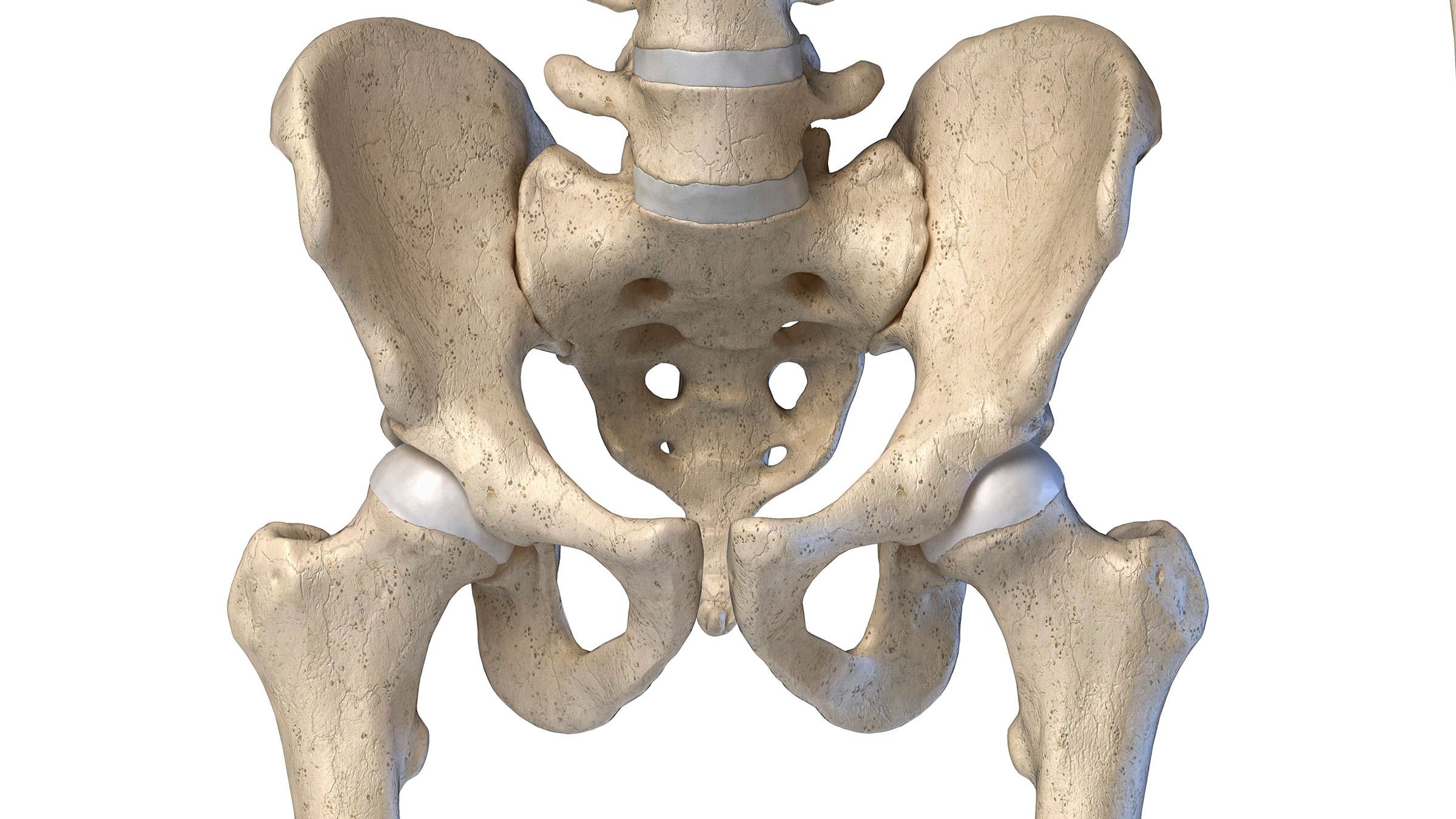
The femur bones, at the hip joints, must be moved slightly apart, toward the back of the joint, and grounded downward, creating a wide base to the pose. The pelvic bones (right and left) adjust in the opposite direction to maintain a centered, balanced alignment of the hip joint and a narrow, lifting sensation through the center of the lower torso. The sitting bones at the bottom of the pelvis move toward each other and forward, creating a strong extension of the hip joints. The top pelvic rims also move forward and toward each other, providing a counterbalance to the action of the sitting bones. The entire pelvis lifts up away from the femur heads, and the overall sensation in the pelvic region is one of tremendous stability without any rigidity. You must experience your own hip joints to know how to adjust them correctly.
The challenge is to work the legs and pelvis without disturbing the breathing. Most of us contract the diaphragm-stomach region when trying to work the hip joint area, disturbing the apana vayu, blocking the circulation and breath, and creating a feeling of hardness. This confusion has to be eliminated through constant attention and increased sensitivity. When we work from the bones and let them carry the weight of the body, the hardness leaves and a deeper form of stability emerges (Figure 2).
To practice the action of the femurs and pelvic bones, place a block or thick book at the backs of the thighs, just below the sitting bones, and stand against a wall (Figure 3). Press the outer top thighs into the block (be careful not to push back from the shinbones), and feel how the sitting bones move toward each other and away from the wall. Then press the inner top thighs into the block, and observe how the top pelvic bones move into each other and forward. Now do both actions simultaneously, without disturbing the breath or tensing the sense organs. Feel the lift and stability created.
Trunk and Spinal Column
As mentioned previously, the back torso moves backward and downward while the front torso moves forward and up. This begins from the coccyx and can be experienced in the movement of the skin. To help create this experience, tie a belt around the pelvis and hang a sandbag or weight directly in front of the coccyx bone (Figure 4). Adjust and work the legs and pelvis as directed earlier, and feel how the heavy coccyx gives you an anchor to ground the back body downward and extend the front body upward. Imagine you are a tyrannosaurus — maybe your reptilian brain will awaken.
As the rib cage is part of the front body, it is lifted forward and up, but this action must not drag the back body forward. This is a difficult separation that can be learned in pranayama and in the other asanas. The correct action of the scapulae will greatly assist here.
Shoulders and Arms
The upper arms and shoulder blades act much like the femurs and pelvic bones. The upper arms resist backward and downward, away from the neck and ears, while the shoulder blades move into the rib cage to support its lift, without being pulled toward the neck or disturbing the spine. To practice this action, stand near a wall, placing the palms on the wall behind you, and press actively into the wall without allowing the shoulder girdle to lift up toward the ears (Figure 5). Feel the effect on the shoulder blades and outer armpit region and the lift of the rib cage and heart.
Head
The most common pathology here is the forward-jutting head, a product of our head-dominant consciousness. Ideally, the center of the head is aligned directly over the center of the torso. There should be an even quality to the front throat and back of the neck, with no unnecessary tension. To help find this position, an outside corner, as in a doorway, is useful (Figure 6). Stand with the heels on a line tangent to the corner. Adjust the pelvis and shoulder girdle and feel where your head sits. The back of the skull should touch the corner along with the coccyx and heels. This back brain–coccyx–heels connection is a very important one for the harmonious integration of the vibratory rhythmic patterns of the body.
The practice of any asana involves not only refinement of technique, but also refinement of the relationship between ourselves and Mother Earth. This relationship, which already exists, bound as we are by the cosmic forces of gravity and electromagnetism, can be one of healing and mutual enhancement or one of pathology and mutual destruction. It all depends on our capacity to shape the quality of our presence on this planet.