
Published November 6, 2026 10:00AM
In Yoga Journal’s Archives series, we share a curated collection of articles originally published in past issues beginning in 1975. This article about how to do Half Moon Pose first appeared in the January-February 2003 issue of Yoga Journal. Find more of our Archives here.
Every yoga pose is but a wrapper for its unique internal gift. Ardha Chandrasana (Half Moon Pose) gives you the license to fly. With only one hand and one foot touching the ground, the rest of your body is free to soar. Your body stretches from head to heel, creating a sense of wide-dancing euphoria. Your heart center opens, expanding to embrace all the world. Among the standing poses, Ardha Chandrasana offers unique access to this vast, unbridled freedom of the heart.
Yet to achieve this unbounded freedom, we must first ground ourselves in a myriad of details. I am frequently asked, “Why are there so many details to attend to in each pose? Why should I make a conscious effort to straighten my legs, rotate my hips, or lift the inner arches of my feet in Ardha Chandrasana? Why not just switch off my brain, relax, and feel?”
I have found that attending to detail actually deepens the ability to feel, rather than hindering it, and makes it possible to receive the inner gifts of yoga. Though details can sometimes be overwhelming, attention to them refines your evolution and gives you great fulfillment and joy.
On the most basic level, details protect you during your practice. On another level, details ensure that you receive the benefits of the pose; detailed instructions help you bring the specific energetic gift of the pose into yourself. For energy to flow correctly, precise alignment is required. Without alignment, energy drains away and the pose collapses.
Of course, refinements can be carried too far, and you can become so focused on details that you lose sight of the large energy flows that circulate through the whole body. The general rule is that you need enough detail so that there will be no injury to the body *and* so that the pose serves its unique function. A useful approach, especially at first, is to work on just one or two details each time you practice the pose, gradually adding more subtle details after you attain the basics of the physical alignment. Trying to do subtle inner work before becoming physically aligned will lead to a collapse in the posture and a sense of frustration.
Details have more profound purposes as well. When you work on generalities, your mind is dull. When you start to focus on detail—in Ardha Chandrasana or in any pose—your awareness is refined. And awareness is the essence of yoga. Through the attention to detail in your practice, through the cultivation of refinement, and through the constant and ever more careful attention to your existence, you will slowly become aware of the soft, inner voice that will guide you to your spirit and to your fulfillment.
Preparing Your Hips
Supta Padangusthasana II (Reclining Hand-to-Big-Toe Pose, side variation) prepares you for Ardha Chandrasana, since it contains all the major movements of Ardha Chandrasana but does not require you to bear weight or to balance. Working on this pose will prevent strain in the buttock muscles as you later try to hold the leg up in Ardha Chandrasana.
To do Supta Padangusthasana II, lie on your back with both legs straight. Bend your right leg and catch your right big toe with the first two fingers of your right hand. (Use a belt around the instep of the foot if you cannot reach your toe.) Exhaling, slowly straighten your right leg completely, fully contracting the thigh muscles of both legs. You should maintain this quadriceps contraction throughout the pose. On your next exhalation, press your right sitting bone away from your head and bring your right leg out to the right side and down toward the ground; if possible, rest the outer right ankle on the floor.
Rather than letting your left hip rise, work to make both iliac crests (front hip bones) equidistant from the floor. This will create flexibility in the adductors and release tense muscles in the front of your pelvis so that when you do Ardha Chandrasana, the pelvis will rest evenly on the head of the standing-leg femur (thighbone). Press your left thigh into the floor. Placing your left hand on your left frontal pelvis, pull it to the left to help open it (Figure 1). Stay for three to nine deep breaths. Exhaling, bring your right leg up so that your arm is once again perpendicular to the floor. Release your right foot, bringing it back down beside the left. Repeat on the other side.
Moving into Ardha Chandrasana
Yoga practitioners move into Ardha Chandrasana from Trikonasana (Figure 2) because the pelvis and the front-leg thighbone are in similar positions in both poses. If you can maintain their placement as you move into Ardha Chandrasana, the pose becomes much easier.
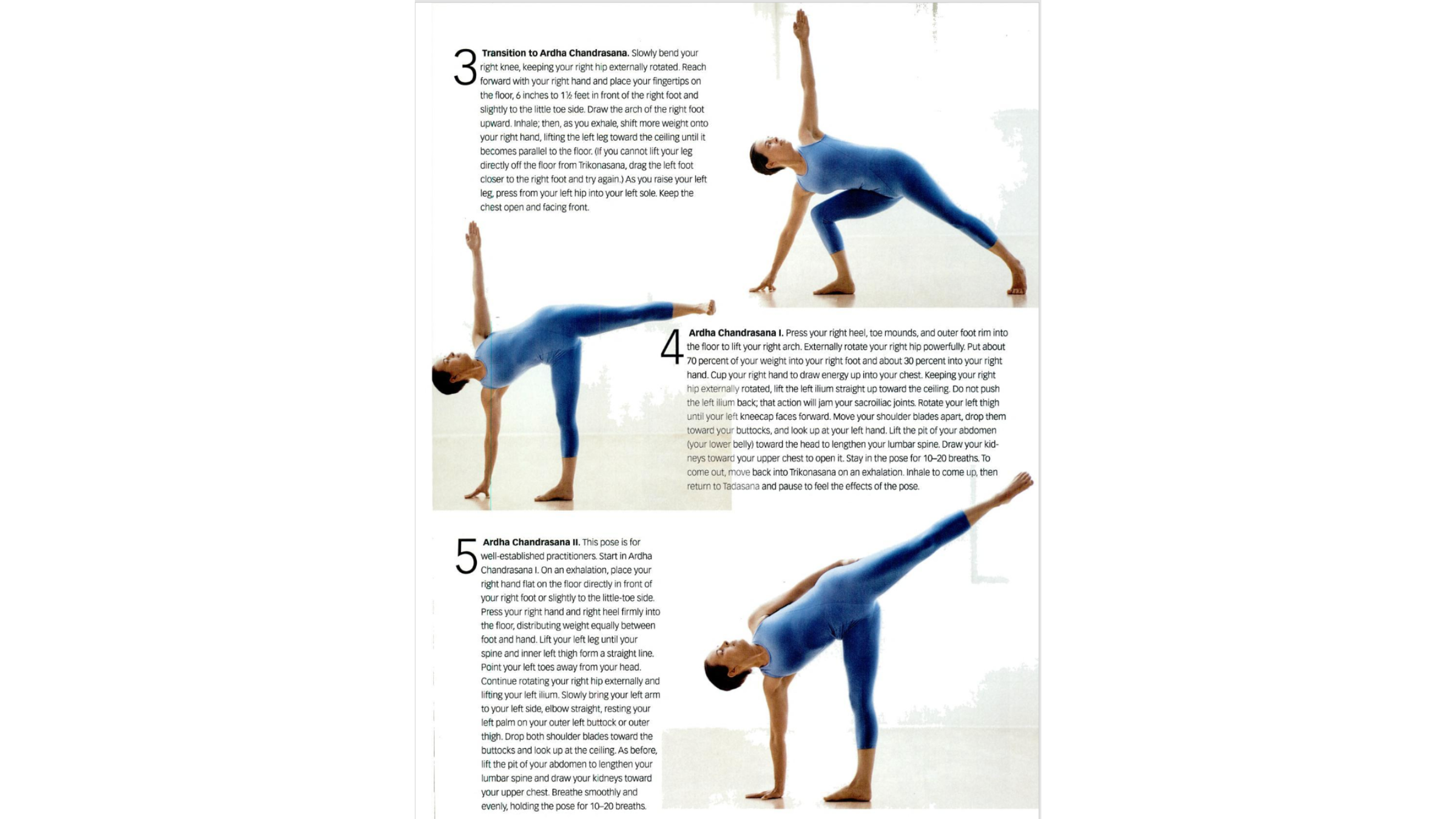
In Trikonasana, take a deep inhalation and visualize your body moving to the next step. Slowly bend your right knee, keeping the right hip externally rotated. Reach forward with your right hand and place the fingertips on the floor about one-and-a-half feet in front of your right foot and slightly to the little toe side (Figure 3). On an exhalation, shift more weight onto your right hand, lifting the left leg toward the ceiling until it becomes parallel to the floor. If you cannot lift your left leg directly from Trikonasana, slide your left foot closer to your right before coming up. Keep your left hand stable and reaching up toward the ceiling throughout your transition. This will greatly improve your balance.
As you move into Ardha Chandrasana, spread the toes and toe mounds of both feet as far apart as you can. This will energize your feet, bring vitality to your brain, and stabilize your movement. Straighten the right leg, powerfully rotating your hip externally so that the right kneecap continues to face your right toes. Even after your right knee is completely straight, continue to rotate the right hip externally. This is the most important action for maintaining safety in the pose, since it protects your inner knee ligaments, a place where many people have searing pain from hyperextension. This rotation also places the head of your femur accurately into joint so that when you lift the left side of your pelvis, you will place your weight evenly on the right hip joint.
Grounding Your Standing Leg
Once in Ardha Chandrasana, distribute your weight evenly between the inner and outer foot of your supporting leg. You will notice that your weight tends to drop to your outer foot. To counteract this, consciously press the big toe mound and the inner heel into the floor while lifting your arch. This action will improve your sense of balance because your foot is the foundation of your pose; its lateral stability will determine the stability of your knee and hip.
If your right knee has rotated internally and you find it difficult to rotate it externally, bend your knee a bit. This action will release your hip and make rotation easier. If your standing-leg knee hyperextends, press the calf muscle forward toward your shin, microbend your knee, and press the top of your thigh (the upper quadriceps) back toward your hamstrings. Maintaining both these movements realigns your leg and prevents your knee joint from locking and distorting.
Now lift your left ilium (hip bone) toward the ceiling. Be careful not to press it back, for this will jam your sacroiliac joints and may eventually cause a compression injury. Another point of caution: Lifting your left ilium will tend to make your right leg rotate internally, and this must be resisted to prevent the damage to your inner knee ligaments. Your right leg’s external rotation must always take priority over the lift of your left ilium. When you do become able to lift your left ilium while maintaining the right hip’s external rotation, you will find that the weight of your body will rest on the center of the hip joint, thereby relieving tension in the outer muscles of your right leg, where many beginners get cramps. For additional stability of your right hip, hug your right outer thigh toward your inner thigh before lifting the left ilium.
The outer right ankle bone, the outer right knee, and the greater trochanter of the right leg (the bony knob at the top outer edge of the thigh) should be in one straight line perpendicular to the floor. If your standing leg is leaning toward your head, there will be compression in the rear of that hip joint and excessive weight in the hand and head. Alternately, if your standing leg is leaning toward your back leg, there will be compression in the front of your standing-leg hip joint and your back leg will then feel sluggish and heavy.
Your standing leg should also be perpendicular when viewed from the side. The right sitting bone tends to fall behind you, which collapses your right groin and puts tension in your outer right hip. Press the outer right hip forward until your right sitting bone is directly above your right heel. Simultaneously, lift your right outer ankle and outer leg toward your hip.
To add a more rigorous element of truth to the alignment of your legs, practice this pose with a wall behind you, placing the little toe of your right foot next to the wall and your right heel approximately a half-inch away from the wall. This makes the pose more difficult because your standing leg is now prevented from dropping backward. In this position, you must squeeze your outer right leg inward and lift your left pelvis straight up in order to do the pose.
Energize the muscles throughout both your legs, creating a sense of compactness, as if all the flesh of your legs is being drawn into your bones. This will create a feeling that your right leg has become a pillar supporting your body; it will also make your left leg feel much lighter.
Ardha Chandrasana not only strengthens the legs but also uses the standing leg to bring energy up from the earth. This upward drawing of energy is a foundational principle in yoga and in many martial arts; it is why you contract your quadriceps in the standing poses. When your quadriceps are relaxed, energy does not lift up your inner legs; when you pull the quadriceps up, they become “pumps” that bring the energy from the earth into your pelvis, where your root chakra and second chakra reside. These chakras cannot function well without a flow of energy. Ardha Chandrasana gives you an opportunity to create this flow.
There are other actions that assist this process of lifting energy. I have found that only through combining the lift of the arches and the lift of the quadriceps can the energy of the earth be transmitted into the pelvis and transmuted into corporeal energy. Lift the arch of your standing leg, suck energy up your inner leg through your groin, and feed the energy into the pelvis via a slight lift of your perineum (Mula Bandha). To accomplish these actions, begin by pressing down the mound of your big toe and the inner heel of your standing leg. To create stability, the outer edge of your standing foot also has to be pressed down strongly.
Thus, you will create arches both lengthwise and widthwise, between your big toe and heel as well as between the inner edge and outer edge of your foot.
Energizing Your Top Leg
Now turn your attention to the left leg. As you continue to rotate the right hip externally (so your knee points directly toward the middle of your foot), externally rotate your left leg so that your left kneecap faces front. Once your left kneecap is facing front, do not rotate your left hip any further.
The next action in your left leg should be to press the top of your thigh back toward your hamstrings; then lengthen the back of your leg into your heel. Simultaneously, draw the left side of the pit of your abdomen—the region of your belly just above your pubic bone—toward your head, creating a stretch across your left groin. This will prevent your left thighbone from falling forward and your left buttock from over-contracting.
To prevent fatigue in the left leg, press it down as if you were resting it on a big balloon. Instead of hanging the upper leg from the outer hip muscles, contract your inner thigh muscles toward your outer thigh. This will take the tension out of your outer hip muscles and strengthen your inner leg, including your adductors.
Aligning Your Pelvis and Abdomen
Two primary actions that are involved in Ardha Chandrasana are the “stacking” of the pelvis and the lifting of the pit of the abdomen. The stacking of your pelvis on your right hip joint not only ensures your safety but also aligns your pelvis to receive energy from your right leg. When the left side of your pelvis moves away from the right foot in Ardha Chandrasana, you will get the sense of your pelvis as an ever-widening bowl. This widening makes the pelvis available for the energy that rises from the earth through your standing leg.
Similarly, the lift of the pit of your abdomen aligns your pelvis with your rib cage, making the floor of your pelvis and your diaphragm parallel. This alignment charges the energy of your abdomen and nourishes your kidneys. As you draw the pit of your abdomen toward your head, your tailbone will move toward your perineum and your sitting bones will tuck toward your top leg heel. Do not tighten or flatten your stomach. Instead, lengthen from your pubis to your chest. This action realigns your pelvis and extends your lower back, preventing strain and cramping around the lumbar spine.
If you have stiff hamstrings or are perhaps new to Ardha Chandrasana, place a block underneath your right hand. This will increase your stability in the pose and take stress off your right leg, thereby allowing you to lift your left pelvis and pull the pit of your abdomen upward without distorting your spine.
As you continue to work in the pose, attempt to make your left kneecap, belly button, and sternum face front by spinning the left side of your chest and abdomen back. This action prevents the abdominal organs from falling into the front of your belly (their state in most daily activities) and makes them instead fall toward your right side. This massages your abdominal organs and relieves stress in your lower digestive system.
In Ardha Chandrasana, once you have filled your pelvis with life force from the earth, draw this energy up into the heart center for inner reflection and inner work. This movement of energy is one of the foundational elements in the way I teach standing poses.
Aligning Your Upper Body
When you do Ardha Chandrasana to your right, your tendency will be to make the right side of your torso shorter than your left side. Instead, work to keep both sides of the waist equally long. To lengthen your right side, press your right armpit forward, opening the right side of your chest by working your right kidney toward the front of your body. Drawing your outer right hip toward your left heel will also help balance the two sides of your waist and your spine.
In addition, press both shoulder blades toward the buttocks and away from each other. These actions release the congested sensation and cramping that can occur in the upper back behind the heart center. The shoulder blade actions also free your shoulders and neck so that your head can turn without tension.
Try to bring both arms in one straight line perpendicular to the floor. To do this, press your left shoulder blade away from your head more strongly than the right. Also, you should counteract the tendency of the upper arm to drop behind you as you open and turn your chest to face forward. Restrict this tendency by lifting the back of your arm up through the nails of your fingers. The upper arm should now be perpendicular to the floor as viewed from the front and side of the room. Lifting your back arm will stabilize it and prevent it from falling backward. The more stable your upper arm, the more stable your pose.
Your bottom arm, like your bottom leg, lifts energy from the earth into your heart. Placing the pads of your fingertips on the floor, form a cup with the right hand. Suck energy up from the earth through this cup into your chest.
All through out your practice of Ardha Chandrasana, always keep your upper-arm palm wide and facing forward, with your fingertips and thumb tip pointing straight up toward the ceiling and with your fingers and thumb pressing together. These actions align your hand energy and develop concentration. You should pull equally into your thumb and little finger to keep both sides of your wrist even.
Do not let your body fall into a backbend; doing a backbend in this pose dissipates the energy from your kidneys through your belly and chest. In contrast, moving the body into one plane aligns the internal flows of spinal energy from your perineum to the crown of your head. When carefully combined, the following three actions will prevent your body from doing a backbend: Stretch from your left sacrum and right sitting bone into your left heel, from the pit of your abdomen into your diaphragm, and from your kidneys into your front upper chest. These stretches will additionally help move your spine toward your head, while pulling your coccyx and left leg toward your left heel.
Once you have incorporated all of these details into Ardha Chandrasana I (see Figure 4), your brain will have given out all the instructions necessary to create alignment in your physical body. After you reach and hold the alignment, your brain’s job is over. Next, you will have to separate your consciousness from your brain, moving it out of your head and into your heart while you perform the internal actions of the pose. To facilitate this separation of consciousness from your brain, relax the muscles of your face, jaw, and tongue.
As you inhale, bring vitality from your lungs into your whole body; as you exhale, make any necessary adjustments to your alignment. You will find that inhalations draw life force into your body, whereas exhalations channel that force through your body. Keep your breath soft and long, breathing only through your nose with the softness of Ujjayi Pranayama (Victorious Breath): Drawing your breath audibly across the back of your throat, inhale with a slight “s” sound and exhale with an “h.” All these actions will help your breath connect your brain to your heart and the world outside you with the world within.