
Published November 11, 2026 10:06AM
In Yoga Journal’s Archives series, we share a curated collection of articles originally published in past issues beginning in 1975. This article about a seated twist first appeared in the March-April 1994 issue of Yoga Journal. Find more of our Archives here.
To encourage new perceptual skills in my students, I like to ask them from time to time to practice in a new spot in the yoga studio. If you’re like most people, after a few classes you find yourself regularly gravitating to the same location, often within a few inches of accuracy.
The mere suggestion to place your mat in the front of the room instead of the cozy corner may make you decidedly un-comfortable. Changing positions enables you to see yourself and the world from a different vantage point, much as a photographer might circle a subject to get pictures from different angles.
It’s not surprising, considering the propensity of our species to form habits, that we tend to perceive our bodies from one perspective, including some aspects of ourselves while leaving others out.
Thus our perception of our body may become like a two-dimensional sketch, deprived of the volume, form, and texture that would extend our awareness into the three-dimensional realm. While Eastern cultures have investigated and honored the inner layers of the body as the key to our physical, mental, and spiritual health, most Western cultures have concerned themselves primarily with the body’s superficial layers. Because of this bias, most of us have come to view our movements as entirely dictated by the muscles and bones, unconsciously deleting other systems from our awareness. Keeping the mind on the outer layers, we become unable to feel or act from our deeper selves.
One of the body systems that brings us most succinctly into a deeper sense of self are the organs, the contents of the musculoskeletal container. Awareness of the organs gives our movements volume, form, and a sense of ripe fullness. Through the health and vitality of the organs, the outer layers gain their strength and form.
Just as we might bring our attention to the sensation of a muscle stretching, we can bring our attention to the sensation of an internal organ. When we change the vantage point of our awareness to bring the inner body into the foreground (an inner adjustment analogous to moving to a different place in the yoga studio), the way we experience ourselves and the quality of our movement will be quite different.
For most of recorded history, yogis have been engaged in just this kind of research, exploring the effects that the asanas (as well as pranayama and meditation) have on the deeper, subtler bodily systems. The ancient practitioners noted which movements and practices stimulated, purified, sedated, or neutralized the energy currents moving deep within the body, correlating these phenomena to health, longevity, and the elevation of consciousness. By contrast, they were not terribly interested in the state of their hamstring muscles, and traditional texts make few references to such structures.
Movements that twist the body compress, elongate, and massage the inner organs. Unfortunately, twists are often practiced exclusively from the perspective of the musculoskeletal system; we use the strength of the muscles and the leverage of the bones to force the body into rotation without ever inviting the soft inner contents along for the ride. Focusing on the internal organs not only reduces the possibility of injury, but stimulates and tones these deep structures by bringing our attention to them, just as electrical activity is created in our muscles simply by visualizing them flexing.
In this article, we’re going to look at how changing the vantage point of our awareness affects the practice of Pose Dedicated to the Sage Marichi (Marichyasana III), a seated twist.
How to Practice Sage Marichi’s Seated Twist
Bringing attention to the inner body is a way to physically organize our presence on this center. Knowing that there is nowhere to “get to,” we can proceed with the full knowledge that we are on our way.
Preliminary Practice
The following exercise was adapted from Sensing, Feeling, and Action by Bonnie Bainbridge Cohen. Sit on a cushion or blanket with your legs crossed. Close your eyes and let yourself settle. Bring your awareness to the soft inner contents of the torso surrounded by the musculoskeletal container. Imagine your body as two concentric cylinders with the soft internal organs on the inside and the harder musculoskeletal system surrounding them. Feel how the rise and fall of the breath swells from the core and communicates itself to the outer layer.
Now gently bring your awareness to each of your major organs. In the chest is the heart, slightly to the left of center, with the lungs on either side. In the upper left quadrant of the abdomen is the stomach; in the upper right quadrant of the belly is the liver, which extends up underneath the rib cage. The small intestines occupy most of the central and lower belly. In the lower right quadrant of the belly, the small intestine becomes the large intestine, which makes a hairpin turn to run up the right side of the belly (the ascending colon), across the top (the transverse colon), and down the left side (the descending colon), finishing as the sigmoid colon and rectum.
You may want to refer to an anatomy text for a more in-depth discussion of the internal organs. For now, sense their general position and volume, using your breath to palpate them. The kidneys lie on either side of the spine above the waist. The uterus is deep in the abdomen above the pubic bone.
Now bring your attention to your skeletal structure, as if you were seeing the body with X-ray vision. Extend your right arm over your head and bend to the left, focusing your attention on the bones moving. Repeat this to the other side.
Returning to the first side, initiate the side bend from the skeleton and then Shift your attention to the underlying organs, focusing on elongating the organs on the right side of the body and compressing the organs on the left. Did you go further? How did the quality of the movement change as your focus shifted?
Now initiate the side bend as a movement that arises from the organs. Breathe into and elongate the organs on the right side of the body, letting the skeleton follow. How did this experience differ from the one in which you had your mind on the skeletal system alone?
The organs are the seat of our deepest emotions; we physically experience strong feelings as sensations in the viscera (for example, the butterflies of fear or the tight knot of anger). Therefore, many people find that when they initiate movement from the organ system, the movement seems to arise out of their deepest self—that is, there is not a dualistic sense that the mind is “doing something” to the body. By contrast, when you perceive the body as nothing but a skeleton, it may feel as though your mind is manipulating your body like a puppet on a string.
Beginner’s Practice
Now integrate this new awareness of your organs into a simple twisting posture.
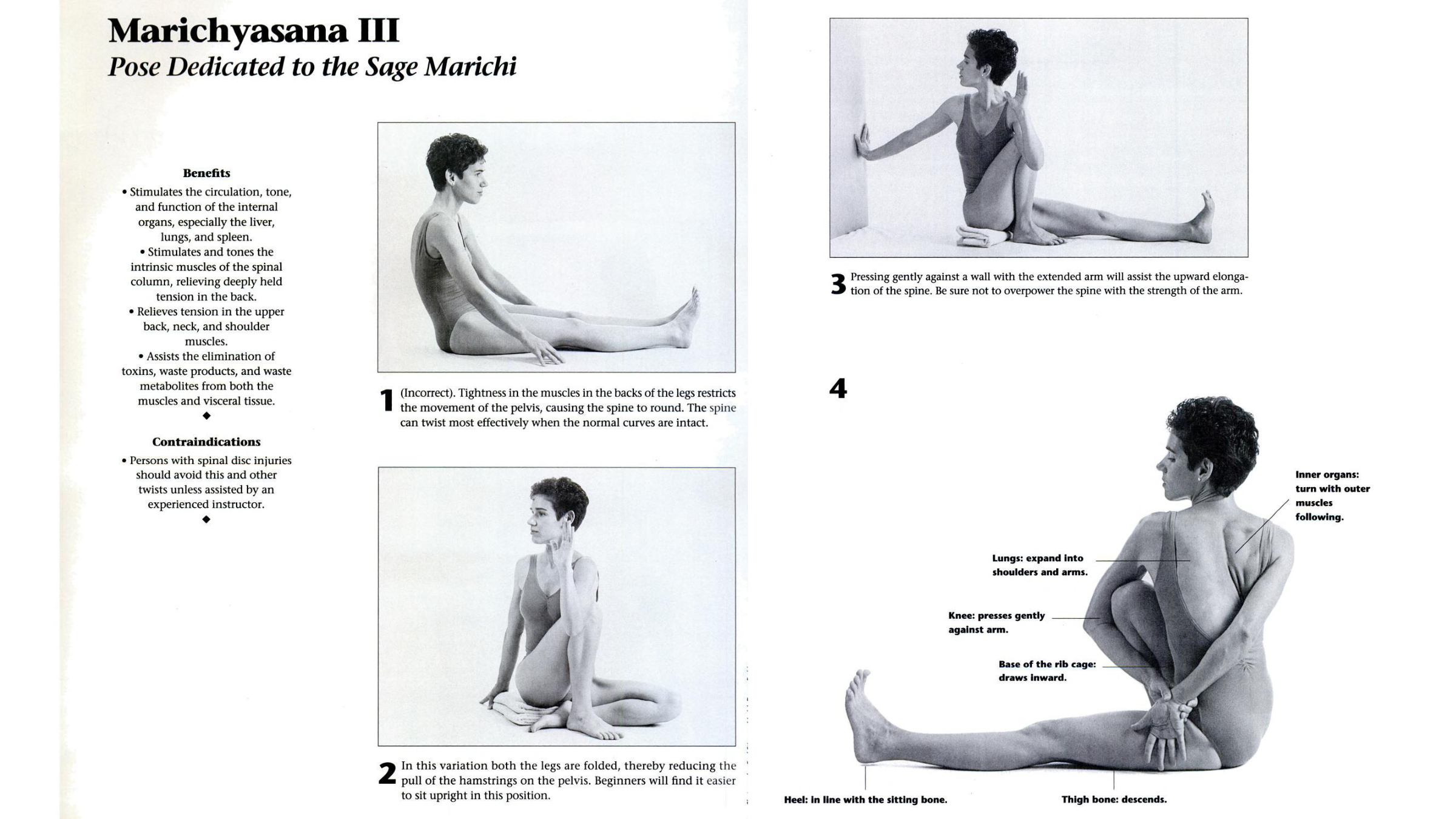
Some preliminary suggestions may make your task easier. One of the obstacles to twisting freely is the inability to sit upright with the normal curves of the spinal column intact. When the legs are extended, this problem may be further exaggerated because the hamstrings may pull on the base of the pelvis, causing the back to round (Figure 1: Incorrect). In this position, you are actually sitting on the base of the spine rather than on the sitting bones, and the collapse of the outer body makes it difficult to breathe freely.
To make sitting—and therefore twisting—a little easier, this first variation calls for both legs to be folded. By deactivating the hamstrings, we allow the pelvis to move more freely into an upright position.
Sit cross-legged with the buttocks elevated on a blanket or cushion. Place the right leg so the shin is upright, with the sole of the right foot directly in front of the left ankle. Inhaling fully, allow the abdomen to expand freely. On your exhalation roll the abdomen to the right, guiding the abdomen back against the spine to encourage the twist. Bring your left elbow onto the outside of the right knee (Figure 2).
With each breath, allow the soft inner body to move circularly in the direction of the twist, very much as if you were doing a belly dance. Once the lower torso is turning freely to the right, direct the breath more fully into the right side of the chest. Expanding the right lung with the inhalation, encourage the thoracic spine to move in and up. As you exhale, release the left lung from the center of the chest out into the shoulder, allowing the muscles along the back of the body to follow the changing shape of the lung.
As this occurs, the shoulder blade and then the arm will move further around.
Replace the elbow against the knee as necessary. When you feel you have reached your limit, stay for a few more breaths, simply letting the inhalation and exhalation oscillate the body slightly to and fro. Release on an exhalation and then repeat on the other side.
Now extend both legs in front of you, placing a blanket underneath your buttocks if necessary to create an erect sitting position. Sit with your back one arm’s length from a wall. Bend your right knee, placing the heel of the right foot in line with the sitting bone of the right side of the pelvis. Extend downward through the length of the left leg, simultaneously pressing the right foot down into the floor. Feel how this groundedness through the bones rebounds up through the body as the energy flows through the soft organs and the bones to support the erect carriage of the torso. When you release the downward movement of the legs, notice how the spine sags and the whole torso wilts.
Sense how the movements of the muscles and bones affect the shape of the internal organs, and vice versa.
As you inhale, direct the breath into the mid and upper chest. With each exhalation, successively turn from the lowest part of the belly to the head. Bring your elbow onto the outside of the right knee and place your hand against the wall, making sure that you are far enough from the wall that the shoulder is not elevated toward the ears (Figure 3). Use your arm to lift and support the torso, but do not overpower the soft movements of the inner body by using the arm to forcefully turn the outer muscles. Instead of using the arm as a “dictator,” let your arm become a “guide.” In the same way, wait for the inner body to yield to the movement, then encourage it with the guiding arm.
Take a few more full breaths before releasing and repeating the movement on the second side.
Advanced Practice
In this exercise you will focus on the contents of the spine—the spinal cord—to bring deeper awareness to your movement. Begin by sitting in Staff Pose (Dandasana) with both legs extended. Bend the left knee and place the heel of the left foot in line with the sitting bone. Now place the left hand immediately behind the left buttock and use it to support the trunk.
Before beginning the twist, take a moment to bring a few central images to mind. Start by bringing your awareness to the contents of the skull. Sense whether the brain is balanced equally between the front and back of the skull. Exiting the brain is the brain stem; then the spinal cord runs through each vertebrae like thread running through a string of beads.
Think of your spinal cord as the tail of your brain and the vertebrae as individual beads, each with its own size and shape.
As you bring your awareness to the brain stem, notice how the spinal cord curves inward so that the cervical vertebrae stack up underneath the head. As you continue your mental journey down the back, the soft spinal cord curves outward, following the convex curve of the thoracic spine. As you move your attention down toward the base of the rib cage, the spinal cord loops back in and the five lumbar vertebrae stack directly under the center of the chest. Continue on down to the massive sacral bone which curves outward and articulates with the two wings of the pelvis.
Having established this anatomical map, begin to sense how the bones of the spine are positioned in relationship to the soft spinal cord. Are there any areas of the spinal cord that feel compressed, perhaps even red and sore from being pressed and rubbed by the bodies of the vertebrae? Are there vertebrae that feel as if they were glued together, or areas where the bones feel rotated or collapsed on one side? Use your breath to gently move your vertebrae as if you were rearranging very precious antique furniture in a room. Adjust the vertebrae so they glide over the spinal cord easily.
As you enter the twist, continue to gauge your movement to avoid any irritation to the spinal cord. (While the brain is insensitive to pain, the outer sheath of the spinal cord is richly supplied with sensory nerve fibers.) Imagine that you are initiating the movement from the level of the spinal cord. If you overpower the spine with the strength of the arm, the result will often be irritation in the spine during the twist and an ache in the back long after your practice is finished.
Once the torso has rotated so the chest is facing the left knee, you can take the “hand lock” by bringing the right arm around the outside of the left shin. Link the fingers or, if possible, hold the left wrist with the right hand. Exhale and draw the hands away from the shoulders, allowing the spine to lengthen strongly upward.
If taking the hand lock compresses the front of the abdomen and collapses the spine, you are moving your skeleton further than the organs can support. Be conscious of using your breath to shape the internal organs. Keep the front of the abdomen open and draw the base of the left rib cage in toward the waist to encourage full spinal extension. Turn the head to look back at the foot of the extended leg (Figure 4). Take a few more breaths and then release. Repeat on the other side.
To clarify the distinction between initiating movement from the inner body and dominating with the outer muscles, you might try the previous exercises again, this time exerting force with the outer body by using the arm as a strong lever. Notice the tone in the muscle tissue when you exert force from the outside, as opposed to the quality when you allow the inner body to give to the movement in its own time. Also notice how the two different ways of initiating movement create different psychological states.
Within each of us is a longing for wholeness. Like the spiraling shape of the twist, our spiritual path must constantly turn back toward the still center within us. The longing to “get somewhere” through yoga is a distortion of our true urge to return back to the undifferentiated, unchanging core from which all life expands.