
Published June 14, 2026 05:49AM
Yoga Journal’s archives series is a curated collection of articles originally published in past issues beginning in 1975. This article about how to do Plough Pose first appeared in the September-October 1985 issue of Yoga Journal.
Recognized as one of the most classic poses of yoga, Halasana offers many benefits to the practitioner. The Plough, it should be remembered, is actually a continuation of Sarvangasana (Shoulderstand) and should be practiced in conjunction with that pose.
One of the obvious benefits of Halasana is the intense stretch it gives to the posterior vertebral column (the back of the spine), from the cervical region (neck) to the sacrum at the base. All structures on the posterior spine are stretched, including muscles, ligaments, tendons, and fascia. In addition, the hamstring muscles—at the back of the thigh, in particular—receive quite a stretch as well. B. K. S. Iyengar suggests that Halasana is especially beneficial for stiffness in the shoulder joints, which are brought into extreme extension and external rotation by Halasana as the arms are placed on the floor and the fingers interlocked.
An important word of caution: If Halasana is practiced with no blankets under the shoulders, too much flexion of the cervical spine may occur. This forces the normal curve out of the neck and places tremendous weight on the delicate cervical spine while it is in a vulnerable position. The student should therefore use enough blankets to allow comfort for the neck and to give the feeling that the head could be turned from side to side. In fact, the head should not be turned from side to side, but one should feel that the movement would be possible.
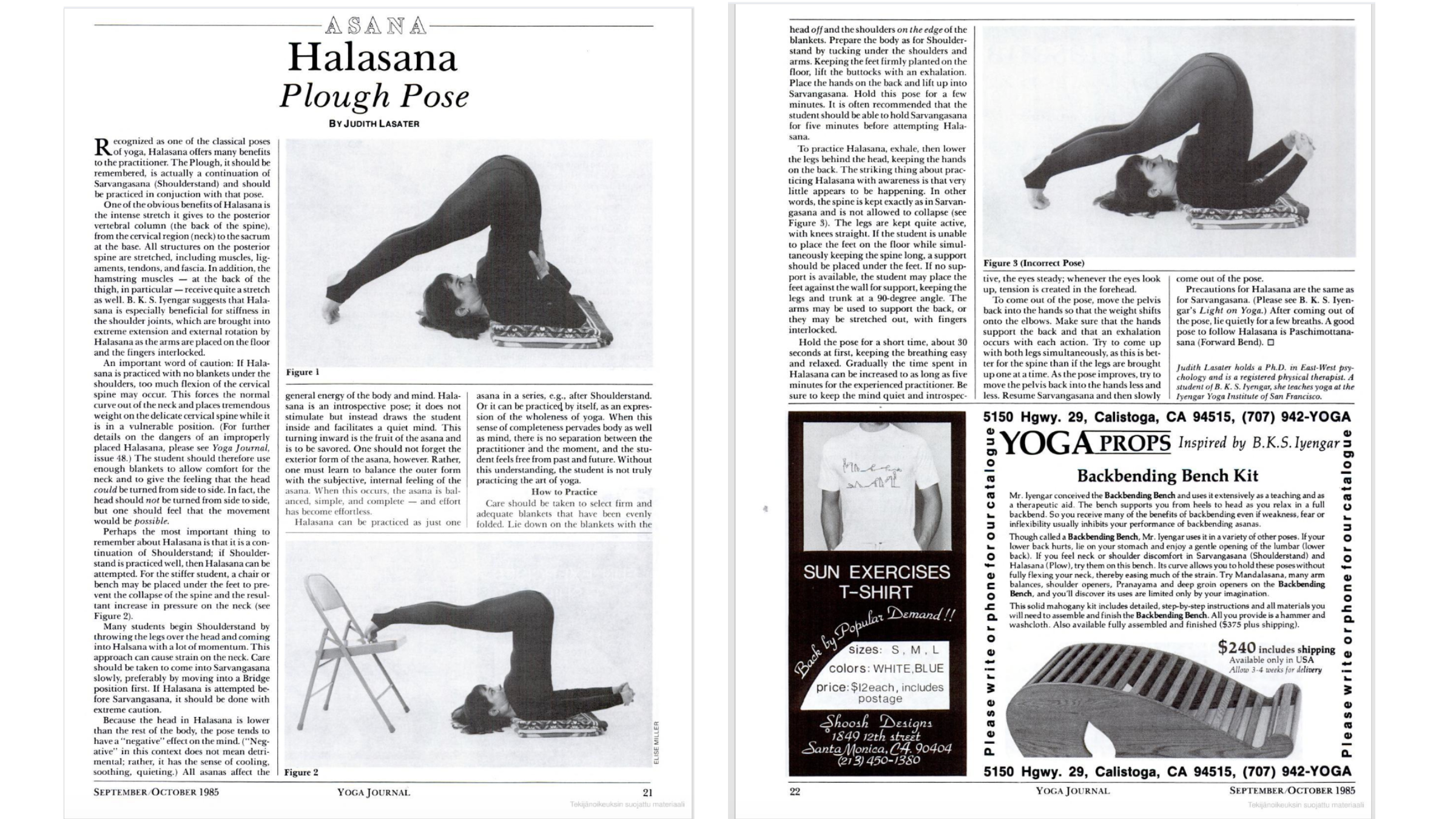
Perhaps the most important thing to remember about Halasana is that it is a continuation of Shoulderstand; if Shoulderstand is practiced well, then Halasana can be attempted. For the stiffer student, a chair or bench may be placed under the feet to prevent the collapse of the spine and the resultant increase in pressure on the neck (see Figure 2).
Many students begin Shoulderstand by throwing the legs over the head and coming into Halsana with a lot of momentum. This approach can cause strain on the neck. Care should be taken to come into Sarvangasana slowly, preferably by moving into a Bridge position first. If Halasana is attempted before Sarvangasana, it should be done with extreme caution.
Because the head in Halasana is lower than the rest of the body, the pose tends to have a “negative” effect on the mind. (“‘Negative” in this context does not mean detrimental; rather, it has the sense of cooling, soothing, quieting.) All asanas affect the general energy of the body and mind. Halasana is an introspective pose; it does not stimulate but instead draws the student inside and facilitates a quiet mind. This turning inward is the fruit of the asana and is to be savored. One should not forget the exterior form of the asana, however. Rather, one must learn to balance the outer form with the subjective, internal feeling of the asana. When this occurs, the asana is balanced, simple, and complete—and effort has become effortless.
Halasana can be practiced as just one asana in a series, e.g., after Shoulderstand.
Or it can be practiced by itself, as an expression of the wholeness of yoga. When this sense of completeness pervades body as well as mind, there is no separation between the practitioner and the moment, and the student feels free from past and future. Without this understanding, the student is not truly practicing the art of yoga.
How to Practice Plough Pose
Care should be taken to select firm and adequate blankets that have been evenly folded. Lie down on the blankets with the head off and the shoulders on the edge of the blankets. Prepare the body as for Shoulderstand by tucking under the shoulders and arms. Keeping the feet firmly planted on the floor, lift the buttocks with an exhalation.
Place the hands on the back and lift up into Sarvangasana. Hold this pose for a few minutes. It is often recommended that the student should be able to hold Sarvangasana for five minutes before attempting Halasana.
To practice Halasana, exhale, then lower the legs behind the head, keeping the hands on the back. The striking thing about practicing Halasana with awareness is that very little appears to be happening. In other words, the spine is kept exactly as in Sarvangasana and is not allowed to collapse (see Figure 3). The legs are kept quite active, with knees straight. If the student is unable to place the feet on the floor while simultaneously keeping the spine long, a support should be placed under the feet. If no support is available, the student may place the feet against the wall for support, keeping the legs and trunk at a 90-degree angle. The arms may be used to support the back, or they may be stretched out, with fingers interlocked.
To practice Halasana, exhale, then lower the legs behind the head, keeping the hands on the back. The striking thing about practicing Halasana with awareness is that very little appears to be happening. In other words, the spine is kept exactly as in Sarvangasana and is not allowed to collapse (see Figure 3). The legs are kept quite active, with knees straight. If the student is unable to place the feet on the floor while simultaneously keeping the spine long, a support should be placed under the feet. If no support is available, the student may place the feet against the wall for support, keeping the legs and trunk at a 90-degree angle. The arms may be used to support the back, or they may be stretched out, with fingers interlocked.
Hold the pose for a short time, about 30 seconds at first, keeping the breathing easy and relaxed. Gradually the time spent in Halasana can be increased to as long as five minutes for the experienced practitioner. Be sure to keep the mind quiet and introspective, the eyes steady; whenever the eyes look up, tension is created in the forehead.
To come out of the pose, move the pelvis back into the hands so that the weight shifts onto the elbows. Make sure that the hands support the back and that an exhalation occurs with each action. Try to come up with both legs simultaneously, as this is better for the spine than if the legs are brought up one at a time. As the pose improves, try to move the pelvis back into the hands less and less. Resume Sarvangasana and then slowly come out of the pose.
Precautions for Halasana are the same as for Sarvangasana. (Please see B. K. S. Iyengar’s Light on Yoga.) After coming out of the pose, lie quietly for a few breaths. A good pose to follow Halasana is Paschimottanasana (Forward Bend).