
Published July 5, 2026 04:04AM
Yoga Journal’s archives series is a curated collection of articles originally published in past issues beginning in 1975. This article about Side Plank Pose (Vasisthasana) first appeared in the May-June 1996 issue of Yoga Journal.
In this exploration of Vasisthasana (Side Plank Pose), we’ll focus on something near and dear to us all: the heart.
The physical heart is slightly to the left side of the chest just below the breast bone (sternum). For convenience, we’ll shift the heart to the center of the chest and somewhat deeper toward the back ribs. The yogis have, in fact, discovered an energy center or chakra (“wheel”) in this neighborhood called the anahata chakra, the “wheel of the unstruck sound,” which is actually the subtle paradigm of our tireless, faithful pump. Anahata is a “sound” only yogis can hear, which is “produced otherwise than by beating”—something like the sound of one hand clapping—often interpreted as the “pulse of life,” the sacred phoneme or mantra om.
When I use the word “heart” in this article, I’ll be talking about the relocated “yoga heart,” unless otherwise noted. The posture I’ve chosen to explore this through is Vasisthasana, dedicated to the sage Vasistha, whose name literally means “owner of wealth.” He was so called because he was the fortunate possessor of Nandini, the marvelous cow that granted all his wishes. When he wanted anything, whether food, jewels, or clothes—whatever his heart desired—all he had to say was, “Give,” and the cow gave it to him.
We’ll be working on a simplified version of the completed posture. Our Vasisthasana, also known as Side Plank Pose, looks like a capital T that’s been tipped over to one side. The legs, torso and head are the vertical trunk of the letter and the sturdily extended arms are the horizontal crossbar.
The arms play a central supporting role in Vasisthasana. Newcomers to the posture are often surprised at how quickly the arms start to tremble and protest, bringing the enterprise to an abrupt—and sometimes collapsed—end. The typical reaction is, “Oh, I don’t have the strength to do this posture.”
There’s no doubt that arm strength is one factor in the success of this posture. But, as Bonnie Bainbridge Cohen, founder of body-mind centering, proposes, overall strength is not solely an issue of muscular consciousness, as many downhearted students suppose. It also depends on our ability to consciously involve the consciousness of organs.
How to Practice Side Plank Pose (Vasisthasana)
We usually move into Side Plank (Vasishthasana) from Downward-Facing Dog (Adho Mukha Svanasana), and onto the right arm and leg first, then the left. As we go through the preparations and exercises below, I’ll give you certain areas of the body to work with—the collar bones (clavicles) and shoulder blades (scapulas), the hands, the inner thighs and heels, and the pelvis. Once you’ve established the proper action in each of these areas, recreate it in everything that follows.
Preparation for Side Plank Pose
We’ll first pinpoint the heart and establish the connection between it and the arms before attempting Vasisthasana. Lie on your back with knees bent, feet hip-width apart, heels a comfortable distance from the buttocks. You can keep the knees hip-width, or buttress them against each other, but whichever you prefer, strap the thighs just above the knees and pad the head and neck with a folded blanket.
With your elbows on the floor, settle your fingertips lightly on your sternum. The word “sternum” derives from a Latin verb that means “to spread out,” so picture it fanning out from its vertical midline along the clavicles toward the tips of the shoulders. In a similar fashion, expand the scapulas away from the spine, using their contact with the floor to assist the movement.
Now measure the front-to-back depth of the chest. How far are your fingertips from the floor? An inch? A foot? Can’t say? Plumb this space for a few minutes, and come back to it later if nothing clicks for you right away. Breathe into the heart (or the upper rib cage, if you can’t find the heart) for a few minutes. Imagine that, with each inhale, it expands and radiates energy, and with each exhale, it contracts and reabsorbs energy.
Next try this experiment. Keep your fingertips on your sternum, but slide the elbows up in line with the shoulders. Inhale and pretend that someone is tugging on a string tied around your right wrist, pulling the hand away from the sternum and straightening the arm out to the side. Inhale and move slowly, ending with the arm and hand, palm up, on the floor.
Leave the arm there for a few breaths, as the invisible partner continues to pull on the wrist, stretching the arm thin like a stick of taffy. Repeat two or three times, and finish with the fingertips back on the sternum. Untie the string.
Then inhale and, as the heart swells with breath, imagine it’s pushing the right arm out to the side, its energy streaming through the arm and out the fingertips like beams of light from five flashlights. Again inhale and move slowly, and again wait when the arm is on the floor. With each inhale, edge the arm away from the billowing heart an eighth of an inch more; with each exhale, maintain that extra eighth of an inch, and let the heart shrink.
Do this two or three times, and compare the feel of the string-pulled arm with that of the heart-pushed arm. Any difference? Repeat the experiment with the left arm, and then with both arms together.
Beginning Side Plank Exercise 1
Stand with your back to the wall, about six inches away. Bend your knees a little, rest your fingertips on the wall beside your hips and, without straightening up, lean against the wall with your torso and arms.
Open your palms wide on the wall, and elongate your arms toward the floor-from the heart, if possible. Press the palms and arms into the wall and, without actually breaking their contact with the wall, burrow the scapulas into the back ribs. Be sure not to scrunch them together toward the spine.
Inhale, push the heels into the floor, lift the heart, and slowly straighten the knees. As the back torso slides up along the wall, resist with the palms and drag the scapulas down. Wait for a minute or two and feel the scapulas press down (toward the floor) and in (against the ribs).
Next, turn your right side to the wall and station yourself about an arm’s distance away. Join the inner edges of the feet, activate the inner thighs, and suck the inner groins—where the thighs meet the bottom of the pelvis—up into the torso. If your thighs feel dull, put a block between them a few inches below the pelvic floor and squeeze.
Reach the right arm out parallel to the shoulders and spread your palm and fingers against the wall. If you’re tight in the shoulder and wrist, angle the fingers so they point somewhat behind you; if you’re freer in these joints, aim the index finger squarely at the ceiling. You might stand your feet two or three inches farther from the wall than your hips:
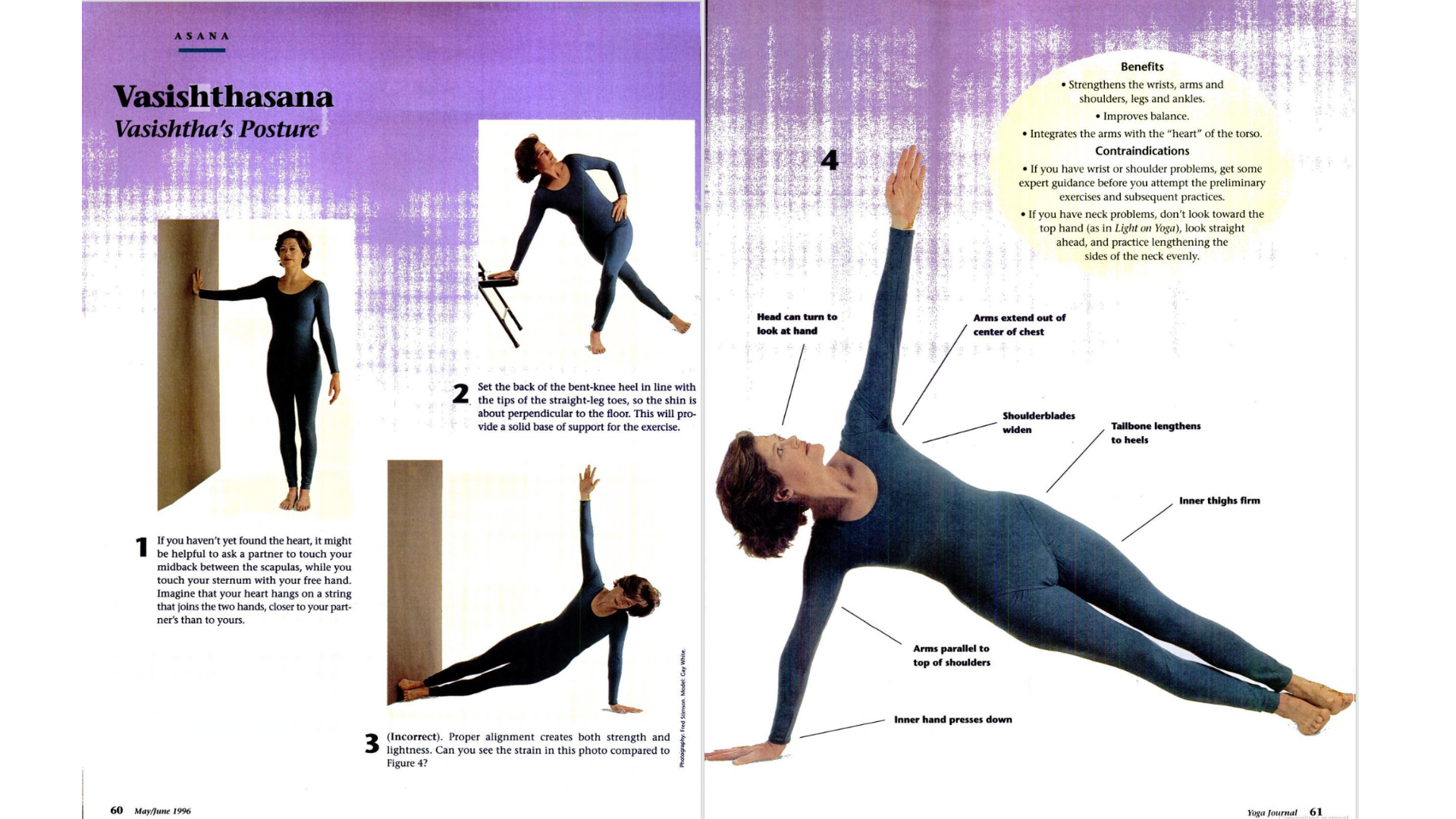
This will tilt you slightly to the right and promote a strong push into the wall with the hand. Concentrate especially on the inner hand, the bases of the index finger, and thumb (Figure 1).
Exhale and slowly bend the elbow toward the wall, tilting even more to the right, pivoting on the ankles without disturbing the vertical alignment of the body. Stop just as the forearm lightly contacts the wall, then inhale and, as you practiced in the preparation, slowly straighten the elbow by pushing from the heart. Wait for 15 to 30 seconds, pulsing the heart energy through the arm to the wall, repeat a couple of times, then do the left side.
Beginning Side Plank Exercise 2
For this exercise, get a chair and, if you need to, pad your feet on a hard floor or glue your feet to a carpet or a sticky mat. Brace the chair against the wall and lay the mat in front of and with its long axis perpendicular to the chair.
Start with modified Downward Dog. Press the base of the palms against the front edge of the seat, splay the palms and fingers on the seat, and walk back from the chair until the arms are long and the heels six to 10 inches behind the pelvis. Be sure to keep the head neutral, with the ears between the arms.
Inhale, step the left foot forward halfway to the chair and, just as you put the sole on the floor, spin it 90 degrees to the left (point the toes away from the chair to the left). Then lift the right foot off the floor, and spin it 90 degrees to the left as well, and put it back down again on its outer edge, in line with the right hand. Now exhale, move the left hand to the left hip, rotate the front of the torso to the left, and push forcefully from the heart into the inner right hand (Figure 2).
Check the pelvis: If it sags toward the floor, lift the right side of the torso and strengthen the right leg, pushing forcefully through the base of the big toe. You should be able to run a straight line from the bridge of the nose, through the sternum and navel, and along the inner right leg to the floor.
The pelvis might also “sag back,” so that the front of your body forms a flat V with its tip at the front groins. Press your left hand against the sacrum (at the back of the pelvis) and nudge the pelvis forward; at the same time, press the hand down against the bone to lengthen it toward the right heel, and draw the pubic bone (at the front base of the pelvis) toward the navel. You should be able to draw another line directly through the middle of the head and torso, from the crown of the skull to the tailbone, and from there again along the inner right leg.
If your right arm or leg is quivering, if your teeth are gritted and your breathing labored, this may be as far as you can go presently. Try to stay for 10 to 15 seconds, and add a few seconds each practice until you can hold for a minute with a song in your heart.
When you’re ready to continue, swing the left leg on top of the right. Then position the left hand beside the shoulder, palm out, and pretend you’re leaning on the ceiling—or perhaps the ceiling is leaning on you—just as you leaned on the wall earlier. Push out from the heart, straighten the arm, and shove the ceiling back where it belongs. Face the palm forward.
Some students have a tendency to open the chest by angling the top arm back, so the hand is behind a plane through the middle of the body from side to side (the frontal plane parallel to the forehead). In order to maintain the span across the upper back, lengthen the top arm straight out of the shoulder joint.
Imagine that the reach of the left arm is hoisting the right hand off the chair, and then, as the left hand pushes on the ceiling, stretch out of the heart oppositely and drive the right hand back into the seat. Oscillate back and forth between the two arms, using the energy of the heart to create stability through the right arm and lightness through the left.
To exit, exhale and smoothly reverse the left hand to the seat, swivel the feet to their original position, and return to Downward Dog. Take a few breaths and repeat to the left.
Continuing Practice
Lay your mat perpendicular to the wall and perform Downward Dog with your heels on the wall, balls of the feet on the floor.
Inhale and shift onto the outer edge of the right foot, flattening the sole against the wall. Then exhale and rotate the torso onto the right arm, depositing the left leg on top of the right—left sole to the wall—and the left hand on the hip.
Again adjust your alignment, both side-to-side and front-to-back. It’s sometimes hard to get it just right alone, so it might be useful, on occasion, to check your alignment in a full-length mirror (if you have one), or ask a sharp-eyed partner for help. Show her or him the photo of “crooked” Vasishthasana (Figure 3), and then the photo of the beautifully executed completed posture (Figure 4). Look for the pair of crossed diagonal lines (relative to the floor) from forehead to heels, and through the arms.
Then inhale and extend the left arm as you did in the previous exercise. Stay for 30 seconds to a minute, circle smoothly back to Dog on an exhale, do the left side for an equal length of time, return to Dog, and exhale down to finish.
Finally, perform the same sequence of movements away from the wall. This time, instead of purposefully extending the top arm after you’re established on the supporting arm, move into the complete posture by gracefully sweeping the top arm off the floor and into position in Vasisthasana.
Continue to explore how the heart and our consciousness intersects with the physical practice of yoga in this companion article on the. moving spirit of yoga.