
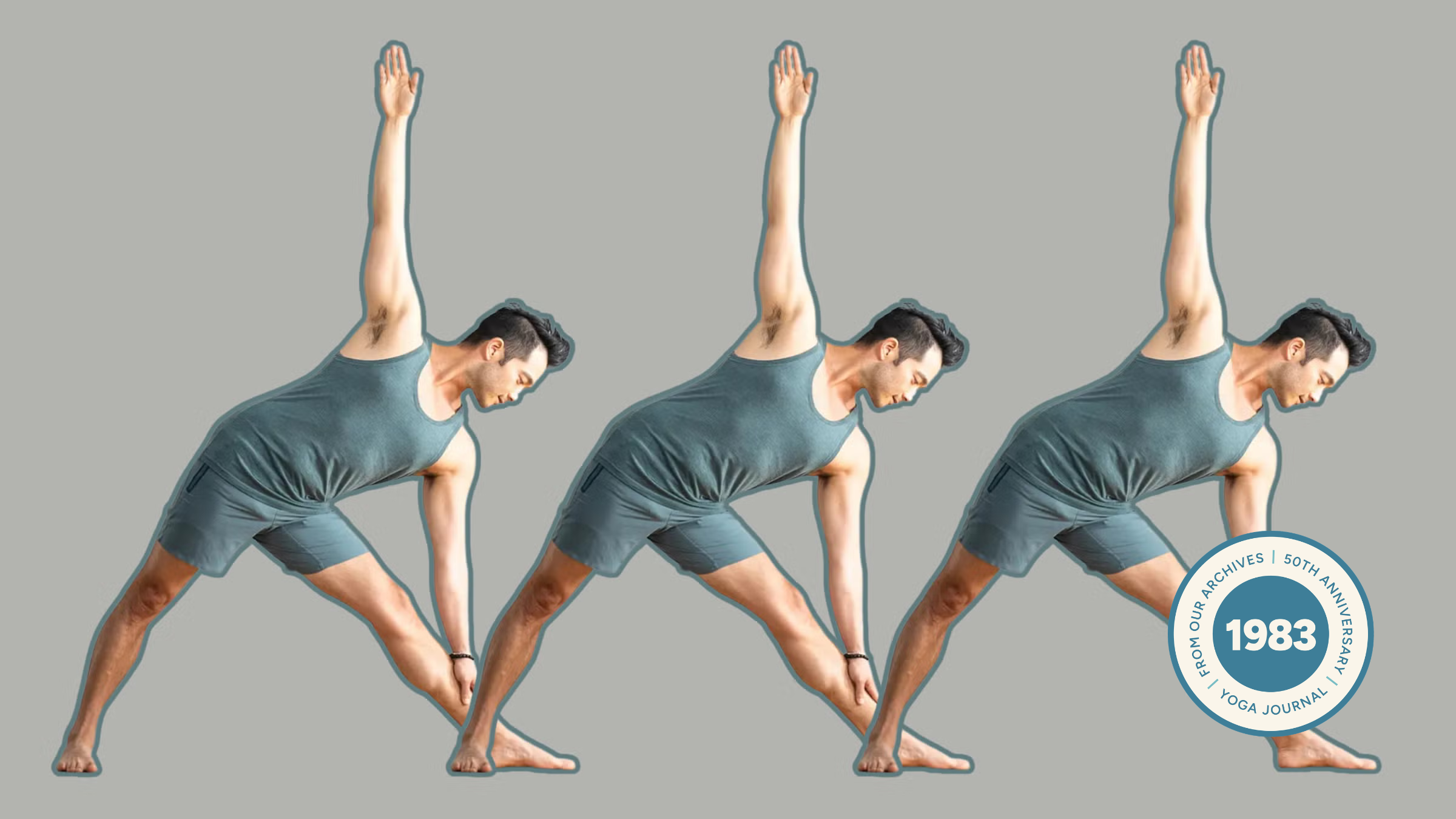
Find stability and open your heart.
(Photo: Andrew Clark; Design in Canva)
Published July 29, 2026 12:41PM
Yoga Journal’s archives series is a curated collection of articles originally published in past issues beginning in 1975. This article about Triangle Pose first appeared in the January-February 1983 issue of Yoga Journal.
With its simple, elegant, yet powerful form. Triangle Pose (Utthita Trikonasana) is the base for most other standing poses. At first it appears to be a side-bend, yet with increased practice, one realizes that the movement must originate from the hip joints, and not the spinal column.
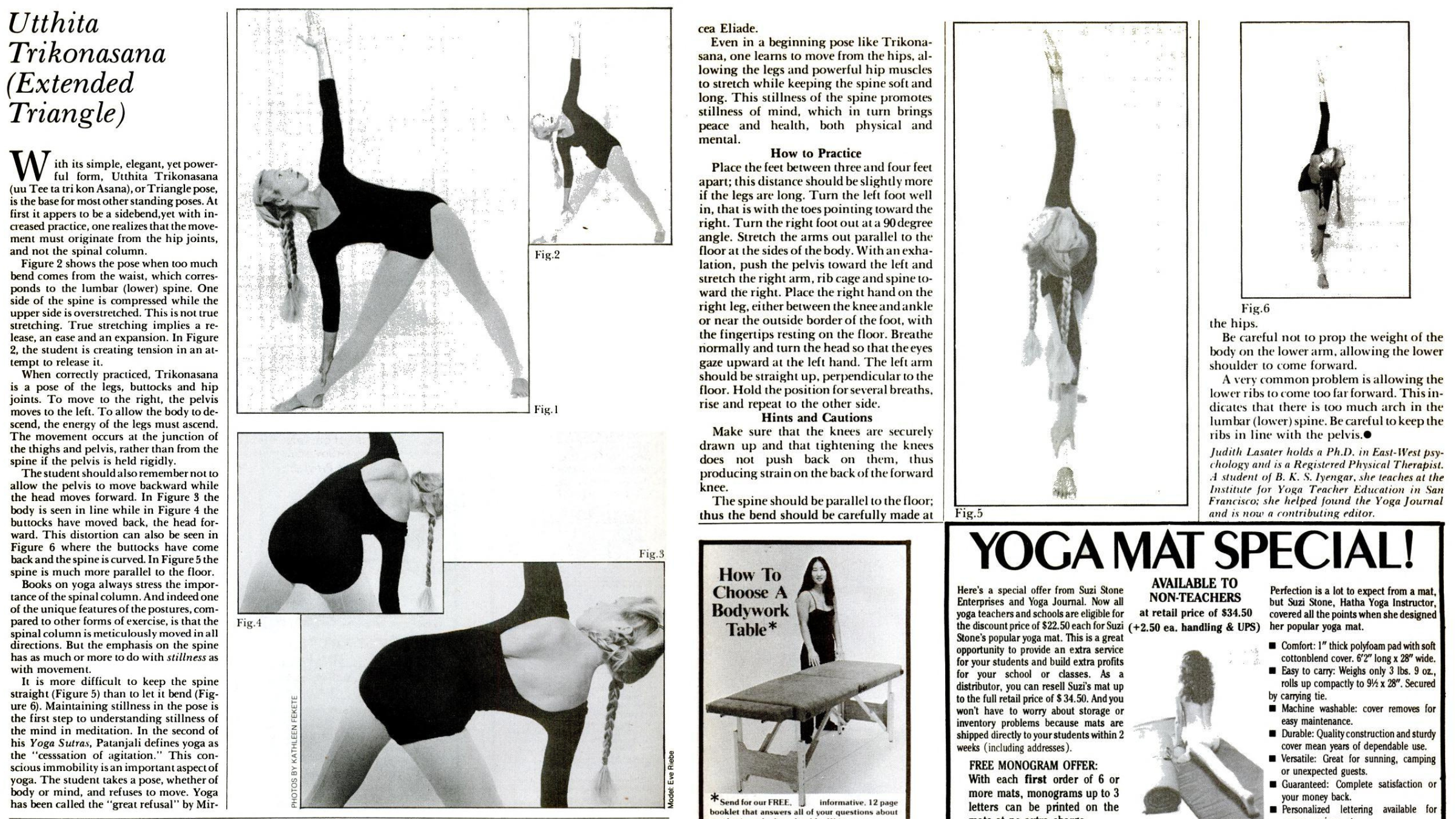
Figure 2 shows the pose when too much bend comes from the waist, which corresponds to the lumbar (lower) spine. One side of the spine is compressed while the upper side is overstretched. This is not true stretching. True stretching implies a release, an ease and an expansion. In Figure 2, the student is creating tension in an attempt to release it.
When correctly practiced, Triangle Pose is a pose of the legs, buttocks, and hip joints. To move to the right, the pelvis moves to the left. To allow the body to descend, the energy of the legs must ascend. The movement occurs at the junction of the thighs and pelvis, rather than from the spine if the pelvis is held rigidly.
The student should also remember not to allow the pelvis to move backward while the head moves forward. In Figure 3 the body is seen in line while in Figure 4 the buttocks have moved back, the head forward. This distortion can also be seen in Figure 6 where the buttocks have come back and the spine is curved. In Figure 5 the spine is much more parallel to the floor.
Books on yoga always stress the importance of the spinal column. And indeed one of the unique features of the postures, compared to other forms of exercise, is that the spinal column is meticulously moved in all directions. But the emphasis on the spine has as much or more to do with stillness as with movement.
It is more difficult to keep the spine straight (Figure 5) than to let it bend (Figure 6). Maintaining stillness in the pose is the first step to understanding stillness of the mind in meditation. In the second of his Yoga Sutras, Patanjali defines yoga as the “cessation of agitation.” This conscious immobility is an important aspect of yoga. The student takes a pose, whether of body or mind, and refuses to move. Yoga has been called the “great refusal” by Mircea Eliade.
Even in a beginning pose like Triangle Pose, one learns to move from the hips, allowing the legs and powerful hip muscles to stretch while keeping the spine soft and long. This stillness of the spine promotes stillness of mind, which in turn brings peace and health, both physical and mental.
How to Practice Triangle Pose
Some things to keep in mind as you practice Trikonasana. First, make sure that the knees are securely drawn up and that tightening the knees does not push back on them, thus producing strain on the back of the forward knee.
Additionally, your spine should be parallel to the floor; thus the bend should be carefully made at the hips. Be careful not to prop the weight of the body on the lower arm, allowing the lower shoulder to come forward. And finally, the lower ribs should never come too far forward. This indicates that there is too much arch in the lumbar (lower) spine. Be careful to keep the ribs in line with the pelvis.
Begin by placing the feet between three and four feet apart; this distance should be slightly more if the legs are long. Turn the left foot well in, that is with the toes pointing toward the right. Turn the right foot out at a 90 degree angle. Stretch the arms out parallel to the floor at the sides of the body.
With an exhalation, push the pelvis toward the left and stretch the right arm, rib cage and spine toward the right. Place the right hand on the right leg, either between the knee and ankle or near the outside border of the foot, with the fingertips resting on the floor.
Breathe normally and turn the head so that the eyes gaze upward at the left hand. The left arm should be straight up, perpendicular to the floor.
Hold the position for several breaths, rise and repeat to the other side.