
Published August 3, 2026 09:46AM
Yoga Journal’s archives series is a curated collection of articles originally published in past issues beginning in 1975. This article about Down Dog (Adho Mukha Svanasana) first appeared in the November-December 1986 issue of Yoga Journal.
A favorite pose for many students, Adho Mukha Svanasana (literally, “Face-Down Dog Pose” but commonly known as Down Dog or Downward-Facing Dog Pose) is practically an entire yoga session in one pose, as it benefits most parts of the body. An effective stretch is given to the hamstring muscles as well as to the gastrocnemius and soleus muscles of the back lower leg. Therefore, it is a good asana for runners and aerobics practitioners, who are usually tight in these areas.
In addition, Adho Mukha Svanasana stretches the shoulder and moves it through its full range of motion while strengthening the triceps muscles at the back of the upper arm. The pose also gives a good stretch to the spine, strengthens the abdominal muscles, and releases neck tension. According to B.K.S. Iyengar, it can also relieve fatigue.
One of the greatest benefits of the pose, however, is that it can be used as a partial inversion. For those suffering from high blood pressure who wish to avoid the classic inversions of Headstand (Salamba Sirsasana) and Shoulderstand (Salamba Sarvangasana), Downward Dog can be a welcome addition to an asana practice.
Dog Pose can be done at the beginning of a practice as preparation for standing poses, or it can be practiced between standing poses as a more restful pose when one has been working vigorously with standing poses and can serve as a good warm-up for such activities as running and swimming.
In addition, many students find Dog Pose a welcome break during the routine of their work day. If full Dog Pose is not possible in the office, the “half-dog pose” can be done: stand about four feet in front of a desk, bend forward, place the hands on the desk, and stretch the back out long, parallel to the floor. Adho Mukha Svanasana is also a beneficial pose to practice during long drives; it can be done on picnic tables at rest stops, and not only feels refreshing but entertains bystanders as well.
Mentally, Dog Pose has the ability to bring one inside, into a more concentrated state, without creating dullness. By creating a little difficulty for the body, the pose serves as a focusing point for the mind. It combines the surrendering feeling of a forward bend with the strength of a standing pose or a pose for the arms.
How to Practice Down Dog or Adho Mukha Svanasana
In verses 20-23 of the first chapter of Patanjali‘s Yoga Sutras, the ancient source book of yoga, the author presents two basic paths for the student: the path of effort and the path of surrender to a higher power. Both of these paths come together in Dog Pose. In order to practice the pose well, one must make an effort, without straining, to take the form of the pose and hold it, despite the difficulties that arise. This is the path of determination and will, and can and does reap the fruit of the whole state of yoga.
This is not the only option open to the student, however. Patanjali also tells us that there is the path of surrender to a higher consciousness, to God, to the perfection of the moment. This aspect is also represented in Adho Mukha Svanasana. While one is holding and being determined, one can also have a sense of letting go, of softening the mind’s hard intellectual grasp on one’s perception of the separateness of all things.
When one practices with this particular approach, the pose, the holding, the letting go, the breathing, and the moment all become one. Thus, by way of this path as well, one has a feeling of “coming home” in the pose. This sense of wholeness, whether it comes initially from the path of effort or from the path of surrender, ultimately includes elements of both, allowing one to enter first the state of silence, then the state of peace, and finally the state of bliss, which is the deepest and fullest teaching of the art of yoga.
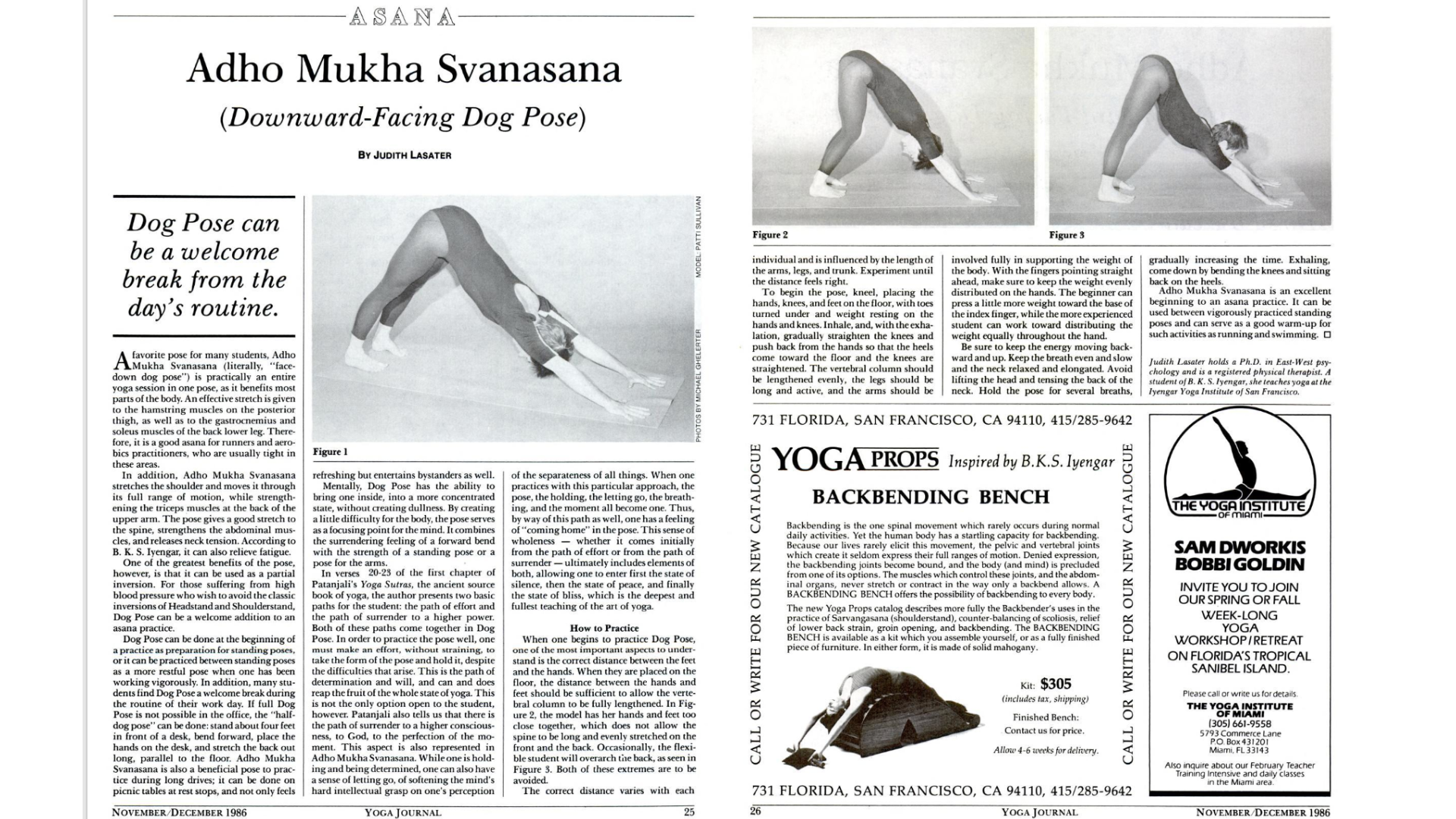
When one begins to practice Dog Pose, one of the most important aspects to understand is the correct distance between the feet and the hands. When they are placed on the floor, the distance between the hands and feet should be sufficient to allow the vertebral column to be fully lengthened. In Figure 2, the model has her hands and feet too close together, which does not allow the spine to be long and evenly stretched on the front and the back. Occasionally, the flexible student will overarch the back, as seen in Figure 3. Both of these extremes are to be avoided. The correct distance varies with each individual and is influenced by the length of the arms, legs, and trunk. Experiment until the distance feels right.
To begin the pose, kneel, placing the hands, knees, and feet on the floor, with toes turned under and weight resting on the hands and knees. Inhale, and, with the exhalation, gradually straighten the knees and push back from the hands so that the heels come toward the floor and the knees are straightened. The vertebral column should be lengthened evenly, the legs should be long and active, and the arms should be involved fully in supporting the weight of the body. With the fingers pointing straight ahead, make sure to keep the weight evenly distributed on the hands. The beginner can press a little more weight toward the base of the index finger, while the more experienced student can work toward distributing the weight equally throughout the hand.
Be sure to keep the energy moving backward and up. Keep the breath even and slow and the neck relaxed and elongated. Avoid lifting the head and tensing the back of the neck. Hold the pose for several breaths, gradually increasing the time. Exhaling, come down by bending the knees and sitting back on the heels.