
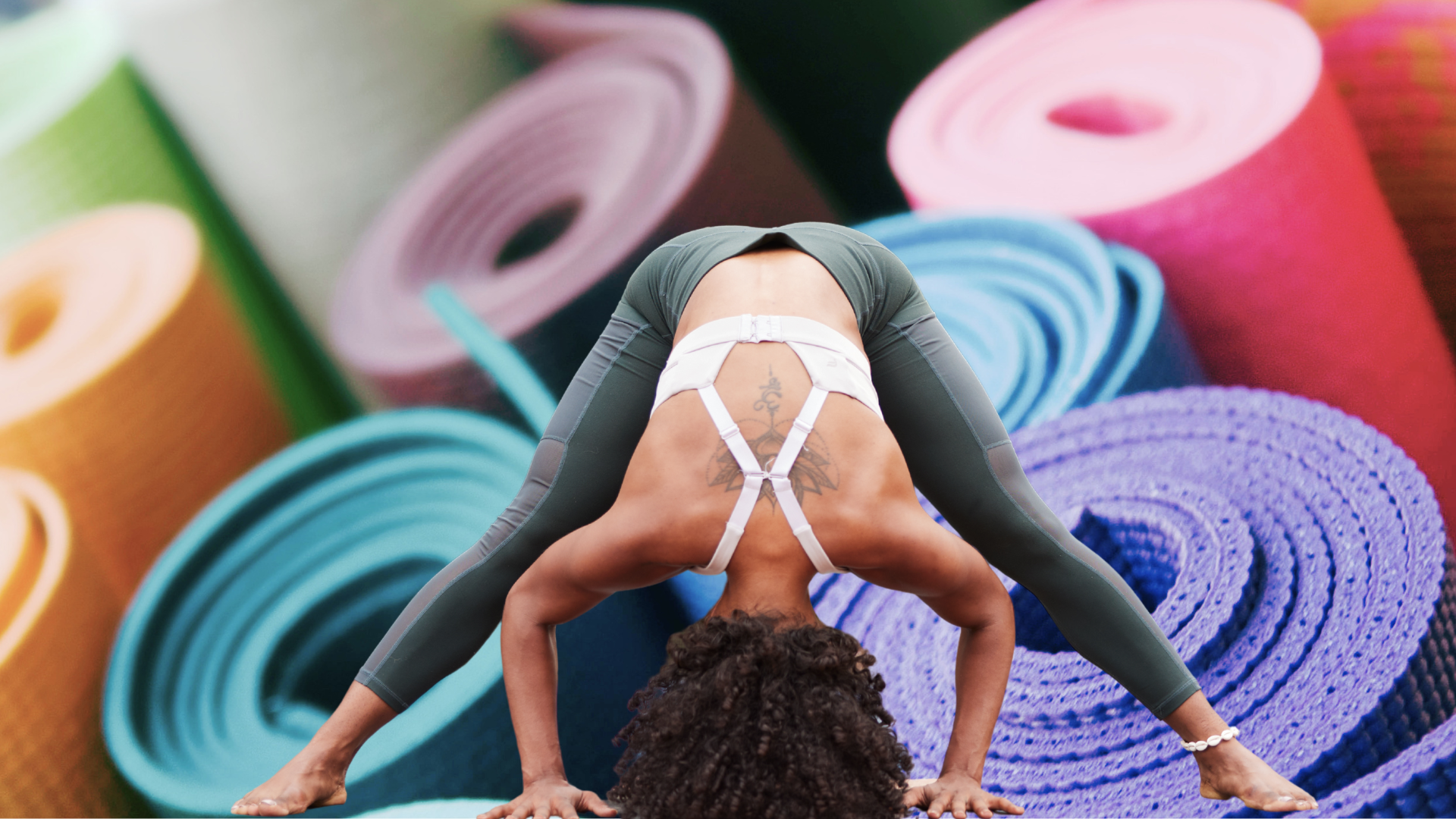
It essentially teaches you the meaning of yoga.
(Photo: Canva)
Published August 16, 2026 07:37AM
Yoga Journal’s archives series is a curated collection of articles originally published in past issues beginning in 1975. This article about Prasarita Padottanasana (Extended Leg Stretch or Standing Wide-Legged Forward Bend) first appeared in the September-October 1986 issue of Yoga Journal.
Of the two sins of yoga, doing too little and doing too much, the second is in many ways the worse.
Stiff students are usually acutely aware of their limitations. They find movement difficult, and they meet resistance to that movement at every turn. Such students have many opportunities to let go, to surrender into the asana, and to concentrate on the sensations it occasions. Usually beginners are more humble because they do not consider themselves advanced in the practice of yoga.
More flexible students, in contrast, may have a tendency to overdo, feeling that “more is better,” and therefore may unconsciously believe that they are more advanced in their understanding. But this ease of movement provides one with little resistance to indicate where one is holding and where one can let go.
If one bends forward easily into a pose such as Prasarita Padottanasana (Extended Leg Stretch), one may experience pride rather than surrender and inner tranquility. Flexible students are convinced that they are doing well; the ego becomes stronger, and these students often have a harder time learning about the inner yoga that the outer asana represents. If one finds Prasarita Padottanasana easy, it does not necessarily mean that one understands the mental and spiritual ramifications of the stillness of asana.
Likewise, the stiffer student is not always the beginner. I have long-time students in classes whose bodies are on the stiffer side, yet whose lives and relationships reflect a deep understanding of the discipline and commitment that the study of yoga entails. On the other hand, I have supple students who, with all their practice, seem to have missed the rich and rewarding inner work of yoga as surely as if they had been coming to an exercise class all these years.
To receive the stretch in Prasarita Padottanasana, as well as the purpose of a yoga practice, one must learn to be humble, whatever one’s abilities. Without giving up in the face of difficulty or becoming overconfident in the face of ease, one should learn to practice without becoming either impressed or depressed—impressed with one’s accomplishments or depressed by one’s slow, at times seemingly nonexistent, progress. Rather, the mark of progress in yoga is inner quietness and freedom from attachment to the asana, which paradoxically allows one to move further into it.
Letting go, whether of the hamstrings and adductors in Prasarita Padottanasana or of the ego in success or failure, is the key to continued progress in asana practice and to the unfolding of understanding that leads one to wisdom and ultimate freedom. This requires concentration for students of all levels: the beginner will find it difficult because tight leg muscles will keep the pelvis from tipping forward and rounding the back; the more advanced student will find it difficult for the opposite reason. If one can bend forward easily, one may tip the pelvis too quickly, create too much hollow in the lower back, and produce strain on the posterior structures of the column. Beginners must concentrate to keep from doing too little in the pose; experienced students must concentrate to keep from doing too much. As strange as this may sound to the stiffer student who longs to be supple, the ability to bend easily is often a mixed blessing.
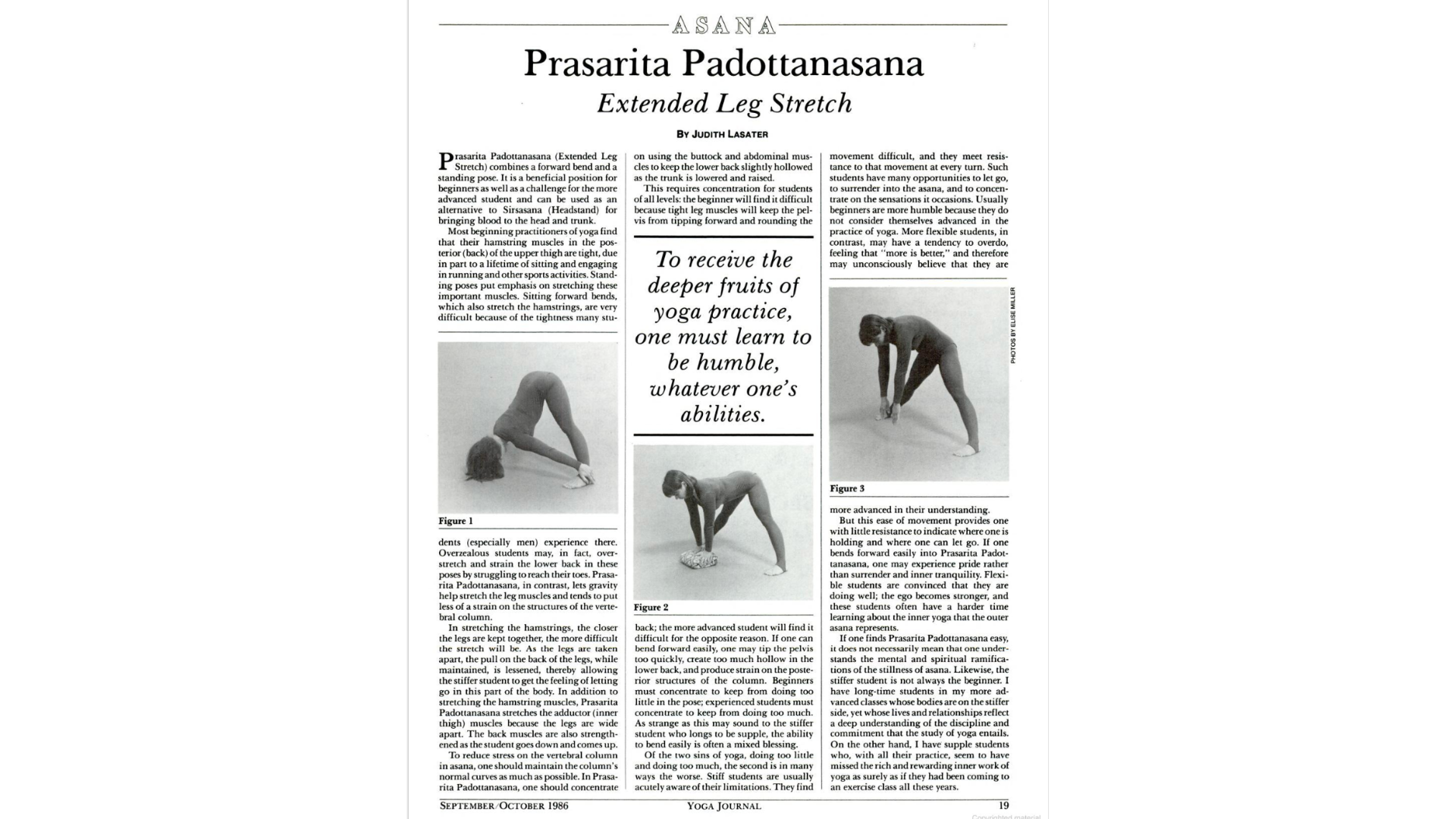
How to Practice Prasarita Padottanasana
Prasarita Padottanasana combines a forward bend and a standing pose. It is a beneficial position for beginners as well as a challenge for the more advanced student and can be used as an alternative to Sirsasana (Headstand) for bringing blood to the head and trunk.
Most beginning practitioners of yoga find that their hamstring muscles in the posterior (back) of the upper thigh are tight, due in part to a lifetime of sitting and engaging in running and other sports activities. Standing poses put emphasis on stretching these important muscles. Sitting forward bends, which also stretch the hamstrings, are very difficult because of the tightness many students (especially men) experience there. Overzealous students may, in fact, overstretch and strain the lower back in these poses by struggling to reach their toes. Prasarita Padottanasana, in contrast, lets gravity help stretch the leg muscles and tends to put less of a strain on the structures of the vertebral column.
Begin by placing the feet wide apart (usually at least four feet), taking care that the toes are aligned. Make sure that the quadriceps in the anterior (front) thigh remain firm throughout without forcing the knee joint backwards into hyperextension. All movement on the muscles of the legs should feel balanced between lifting up and pushing down, with no horizontal movement at the knee joints.
Place the hands on the waist and with an exhalation bend forward, keeping the back long and slightly curved. Keep the abdomen firm, and feel the work of the buttocks and hamstrings as they aid in letting the trunk down against the pull of gravity. Do not let the back round as in Figure 3, and do not hold the breath, as this is as much a sign of resistance as tight muscles. Keep the breath even and free throughout the pose.
If the body is stiff, place the hands on a folded blanket, as shown in Figure 2. A stack of books may also be used, and for some students the seat of a chair may be necessary to help keep the back in good alignment. Hold the pose for several breaths, up to a minute. Take care that the neck is not lifted unduly, creating strain in the muscles of the cervical spine (neck) and upper back. If possible, stretch the arms out and grasp the ankles, or put the hands on the floor in line with the shoulders, keeping the elbows aligned with the hands.
In stretching the hamstrings, the closer the legs are kept together, the more difficult the stretch will be. As the legs are taken apart, the pull on the back of the legs, while maintained, is lessened, thereby allowing the stiffer student to get the feeling of letting go in this part of the body. In addition to stretching the hamstring muscles, Prasarita Padottanasana stretches the adductor (inner thigh) muscles because the legs are wide apart. The back muscles are also strengthened as the student goes down and comes up.
To reduce stress on the vertebral column in asana, one should maintain the column’s normal curves as much as possible as in Figure 1. In Prasarita Padottanasana, one should concentrate on using the buttock and abdominal muscles to keep the lower back slightly hollowed as the trunk is lowered and raised.
To come up without causing too much strain on the back, place the hands on the waist or hips. Keep the back long, and use the inner and back thigh muscles as well as the abdomen and buttocks to control the action. The breath, once again, should be free. Most students prefer to inhale while coming up and to exhale while going down.
Prasarita Padottanasana can be used in the standing pose series to cool the mind and body after more strenuous poses. It can also be used as a pleasant transition to other forward bends or to Sirsasana (Headstand).
Figure 1 Photograph of yoga practitioner in full Prasarita Padottanasana with head on floor
Figure 2 Photograph of yoga practitioner in modified Prasarita Padottanasana using a folded blanket
Figure 3 Photograph of yoga practitioner bending forward with hands on the floor, side view
Photos by Elise Miller