
Published August 25, 2026 11:28AM
In Yoga Journal’s Archives series, we share a curated collection of articles originally published in past issues beginning in 1975. These stories offer a glimpse into how yoga was interpreted, written about, and practiced throughout the years. This article about Lotus Pose (Padmasana) first appeared in the November-December 1979 issue of Yoga Journal. Find more of our Archives here.
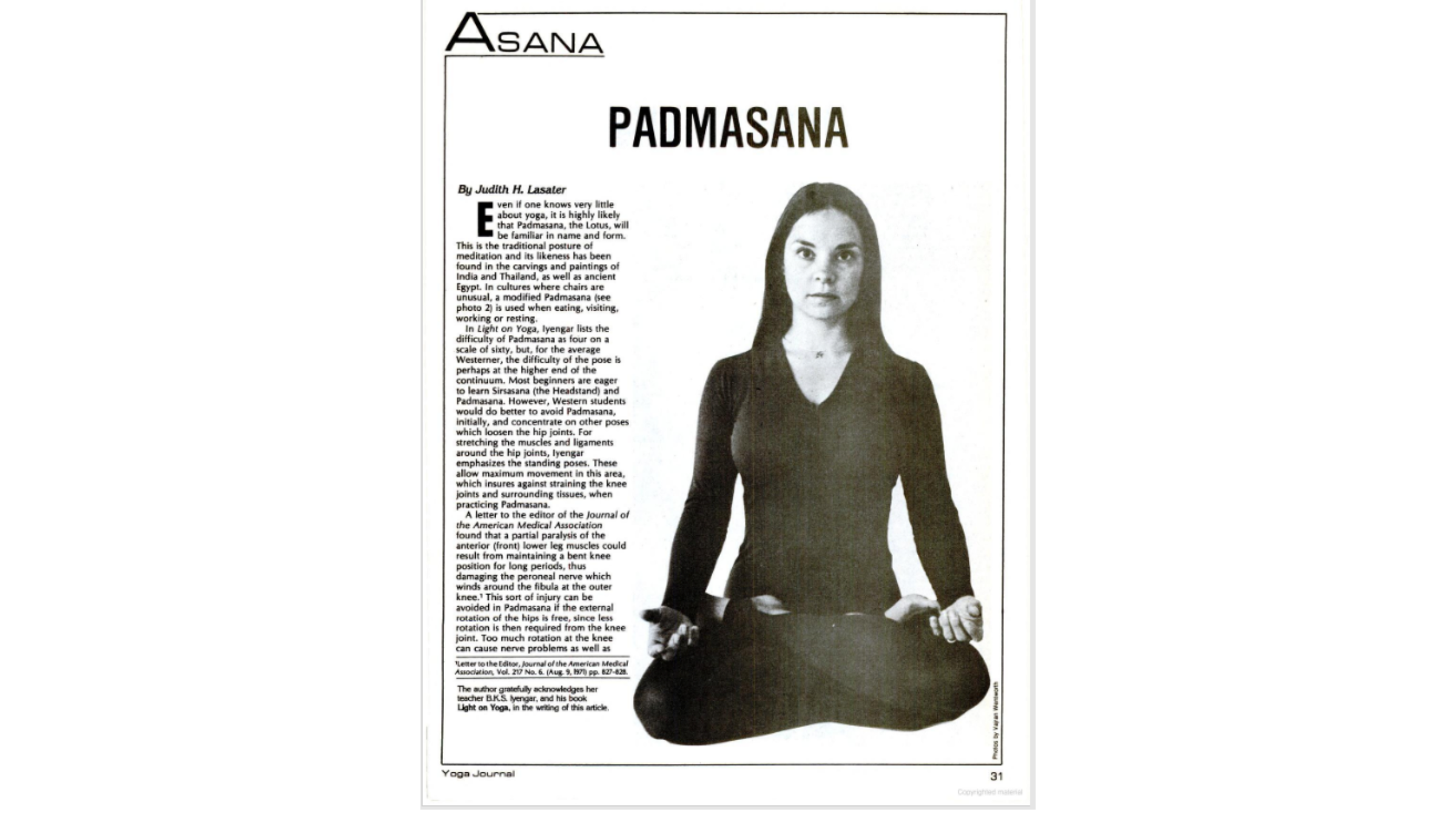
Even if one knows very little about yoga, it is highly likely that Padmasana, the Lotus, will be familiar in name and form. This is the traditional posture of meditation and its likeness has been found in the carvings and paintings of India and Thailand, as well as ancient Egypt. In cultures where chairs are unusual, a modified Padmasana is used when eating, visiting, working or resting.
In Light on Yoga, Iyengar lists the difficulty of Padmasana as four on a scale of sixty, but, for the average Westerner, the difficulty of the pose is perhaps at the higher end of the continuum. Most beginners are eager to learn Sirsasana (the Headstand) and Padmasana. However, Western students would do better to avoid Padmasana, initially, and concentrate on other poses which loosen the hip joints. For stretching the muscles and ligaments around the hip joints, Iyengar emphasizes the standing poses. These allow maximum movement in this area, which insures against straining the knee joints and surrounding tissues, when practicing Padmasana.
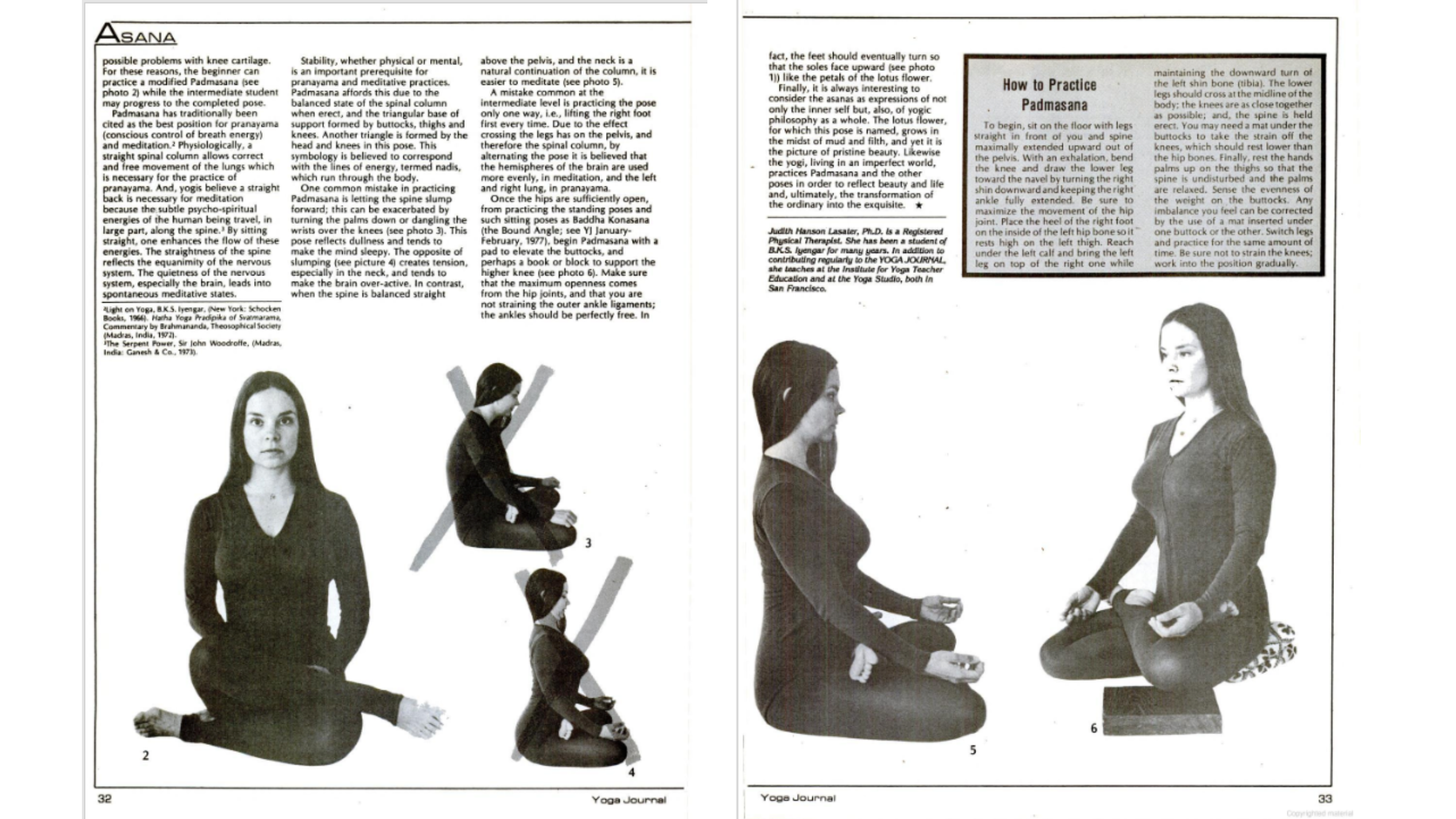
A letter to the editor of the Journal of the American Medical Association found that a partial paralysis of the anterior (front) lower leg muscles could result from maintaining a bent knee position for long periods, thus damaging the peroneal nerve which winds around the fibula at the outer knee.¹ This sort of injury can be avoided in Padmasana if the external rotation of the hips is free, since less rotation is then required from the knee joint. Too much rotation at the knee can cause nerve problems as well as possible problems with knee cartilage. For these reasons, the beginner can practice a modified Padmasana (see photo 2) while the intermediate student may progress to the completed pose.
Padmasana has traditionally been cited as the best position for pranayama (conscious control of breath energy) and meditation.² Physiologically, a straight spinal column allows correct and free movement of the lungs which is necessary for the practice of pranayama. And, yogis believe a straight back is necessary for meditation because the subtle psycho-spiritual energies of the human being travel, in large part, along the spine.³ By sitting straight, one enhances the flow of these energies. The straightness of the spine reflects the equanimity of the nervous system. The quietness of the nervous system, especially the brain, leads into spontaneous meditative states.
Stability, whether physical or mental, is an important prerequisite for pranayama and meditative practices. Padmasana affords this due to the balanced state of the spinal column when erect, and the triangular base of support formed by buttocks, thighs and knees. Another triangle is formed by the head and knees in this pose. This symbology is believed to correspond with the lines of energy, termed nadis, which run through the body.
One common mistake in practicing Padmasana is letting the spine slump forward; this can be exacerbated by turning the palms down or dangling the wrists over the knees (see photo 3). This pose reflects dullness and tends to make the mind sleepy. The opposite of slumping (see picture 4) creates tension, especially in the neck, and tends to make the brain over-active. In contrast, when the spine is balanced straight above the pelvis, and the neck is a natural continuation of the column, it is easier to meditate (see photo 5).
A mistake common at the intermediate level is practicing the pose only one way, i.e., lifting the right foot first every time. Due to the effect crossing the legs has on the pelvis, and therefore the spinal column, by alternating the pose it is believed that the hemispheres of the brain are used more evenly, in meditation, and the left and right lung, in pranayama.
Once the hips are sufficiently open, from practicing the standing poses and such sitting poses as Baddha Konasana, begin Padmasana with a pad to elevate the buttocks, and perhaps a book or block to support the higher knee (see photo 6). Make sure that the maximum openness comes from the hip joints, and that you are not straining the outer ankle ligaments; the ankles should be perfectly free. In fact, the feet should eventually turn so that the soles face upward (see photo 1) like the petals of the lotus flower.
Finally, it is always interesting to consider the asanas as expressions of not only the inner self but, also, of yogic philosophy as a whole. The lotus flower, for which this pose is named, grows in the midst of mud and filth, and yet it is the picture of pristine beauty. Likewise the yogi, living in an imperfect world, practices Padmasana and the other poses in order to reflect beauty and life and, ultimately, the transformation of the ordinary into the exquisite.
How to Practice Padmasana
To begin, sit on the floor with legs straight in front of you and spine maximally extended upward out of the pelvis. With an exhalation, bend the knee and draw the lower leg toward the navel by turning the right shin downward and keeping the right ankle fully extended. Be sure to maximize the movement of the hip joint. Place the heel of the right foot on the inside of the left hip bone so it rests high on the left thigh. Reach under the left calf and bring the left leg on top of the right one while maintaining the downward turn of the left shin bone (tibia). The lower legs should cross at the midline of the body; the knees are as close together as possible; and, the spine is held erect. You may need a mat under the buttocks to take the strain off the knees, which should rest lower than the hip bones. Finally, rest the hands palms up on the thighs so that the spine is undisturbed and the palms are relaxed. Sense the evenness of the weight on the buttocks. Any imbalance you feel can be corrected by the use of a mat inserted under one buttock or the other. Switch legs and practice for the same amount of time. Be sure not to strain the knees; work into the position gradually.
Footnotes & Author Notes
¹ Letter to the Editor, Journal of the American Medical Association, Vol. 217 No. 6, (Aug. 9, 1971) pp. 827-828.
² Light on Yoga, B.K.S. Iyengar, (New York: Schocken Books, 1966). Hatha Yoga Pradipika of Svatmarama, Commentary by Brahmananda, Theosophical Society (Madras, India, 1972).
³ The Serpent Power, Sir John Woodroffe, (Madras, India: Ganesh & Co., 1973).
The author gratefully acknowledges her teacher B.K.S. Iyengar, and his book Light on Yoga, in the writing of this article.