
Updated September 7, 2026 06:35PM
In Yoga Journal’s Archives series, we share a curated collection of articles originally published in past issues beginning in 1975. This article about Wide-Legged Standing Forward Fold (Prasarita Padottanasana) first appeared in the March-April 1979 issue of Yoga Journal. Find more of our Archives here.
Patanjali, author of the Yoga Sutras, lists five major afflictions, or klesas, which impede mental equanimity. One of these is dvesa, or aversion, which can manifest in many ways. Physically, it can be experienced as resistance to the forward stretch of a pose like Wide-Legged Standing Forward Bend. Often these people resist forward bends in general, both mentally and physically. According to Eliade, asana is a “single, archetypal, iconographic posture” which freezes for a moment the process of the bodymind into a “totalization.”* Consciousness is merely magnified and expressed more clearly through the moment of asana.
After watching many types of personalities and bodies practice hatha yoga, I have noticed that most people have a preference for either forward or backward bends. Since an asana can only represent what one is at other times, it could be that this preference occurs as an expression of personality. Perhaps one who prefers forward bends is drawn more easily to surrender and compliance and needs the balance of backbends to help create more extroversion, assertion and confidence. Conversely, one who is drawn to backbends may achieve greater balance through practice of forward bends. As alignment of the psycho-physical-spiritual being occurs in the practice, energy is free to flow fully and thus lends a natural balance to the dynamic stillness of asana. This is the process of yoga. It is interesting to note that when one experiences true surrender of the body, especially of the legs, and surrenders the mind as well by letting go of feelings of resistance and defiance, one experiences strength in the midst of surrender in forward bends.
Wide-Legged Standing Forward Fold (Prasarita Padottanasana) is a pose of surrender, humility, merging, and release. The student must give in and relax the powerful muscles of the legs in order to bend forward. (Prasarita means “extended” and pada is “foot.”) Just as in prayer, where one drops the head, the yogi creates that same feeling of reverence by bending forward in such poses as this one.Thus Wide-Legged Standing Forward Bend allows one to release feelings of anger and resistance by experiencing them fully.
When the legs are released, the sense of freedom which follows is exhilarating, giving one a feeling of inner strength while enjoying outer flexibility.
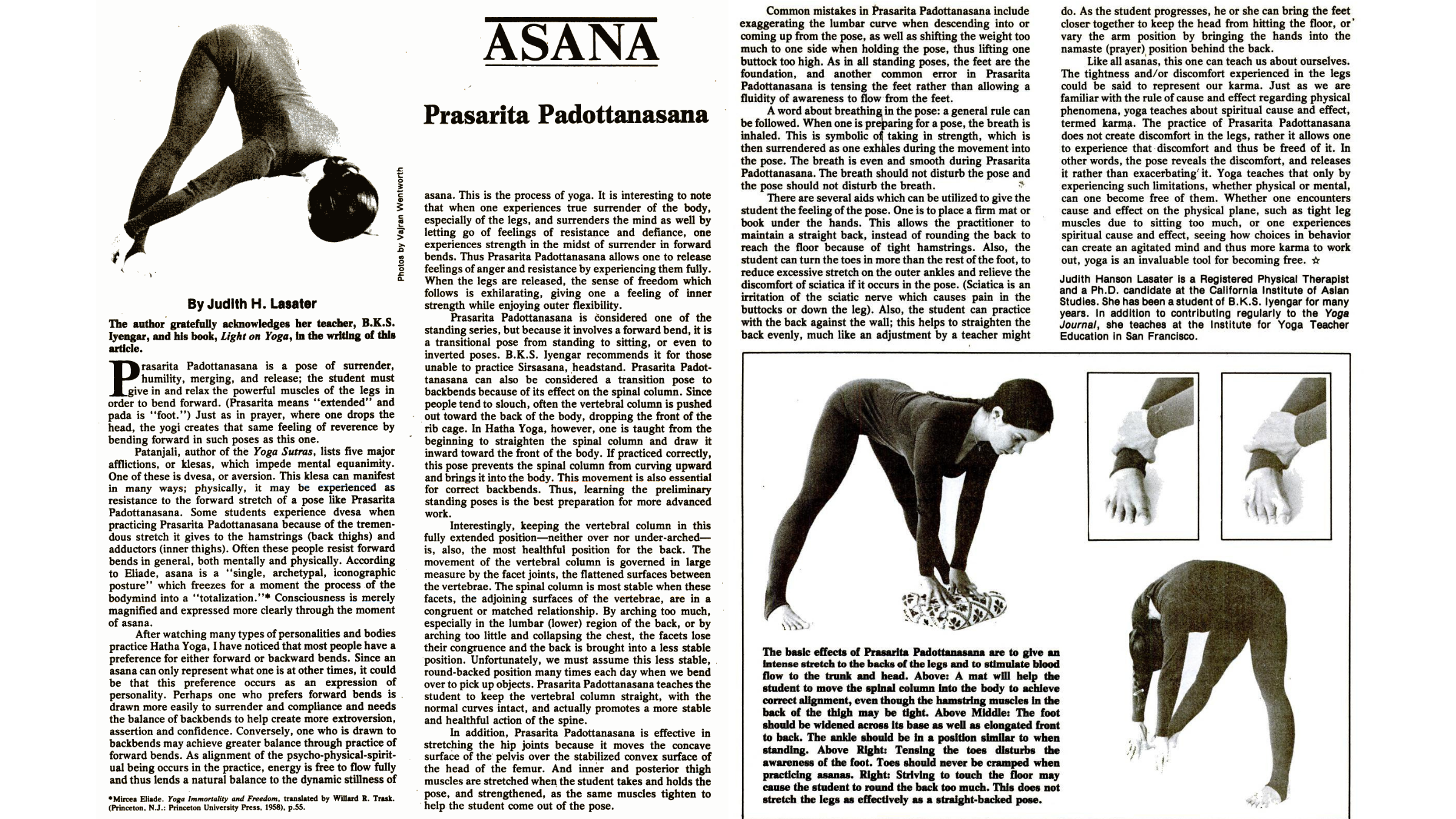
Wide-Legged Standing Forward Fold is considered one of the standing series, but because it involves a forward bend, it is a transitional pose from standing to sitting, or even to inverted poses. B.K.S. Iyengar recommends it for those unable to practice Headstand (Sirsasana). Wide-Legged Standing Forward Bend can also be considered a transition pose to backbends because of its effect on the spinal column. Since people tend to slouch, often the vertebral column is pushed out toward the back of the body, dropping the front of the rib cage. In Hatha Yoga, however, one is taught from the beginning to straighten the spinal column and draw it inward toward the front of the body. If practiced correctly, this pose prevents the spinal column from curving upward and brings it into the body. This movement is also essential for correct backbends. Thus, learning the preliminary standing poses is the best preparation for more advanced work.
(Photo: Yoga Journal, 1979)
Benefits of Wide-Legged Standing Forward Fold
Interestingly, keeping the vertebral column in this fully extended position—neither over nor under-arched—is the most healthful position for the back. The movement of the vertebral column is governed in large measure by the facet joints, the flattened surfaces between the vertebrae. The spinal column is most stable when these facets, the adjoining surfaces of the vertebrae, are in a congruent or matched relationship. By arching too much, especially in the lumbar (lower) region of the back, or by arching too little and collapsing the chest, the facets lose their congruence and the back is brought into a less stable position.
Unfortunately, we must assume this less stable, round-backed position many times each day when we bend over to pick up objects. Wide-Legged Standing Forward Bend teaches the student to keep the vertebral column straight, with the normal curves intact, and actually promotes a more stable and healthful action of the spine.
In addition, Wide-Legged Standing Forward Bend is effective in stretching the hip joints because it moves the concave surface of the pelvis over the stabilized convex surface of the head of the femur. And inner and posterior thigh muscles are stretched when the student takes and holds the pose, and strengthened, as the same muscles tighten to help the student come out of the pose. Some students experience dvesa when practicing Wide-Legged Standing Forward Bend because of the tremendous stretch it gives to the hamstrings (back thighs) and adductors (inner thighs).
Things to Keep in Mind
Common mistakes in Wide-Legged Standing Forward Fold include exaggerating the lumbar curve when descending into or coming up from the pose, as well as shifting the weight too much to one side when holding the pose, thus lifting one buttock too high. As in all standing poses, the feet are the foundation, and another common error in Wide-Legged Standing Forward Bend is tensing the feet rather than allowing a fluidity of awareness to flow from the feet.
A word about breathing in the pose. A general rule can be followed: When one is preparing for a pose, the breath is inhaled. This is symbolic of taking in strength, which is then surrendered as one exhales during the movement into the pose. The breath is even and smooth during Wide-Legged Standing Forward Bend. The breath should not disturb the pose and the pose should not disturb the breath.
Props and Support
There are several aids which can be utilized to give the student the feeling of the pose. One is to place a firm mat or book under the hands. This allows the practitioner to maintain a straight back, instead of rounding the back to reach the floor because of tight hamstrings. Also, the student can turn the toes in more than the rest of the foot, to reduce excessive stretch on the outer ankles and relieve the discomfort of sciatica if it occurs in the pose. (Sciatica is an irritation of the sciatic nerve which causes pain in the buttocks or down the leg). Also, the student can practice with the back against the wall; this helps to straighten the back evenly, much like an adjustment by a teacher might do. As the student progresses, he or she can bring the feet closer together to keep the head from hitting the floor, or vary the arm position by bringing the hands into the namaste (prayer), position behind the back.
Like all asanas, this one can teach us about ourselves. The tightness and/or discomfort experienced in the legs could be said to represent our karma. Just as we are familiar with the rule of cause and effect regarding physical phenomena, yoga teaches about spiritual cause and effect, termed karma. The practice of Wide-Legged Standing Forward Bend does not create discomfort in the legs, rather it allows one to experience that discomfort and thus be freed of it. In other words, the pose reveals the discomfort, and releases it rather than exacerbating it. Yoga teaches that only by experiencing such limitations, whether physical or mental, can one become free of them.
Whether one encounters cause and effect on the physical plane, such as tight leg muscles due to sitting too much, or one experiences spiritual cause and effect, seeing how choices in behavior can create an agitated mind and thus more karma to work out, yoga is an invaluable tool for becoming free.
The author gratefully acknowledges her teacher B.K.S. Iyengar and his book Light on Yoga in the writing of this article.