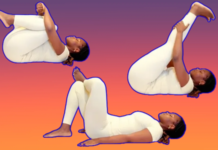

Dr Rob Lamport, Doctor of Chiropractic and one of the lead teachers at Tara Mitra Yoga School, explores what the anatomy of the spine can teach yoga teachers and practitioners about back pain.
A student arrives to class early and says, “My lower back has been tight all week. What should I stretch?”
It sounds like a straightforward question, no? But, a teacher who has spent time working with back pain will want to know a little more. Like. What movements feel comfortable? Is the tightness constant or does it come and go through the day? Is there pain in the leg? What happens after practice?
The answer begins with the person, rather than a posture.
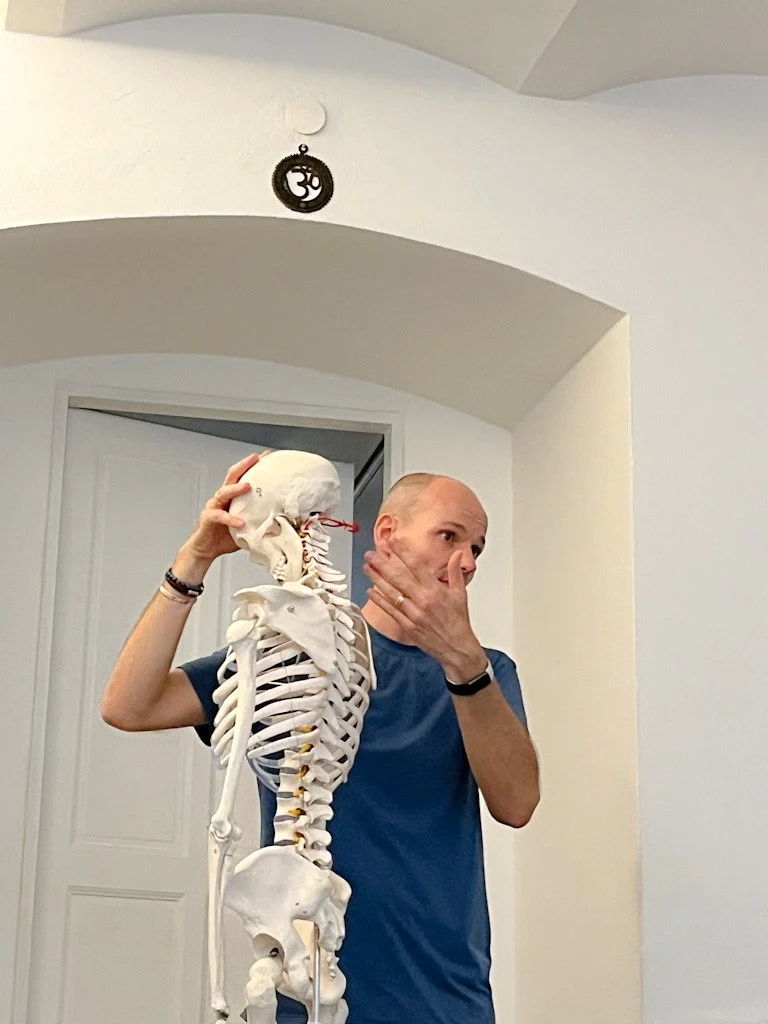
In our free class, Decoding Low Back Pain, Dr Rob took a simple model of the spine and used it to explore these everyday questions. He looked at the vertebrae, discs and nerves; at what changes when we bend forward or backward; and at why the amount of movement we choose matters.[Attachment]
Why can a lower back feel tight?
Tightness is something we feel, rather than a diagnosis. It can have different contributors, and a person’s description alone cannot tell us exactly what is happening in their spine.
Dr Rob’s point was practical. When a back feels uncomfortable or sensitive, the instinct to stretch more deeply deserves a moment of enquiry. A smaller movement might feel easier. Changing the direction of movement might help. The response may vary from one person to another, and from one day to the next.
For a practitioner, this creates room to explore instead of trying to reach a particular shape. For a teacher, it changes the first question from “Which stretch should I give them?” to “What can I observe, and what can they tell me?”
That is a much better place to begin.
What happens when the spine moves?
The lower back moves as part of a larger system. When we fold forward, extend backward or twist, the spine moves alongside the hips, pelvis and surrounding tissues. The discs and nerves are part of that picture too.
Rob showed how movement changes the demands on these structures. He also made an important point: our bodies benefit from movement. The skill lies in choosing a range and level of effort that a person can manage comfortably, then paying attention to the response.
Consider a forward bend. Two students might appear to be doing the same posture. One may move readily through the hips and feel comfortable. The other may find that the movement is concentrated in the lower back. A cue to “go deeper” reaches them both, but it may serve them very differently.
Anatomy helps a teacher see why. It gives us something more useful than a rule about the posture: a way to consider where movement is taking place and how much is being asked of the person doing it.
What can Śalabhāsana teach us about back pain?
Dr Rob used Śalabhāsana (locust pose), as an example.
In the full expression of the posture, the practitioner lifts the upper body and both legs. That creates a substantial demand through the back. Now imagine lifting one leg gently while allowing the movement to come primarily from the hip. The shape is smaller, and the demand on the lower back changes.
A teacher can use that difference thoughtfully. Perhaps the student begins with a small movement and begins to feel steady or, it might even feel like it’s too much today. Slowly, over time, we build their practice.
The useful question is: what is the function that this version of the posture provides this person, at this point in their practice?
That question applies far beyond Śalabhāsana. It can guide how we approach a forward bend, a twist, a standing posture or an ordinary transition from the floor to standing.
What does good yoga teaching offer someone with back pain?
For someone with back pain, useful teaching often begins with clear information, a manageable way to keep moving and the chance to build confidence in their own experience. Clinical guidance also emphasises advice tailored to the person’s needs and capabilities, including support to continue normal activities where appropriate.
Yoga can contribute to that process as it offers opportunities to move, notice, adjust and gradually learn what feels possible. The research on chronic, non-specific low back pain suggests yoga can bring small improvements in pain and function compared with doing no exercise; its results for back-related function appear broadly similar to other back-focused exercise. That is a good reason to teach it carefully, rather than make grand promises for it.
In Dr Rob’s class, a recurring principle was the quality of movement. A smaller movement done with attention may tell us more than several repetitions performed while striving to get further.
For teachers, this means watching closely and listening to what the student reports. For practitioners, it means noticing how a movement feels while you are doing it and how you feel afterwards. Both are part of learning.
Seeing the whole person
Rob began his session with a reminder that his focus on physical anatomy was only one way of looking at back pain. People bring their histories, concerns, habits and daily lives into the way they experience it.
This is also reflected in international guidance for chronic low back pain, which recommends person-centred care that takes physical, psychological and social factors into account.
Anatomy gives us valuable knowledge. It can help us understand why an adaptation changes a movement, recognise when a student needs a different approach, and communicate more clearly. It also helps us recognise the limits of our role as yoga teachers. A student with concerning or changing symptoms may need an assessment from an appropriate healthcare professional.
Learning to ask better questions
The student who says, “My back feels tight, what should I stretch?” has given us a starting point.
We can ask what movements feel comfortable. We can observe how they bend and extend. We can offer a smaller variation and see how they respond. We can draw on anatomy while remaining curious about the person in front of us.
That is the work Dr Rob introduces in Decoding Low Back Pain: bringing knowledge of the body into the ordinary decisions we make in practice and teaching.
Dr Rob’s anatomy teaching is also part of our one-year Yoga Mentorship Program at Tara Mitra Yoga School. For teachers and practitioners who would like to explore these questions more deeply, the mentorship offers space to study anatomy as something living and applicable, knowledge you can bring back to the mat and to the people you teach.
Explore the Yoga Mentorship Program
This article is for education and does not replace individual healthcare advice.
Sources
• Dr Rob Lamport, Decoding Low Back Pain: A Practical Guide for Yoga Teachers and Practitioners, Tara Mitra Yoga School, September 2026
• National Institute for Health and Care Excellence (NICE), Low back pain and sciatica in over 16s: assessment and management.[org]
• Cochrane, Yoga for chronic non-specific low back pain, 2022.[cochrane]
• World Health Organization, WHO guideline for non-surgical management of chronic primary low back pain in adults, 2023.[who]