

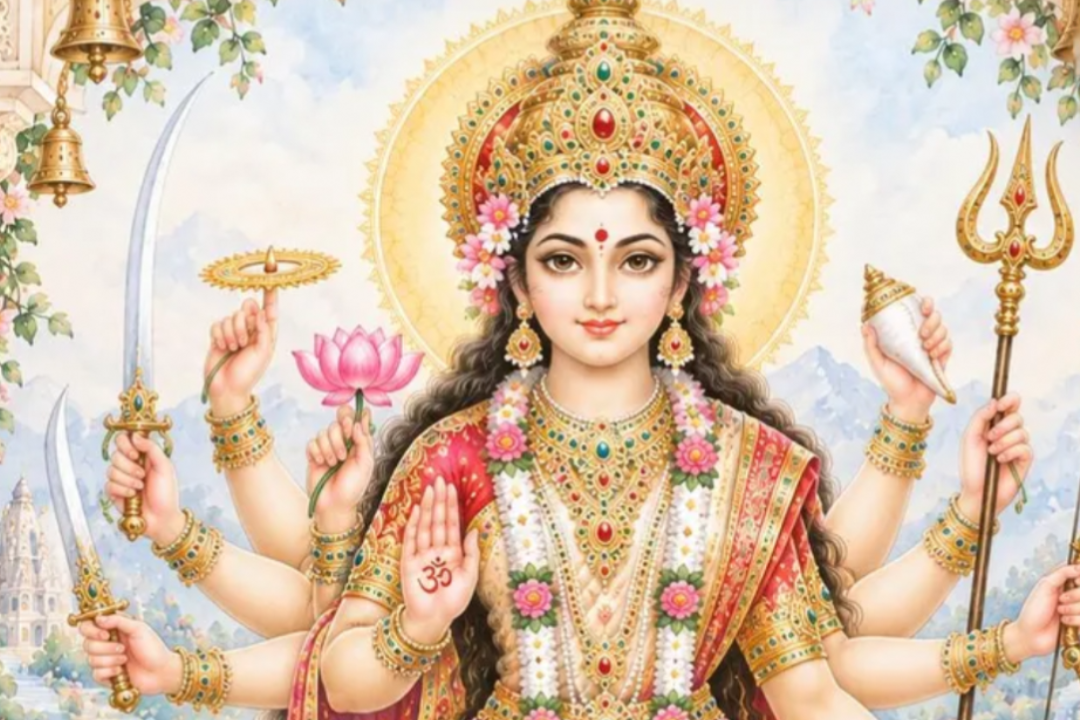
Navratri is a nine-night festival honouring Devī, the Goddess, through stories, chanting, music, dance and traditional observances. Its name comes from the Sanskrit nava, meaning nine, and rātri, meaning night.
Each day corresponds to one of Durga’s nine forms, collectively known as the Navadurgā.
The Goddess imagery is striking. One carries a rosary and water pot. Another holds a child. Others carry weapons, ride animals or appear in a fierce form. These differences are not incidental: they belong to a rich tradition of stories through which people have explored power, knowledge, protection and transformation.
Yet, understanding Navratri involves more than attaching a positive quality to each figure. Nor does it require us to adopt beliefs that are unfamiliar to us. We can begin by learning about the tradition and considering the questions it opens. For example,
What kind of strength protects rather than dominates? How does knowledge become understanding? What enables us to recognize a destructive pattern, and change our relationship with it?
A picture alone doesn’t answer these questions. They become clearer through study.
What Is Navratri? Understanding the Different Observances
Navratri occurs more than once each year. The two most widely known are Chaitra Navratri in spring and Śāradīya Navratri in autumn.
The festival also takes different forms across regions and communities.
In many northern and western Indian traditions, the nine days are associated with the Navadurgā. In Bengal, the autumn celebrations centre on Durga Puja and the Goddess’s defeat of Mahiṣāsura, the buffalo demon. Elsewhere, the emphasis may fall on Lakṣmī, Sarasvatī, local forms of Devī, or particular combinations of chanting, music, dance and communal observance.
Another familiar practice dedicates three days each to Durga, Lakṣmī and Sarasvatī. This differs from the nine-form Navadurgā sequence, though both fall within the wider traditions centred on Devī.
No single explanation describes every Navratri celebration.
The tenth day, Vijayadaśamī, also known as Dussehra or Daśarā in many communities, is associated with victory and auspicious beginnings. Its stories and customs vary, including traditions connected with Durga’s victory and others with Rama’s defeat of Ravana.
Devī and Śakti: More Than a Symbol of Strength
Devī refers to the Goddess. Śakti refers to power, capacity or potency.
In traditions centred on Devī, Śakti is understood as divine power, not simply as a collection of qualities thought to be feminine. The Goddess may be honoured through many names and forms, each with particular stories and associations.
Durga is commonly associated with protection and defeating destructive forces. Lakṣmī is associated with prosperity and auspiciousness. Sarasvatī is associated with knowledge, speech, music and the arts.
These descriptions introduce the figures, but they don’t exhaust their significance.
It is tempting to translate Śakti immediately as “inner strength” or “personal empowerment.” Those may open a helpful conversation, but they don’t capture the full understanding.
A more thoughtful approach examines what power is, how it operates, and what directs it.
Power can create, sustain, protect and transform. It can also be misused. Knowledge can guide action, but without discernment, it doesn’t guarantee wise conduct. Strength can support another person or become a means of control.
The stories of Devī give these questions a vivid form.
Where Do the Nine Forms of Durga Come From?
The familiar Navadurgā sequence begins with Śailaputrī and ends with Siddhidātrī. Their names appear in the opening verses of the Devī Kavaca, the “Armour of the Goddess,” a protective chant traditionally recited alongside the Devī Māhātmya.
This difference is important: the naming verses identify the nine forms, but don’t provide a complete visual specification for each one.
Their familiar images reflect devotional and artistic traditions. The number and arrangement of weapons, the vehicle and other details may vary.
Nor should the Devī Māhātmya be described as a narrative that introduces these nine forms one after another. The text and the Navadurgā sequence are closely associated, but they are not interchangeable.
The descriptions below introduce common identifying features. The reflections alongside them draw on my study and teaching of yoga, including an approach Sashikala Ananthanarayanan explores, in which the forms invite inquiry into the capacities that unfold through life’s different stages and responsibilities. This is a teaching perspective, not a claim that every traditional source explains the sequence in the same way.
The Nine Forms of Durga
1. Śailaputrī — Daughter of the Mountain
Śailaputrī’s name means “daughter of the mountain.” She is associated with Pārvatī, the daughter of Himavān, and is commonly depicted riding a bull and holding a trident and a lotus.
In the teaching perspective Sashi explores, this form connects to the beginning of a journey: capacities are present, but their full expression has yet to unfold.
This offers a useful way to consider learning.
We do not begin with complete understanding. We begin with possibilities, influences and questions. Practice gradually reveals both our capacities and our limitations.
The beginning is not an inferior stage to be hurried through. It is where we establish the relationship with learning that will support everything that follows.
2. Brahmacāriṇī — The Ascetic and Learner
Brahmacāriṇī is associated with Pārvatī’s austerities and disciplined practice. She is commonly shown on foot, holding a rosary and water pot.
Her form highlights sustained effort.
In the teaching material from Sashi’s session, this stage is also explored through a student’s commitment: someone willing to meet the demands of learning rather than stay satisfied with what is already familiar.
In this sense, discipline is not punishment. It is the capacity to stay engaged with what is relevant.
In yoga, that may mean returning to a practice, listening more carefully or allowing a question to remain open rather than jumping quickly to an answer.
3. Candraghaṇṭā — Strength That Can Respond
Candraghaṇṭā is recognized by the bell-shaped crescent on her forehead. She is commonly depicted as a many-armed warrior, carrying weapons and other attributes, and riding a lion or tigress.
Her image introduces a different expression of strength: the capacity to engage with the world.
It is one thing to develop understanding in a protected setting. It is another to act when circumstances demand it, relationships are complicated, or something important needs defending.
Courage is not simply forcefulness. It may require a clear voice, a considered boundary or the ability to remain steady without escalating a conflict.
Strength is useful not only for its intensity, but for the understanding that directs it.
4. Kūṣmāṇḍā — Creative Capacity
Kūṣmāṇḍā is commonly depicted with eight arms. In widely circulated devotional accounts, she is associated with the creation of the universe. That account is not narrated in the brief naming passage of the Devī Kavaca.
The teaching perspective in the material Sashi shared explores this form in relation to recognizing creative capacity.
For our own inquiry, this need not mean inventing something extraordinary.
We participate in creation through ordinary actions: the atmosphere we establish in a classroom, the quality of attention we bring to a relationship, the habits we cultivate and the work we choose to sustain.
Recognizing capacity also brings responsibility. What are we making possible through the way we live?
5. Skandamātā — Care and Responsibility
Skandamātā means “mother of Skanda,” also known as Kārttikeya. Her clearest identifying feature is the child she holds. She is commonly shown with lotuses and a lion as her vehicle.
Her image brings care and protection into the sequence.
The teaching material explores this maternal capacity more broadly than biological motherhood, including care for a child who comes into one’s life through other relationships.
This wider inquiry matters. Care can be expressed through parenting, teaching, mentoring and supporting another person’s development.
But care and control are not the same.
To support growth, we need to recognize what assistance is appropriate and what the other person must discover or undertake for themselves.
6. Kātyāyanī — Protective Action
Traditional accounts associate Kātyāyanī with the sage Kātyāyana. She is commonly depicted as a warrior riding a lion, often holding a sword and lotus.
Her image directs attention towards protective action.
Sometimes gentleness alone is not enough. We may need to challenge something harmful; we may need to uphold a boundary.
This does not make aggression a virtue. It raises a harder question: can we act firmly without being governed by the same destructive impulses we try to confront?
In teaching and practice, discernment must eventually become conduct. What we understand matters, but so does what we do with that understanding.
7. Kālarātri — The Fierce Form
Kālarātri is depicted in a dark, fierce form, commonly riding a donkey.
Her appearance may unsettle someone encountering the imagery for the first time. Yet fierceness doesn’t make her a negative figure, and darkness shouldn’t be equated with moral failure.
Her image challenges the expectation that what protects us must always appear gentle or reassuring.
In personal reflection, this raises the question of what we resist acknowledging.
Most patterns don’t change while we leave them unexamined. Recognizing them may be uncomfortable, especially when they contradict the image we hold of ourselves.
The point is not to glorify discomfort. It is to distinguish between difficulty that needs support and difficulty we avoid because it asks us to see more honestly.
8. Mahāgaurī — Clarity and Renewal
Mahāgaurī’s name refers to her exceptionally fair or white appearance. She is commonly depicted in white garments, often riding a bull, and shown with attributes such as a trident and small drum.
Her imagery often conveys purity and serenity. These colour descriptions identify the traditional image; they should not be treated as judgements about human skin colour.
In the teaching material, this form is explored through recovery and a return to a more settled expression after fierceness.
That offers an important counterpoint.
A capacity to confront difficulty is valuable, but living permanently in confrontation is another matter. We also need to recognize when a demanding response has served its purpose.
What allows us to recover clarity? How do we return to care, steadiness and ordinary responsibilities without denying what has happened?
9. Siddhidātrī — Accomplishment and Its Purpose
Siddhidātrī means “giver of siddhis.” Depending on context, siddhi can refer to accomplishment, attainment or extraordinary power. She is commonly shown with four arms, holding a conch, discus, mace and lotus, often seated on a lotus.
Her place at the end of the sequence invites an inquiry into accomplishment.
What is the purpose of developing our capacities? What guides their use? Does achievement deepen understanding, or does it simply strengthen our need for recognition?
Patañjali offers a related caution in the Yoga Sūtra. In sūtra 3.37, the capacities under discussion are described as obstacles to samādhi, although accomplishments when the mind is outward-turned. This is a particular statement within his teaching, not an explanation of Siddhidātrī’s tradition.
The comparison nevertheless helps us distinguish between acquiring a capacity and becoming free from our attachment to it.
The Devī Māhātmya and the Story of Mahiṣāsura
The Devī Māhātmya is a Sanskrit text within the Mārkaṇḍeya Purāṇa, generally dated by scholars to approximately the fifth or sixth century CE.
It comprises thirteen chapters and is traditionally known as the Durga Saptaśatī, the “Seven Hundred.” Its recitation is commonly called Caṇḍī Pāṭha. Among its best-known narratives is Durga’s defeat of Mahiṣāsura, the buffalo demon.[templepurohit]
The story presents a destructive power that must be confronted and overcome. Its language is vivid: conflict, weapons, transformation and victory.
It would be easy to dismiss this as a violent story, or to simplify it by saying that the demon “just means the ego.” Neither approach does justice to its depth.
The narrative has its own place within the tradition. Alongside that, teachers may explore what such encounters reveal about human experience.
In the approach Sashi describes, confronting one’s own destructive tendencies can begin a more serious engagement with practice. The emphasis is not merely on condemning an external enemy, but on recognizing what must change within oneself.
This is a demanding inquiry.
We may easily recognize harmful behaviour in someone else but, recognizing our own contribution takes much more patience and honesty. We can easily justify control as care, rigidity as discipline or reactivity as strength.
The story doesn’t offer a quick technique for resolving these patterns; instead, it gives us a way to ask what kind of understanding and capacity we need to meet them.
Durga, Lakṣmī and Sarasvatī: Three Movements of Study
In some Navratri traditions, three days are dedicated to Durga, three to Lakṣmī and three to Sarasvatī. This arrangement is separate from the Navadurgā sequence.
From a teaching perspective, these forms unfold in a progression: confronting destructive tendencies, developing the resources that support the path, and receiving the knowledge needed to pursue it.
This is richer than saying we first remove negativity, then acquire wealth, then become knowledgeable.
Resources are not an end in themselves. They can make certain actions possible, indeed, but knowledge isn’t simply information. It must help us understand and respond well.
The threefold framework raises a practical question: do we have the clarity, means and guidance to live according to what we say matters?
These are themes that deserve sustained study rather than a fixed formula applied to everyone.
Navratri and the Three Guṇas
The three guṇas, tamas, rajas, and sattva, are central to Sāṅkhya philosophy and appear in the Bhagavad Gītā and yoga teachings.
In classical Sāṅkhya, they constitute prakṛti, the source of material and mental manifestation. They are not simply three moods or personality types.
The Sāṅkhya Kārikā describes their functions in terms of illumination, activity, and restraint, while emphasizing their interaction.
Tamas is associated with inertia and obscuration. Rajas is associated with activity and movement. Sattva is associated with illumination and clarity.
These qualities can help us examine experience, but they should not become a scorecard.
Rest is not automatically bad; activity is not automatically progress, and calmness is not direct understanding.
Some teachings interpret Navratri’s three groups of days in relation to these guṇas, describing their associations or a movement toward greater clarity. This is one lens, not a universal account of the festival.
Nor should Durga be reduced to tamas, Lakṣmī to rajas or Sarasvatī to sattva. Their traditional significance is much wider.
For students of yoga, the key question is how these qualities shape perception and action, and how we learn to recognize their operation without fully identifying with them.
Bringing the Stories into Practice
The relationship between a traditional story and personal reflection requires discernment.
We don’t need to treat every narrative as a literal description of ordinary events. But neither should we rewrite it until it says only what we already believe.
Real learning asks us to listen first.
What does the story say? Where does a particular interpretation come from? What is the teacher drawing our attention towards? Which parts are we resisting or simplifying?
Only then can we begin to explore its relevance to our own experience.
During Navratri, that might mean taking a little time each day to focus on one form, learning its name and identifying features, and considering a question it raises.
The aim doesn’t have to be finding a personal lesson in everything. Sometimes the most valuable outcome is recognizing that there is simply more to understand.
Sanskrit Chanting and Careful Learning
The names and verses associated with the Navadurgā offer another route into study.
The Navadurgā Stotram requires care. The nine-name passage from the Devī Kavaca and collections of individual verses addressing the forms are not necessarily the same text. It helps to identify the version being taught and its source.
Pronunciation, meaning and recitation all belong together.
A transliteration can support learning, but listening helps us recognize distinctions that are easy to miss on the page. Repetition builds familiarity; attentive repetition builds accuracy.
Not every Sanskrit chant uses Vedic accent. We should learn the conventions appropriate to the particular text rather than assume that all Sanskrit chanting follows one system.
There is no need to rush toward memorization; it happens naturally with continued practice. Learning carefully can change the quality of our attention as much as our familiarity with the words.
Why These Studies Deserve Time
Navratri brings together stories, images, language, philosophy and living traditions. Each offers a different way to understand.
A short article can introduce the nine forms and clarify some common confusions. It cannot communicate everything that emerges through a teacher’s explanation, discussion and sustained practice.
The deeper questions often arise after the first explanation.
What is the difference between discipline and rigidity? When does care become control? How does a capacity become useful rather than merely impressive? What helps us recognize something accurately when our preferences are involved?
These are questions we return to, not finish lines to cross.
My teaching at Tara Mitra Yoga brings together traditional yoga practice, philosophy, Sanskrit chanting, prāṇāyāma and yoga therapy, grounded in study within the Krishnamacharya lineage.
We give these subjects time: learning their context, examining their language, and exploring how understanding can inform how we practice, teach, and live.
To explore this work further, visit the 1:1 teaching, classes and mentorship pages at Tara Mitra Yoga. They describe the opportunities for deeper study and the approach that guides a sincere practice.
Frequently Asked Questions About Navratri
What does Navratri mean?
Navratri means “nine nights,” from the Sanskrit nava (nine) and rātri (night). Navratri is a widely used English spelling; Navarātri is the Sanskrit transliteration.
Is Navratri observed more than once a year?
Yes. There are several observances during the year. The two most widely known are Chaitra Navratri in spring and Śāradīya Navratri in autumn.
What are the nine forms of Durga?
The familiar sequence is Śailaputrī, Brahmacāriṇī, Candraghaṇṭā, Kūṣmāṇḍā, Skandamātā, Kātyāyanī, Kālarātri, Mahāgaurī and Siddhidātrī. Their names appear in the Devī Kavaca.
Do Durga images always look the same?
No. Common identifying features distinguish the forms, but details vary across artistic and regional traditions. The named verses don’t provide a complete drawing specification. Each Goddess has symbols; look for those instead.
Does the Devī Māhātmya tell the story of all nine forms in order?
No. The Devī Māhātmya and the familiar Navadurgā sequence are closely associated, but they are not interchangeable. The nine names are listed in the accompanying Devī Kavaca.
Are the stories simply metaphors for the mind?
No. They have their own traditional significance. Teachers may also use them to explore human experience, but they should identify such interpretations rather than present them as the only meaning.
How can I begin studying Navratri?
Learn which tradition or lens is being presented. Start with the names, stories, and sources, and seek knowledgeable guidance for chanting or deeper textual study, since these cannot be learned from a recording. Curiosity is a good start; learning carefully with the right source gives it direction.
Tara Mitra Yoga is an online school for dedicated students and teachers seeking traditional yoga study, thoughtful mentorship and a deeper understanding of practice.
At Tara Mitra Yoga, we study traditional yoga through its texts, practices and living teaching traditions. Our courses and mentorship bring together yoga philosophy, Sanskrit chanting, prāṇāyāma and the practical questions that arise in learning and teaching.
Explore our yoga philosophy courses, Sanskrit chanting classes and Yoga Teacher Mentorship programme to learn more about this approach and the opportunities for continued study.