
Published October 16, 2026 11:16AM
In Yoga Journal’s Archives series, we share a curated collection of articles originally published in past issues beginning in 1975. This article about Marichyasana first appeared in the November-December 1987 issue of Yoga Journal. Find more of our Archives here.
The symbols used in depicting the chakras are taken from Hindu mythology—conches, tridents, lotuses, cobras—and on the surface seem alien to the Western mind. But the meaning behind the symbols is universal and open for all to experience.
The sixth chakra of the kundalini system, called ajna chakra, is located between the eyebrows, and is traditionally regarded as the seat of the mind (manas). Ajna means “command,” because at this level of consciousness we train the conscious mind, through the practice of meditation, to intercede at the moment of reaction, and thus learn to overcome our greed, fear, desire, ambition, pride, anger—the various ways we “misuse” ourselves in the world.
This yogic idea of “command” closely resembles the principle of “inhibition” put forward in the early part of this century by F. M. Alexander. This young Australian actor introduced a method for developing body awareness—later known as the Alexander Technique—which is based on careful observation of the head and neck reflexes in such simple activities as sitting down, standing up, and walking.
During his stage career, Alexander had suffered from chronic hoarseness, which medical treatment could not cure. He finally concluded that he was using his voice incorrectly. Standing before a mirror, he noticed the tendency to throw his head back whenever he began a recitation—which put a definite strain on his voice, and also shortened his spine. When Alexander learned to inhibit the initial impulse to fling back his head, not only did he regain his voice, but his posture gradually improved, and the respiratory problems that had plagued him all his life vanished as well. Thus, in the Alexander Technique, inhibition of our habitual responses becomes the “means-whereby” we take conscious control of our lives.’
As Alexander himself observed, the movement of the head not only affects the curve of the cervical spine and the muscular tension of the neck, but also dictates a pattern of muscular response for the rest of the body. You can experience this for yourself by trying the following exercise.
Getting to Know Your Spine
First stand in Mountain Pose (Tadasana) with your feet a few inches apart and your hands on your hips. Then lift your chin to throw the head back, and move forward into Standing Forward Bend (Uttanasana). Feel how the back arches at the lumbar region, and how the weight of the body falls back onto the heels. For flexible students with hyperextended knees, this movement puts enormous strain on the back of the knees. When you come up from the forward bend position, first lift the head and arch the neck, and observe how strongly the muscles of the lower back must work to pull you up.
Now stand in Mountain Pose with your feet a few inches apart, and, firming your legs, allow the energy of the spine to lift through the crown of your head. As you move forward into Standing Forward Bend, keep the head in a neutral position by lengthening the cervical spine. By maintaining the head-neck relationship, you will find that the rest of the body responds differently as well—the lower back does not over-arch, and the weight stays forward on the feet, reducing the strain at the back of the knees. Many students have commented that kinesthetically this movement feels lighter and more effortless. Then, as you come up, do not lift the chin, but continue to lengthen through the crown of the head, and feel how the muscles of the lower abdomen now give strength and support to the movement, so that the front and back body work evenly.
In his scientific investigations of the head-neck reflexes in animals during the 1920s, Rudolph Magnus confirmed the principle that “in posture and movement the head leads and the body follows.” Magnus also conducted research on the so-called attitudinal reflexes. As Frank Pierce Jones reports, “The attitudinal reflexes with receptors in the labyrinths and in the joints of the neck […] are used by an animal to maintain a position that 1s assumed for some special purpose, like that of a cat… looking up at a piece of meat held high. The position taken by the head imposes on the rest of the body an attitude which is maintained as long as it is functional. According to Magnus, they are the most enduring and untiring of reflexes.”
Is it possible to contact these attitudinal reflexes in our practice of the asanas? Try the following two-part exercise, and determine for yourself. First come into Half Moon Pose (Ardha Chandrasana), balancing on the right leg and the right fingertips, with the left leg parallel to the floor, the left arm extended to the ceiling, and the torso facing directly forward.
Hold the position for half a minute, and, as you descend from the pose, concentrate mainly on keeping the left leg fully extended and the left kneecap lifted. Observe how the body and mind respond to these instructions.
Then repeat Half Moon Pose to the same side, but this time bring your awareness to the lengthening of the cervical spine, and maintain the head-neck relationship as you bend the right leg and bring the left leg back to the floor. Do you notice any difference in the quality of the movement?
In my experience, when I come down from Half Moon Pose by keeping the back leg straight, I feel awkward and clumsy, as though my leg were packed in a plaster cast. My chest tightens with anxiety, as though I were a pilot trying to land in a fog. I have no sense of where I am in space, no inner radar, and my back leg hits the floor with a thud. I am the victim of what Alexander calls “end-gaining”—I am thinking only of the goal.
On the other hand, when I keep my awareness on the length of the spine and the position of the head and neck, I glide out of the pose like a kite. My back leg remains straight, without mental coercion, and my back foot touches the floor with prehensile tact. But what I feel most is a sense of profound integration—that somehow, in awakening the attitudinal reflexes, I have aligned myself with my basic nature, so that all movement has become light and effortless. I am no longer concerned with the goal, only with the “means-whereby.”
Awareness of the head-neck relationship has given me new insight into a variety of poses, especially backbends and inverted poses, but most unexpectedly into Pose Dedicated to the Sage Marichi I, or Sage’s Pose I (Marichyasana I; Figure 1). Named after the mythological sage Marichi, the son of Brahma the Creator, this twist seated forward bend is one of the basic sitting poses, which begins as a twist and moves into a forward bend. For the purposes of this article, I have dealt separately with these two aspects of the pose. I would also caution those with lower back problems to practice the twisting variations only, and to omit the forward bending variations until they have guidance from a teacher.
How to Practice Pose Dedicated to the Sage Marichi I
The first variation of the Pose Dedicated to the Sage Marichi I twist is especially suitable for beginning students. Sit at the edge of a folded blanket with your legs extended and your spine erect, as for Staff Pose (Dandasana).
Variation 1: Seated Twist
Draw the right thigh toward the chest, so that the right heel is in line with the right sitting bone, and the sole of the foot is in firm contact with the floor. The right hip may lift slightly off the blanket. Now bring your left hand onto the floor behind you, and lift the spine through the crown of the head as you turn the torso away from the bent knee. Place the back of the right arm against the inner right knee, keeping the right arm bent. Press the right knee against the arm, and the arm against the knee, as you continue to lift the spine and deepen the twist.
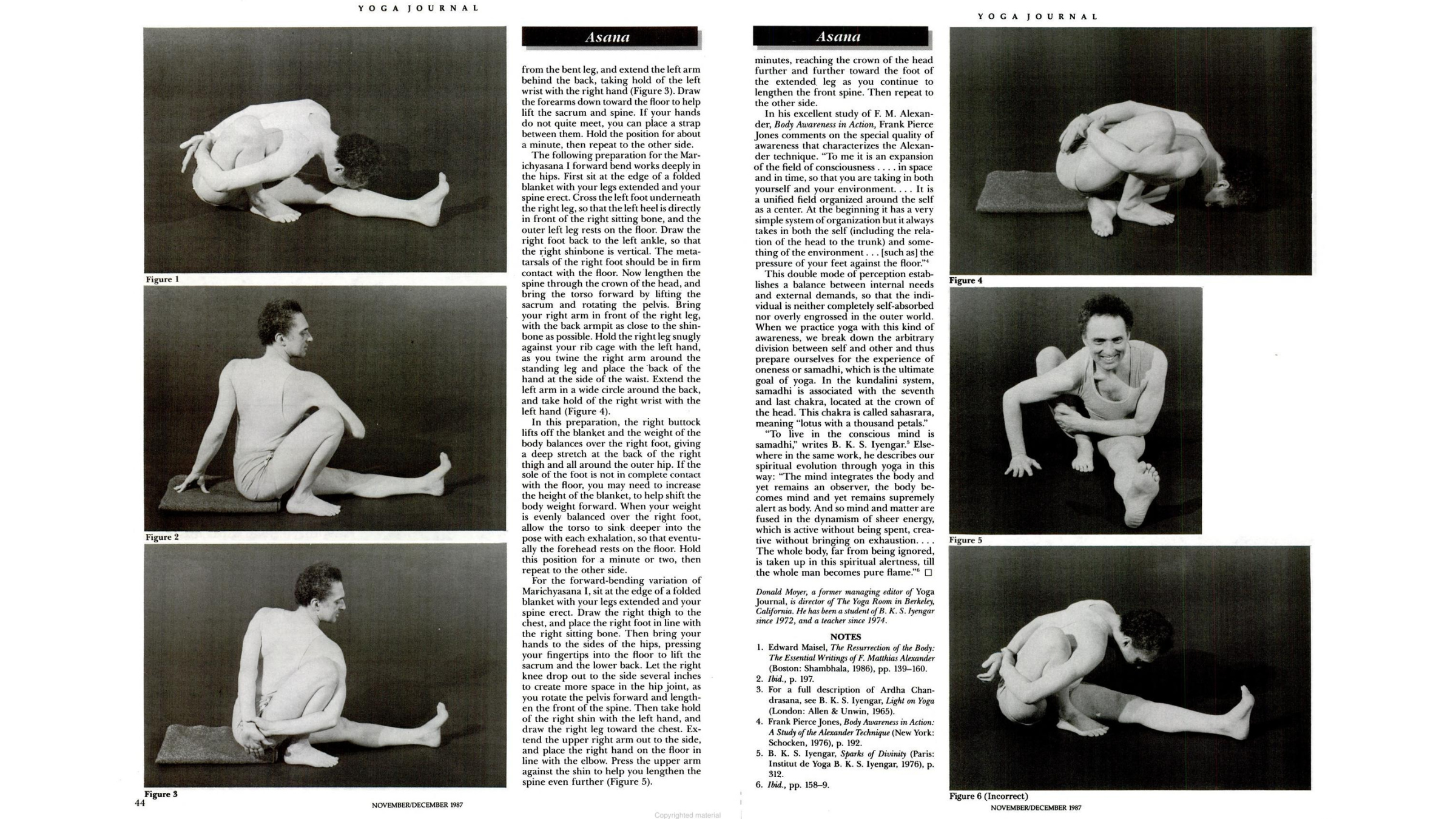
The head may turn either over the left shoulder or forward to look at the left foot (Figure 2). More flexible students may complete the Pose Dedicated to the Sage Marichi I twist by entwining the arms as follows. From the initial twisting position, turn the torso to face the extended leg, and lengthen the front of the spine forward, so that the right armpit slides down the right shinbone. Circle the right arm around the bent leg, placing the back of the hand at the right side of the waist. Then twist the rib cage away from the bent leg, and extend the left arm behind the back, taking hold of the left wrist with the right hand (Figure 3). Draw the forearms down toward the floor to help lift the sacrum and spine. If your hands do not quite meet, you can place a strap between them. Hold the position for about a minute, then repeat to the other side.
Variation 2: Seated Forward Bend
The following preparation for the Pose Dedicated to the Sage Marichi I seated forward bend works deeply in the hips. First sit at the edge of a folded blanket with your legs extended and your spine erect. Cross the left foot underneath the right leg, so that the left heel is directly in front of the right sitting bone, and the outer left leg rests on the floor. Draw the right foot back to the left ankle, so that the right shinbone is vertical. The metatarsals of the right foot should be in firm contact with the floor. Now lengthen the spine through the crown of the head, and bring the torso forward by lifting the sacrum and rotating the pelvis. Bring your right arm in front of the right leg, with the back armpit as close to the shinbone as possible. Hold the right leg snugly against your rib cage with the left hand, as you twine the right arm around the standing leg and place the back of the hand at the side of the waist. Extend the left arm in a wide circle around the back, and take hold of the right wrist with the left hand (Figure 4).
In this preparation, the right buttock lifts off the blanket and the weight of the body balances over the right foot, giving a deep stretch at the back of the right thigh and all around the outer hip. If the sole of the foot is not in complete contact with the floor, you may need to increase the height of the blanket, to help shift the body weight forward. When your weight is evenly balanced over the right foot, allow the torso to sink deeper into the pose with each exhalation, so that eventually the forehead rests on the floor. Hold this position for a minute or two, then repeat to the other side.
For the forward-bending variation of Pose Dedicated to the Sage Marichi I, sit at the edge of a folded blanket with your legs extended and your spine erect. Draw the right thigh to the chest, and place the right foot in line with the right sitting bone. Then bring your hands to the sides of the hips, pressing your fingertips into the floor to lift the sacrum and the lower back. Let the right knee drop out to the side several inches to create more space in the hip joint, as you rotate the pelvis forward and lengthen the front of the spine. Then take hold of the right shin with the left hand, and draw the right leg toward the chest. Extend the upper right arm out to the side, and place the right hand on the floor in line with the elbow. Press the upper arm against the shin to help you lengthen the spine even further (Figure 5).
When there is no gap between the inner right thigh and the rib cage, you are ready to complete the pose. Hold the right leg in position with the left hand, as you twist the right arm around the bent leg, placing the back of the hand against the outer waist. Then release the left hand from the right shin, and roll the left shoulder toward the ceiling to open the left side of the chest. Extend the left arm behind the back, taking hold of the left wrist with the right hand (Figure 1).
When the arms are entwined behind the back, it is time to look inward to adjust the balance of the pose. Notice first how the shoulder on the bent-leg side tends to hunch toward the ear in this position, causing the right side of the rib cage to overextend and the left side to contract (Figure 6). To correct this imbalance, draw the right sitting bone back toward the floor, and lengthen the left side of the rib cage forward. The shoulders should be level, and both sides of the rib cage should be evenly extended. The left thigh should remain firm, with the knee and foot pointing directly toward the ceiling (Figure 1).
The Pose Dedicated to the Sage Marichi I seated forward bend often gives a feeling of confinement or slavery—the arms are handcuffed around the bent leg, the shoulders are hunched in an attitude of despair, and the weight of the head hangs wearily down.
For me, freedom in this pose comes only when I bring my awareness to the movement of the head and neck. Therefore, instead of dropping the head forward, keep the crown of the head in line with the tailbone, and, as you draw the shoulders back, think of lengthening the front of the cervical spine. This inner movement calls into play the deeper muscles of the neck and allows the surface muscles to relax, so that the sides of the neck grow long and the front brain feels light and clear. Hold this position for one to two minutes, reaching the crown of the head further and further toward the foot of the extended. leg as you continue to lengthen the front spine. Then repeat to the other side.
Expanding Your Body’s Awareness
In his excellent study of F. M. Alexander, Body Awareness in Action, Frank Pierce Jones comments on the special quality of awareness that characterizes the Alexander technique.
“To me it is an expansion of the field of consciousness […] in space and in time, so that you are taking in both yourself and your environment […] It is a unified field organized around the self as a center. At the beginning it has a very simple system of organization but it always takes in both the self (including the relation of the head to the trunk) and something of the environment […] [such as] the pressure of your feet against the floor.” This double mode of perception establishes a balance between internal needs and external demands, so that the individual is neither completely self-absorbed nor overly engrossed in the outer world.
When we practice yoga with this kind of awareness, we break down the arbitrary division between self and other and thus prepare ourselves for the experience of oneness or samadhi, which is the ultimate goal of yoga. In the kundalini system, samadhi is associated with the seventh and last chakra, located at the crown of the head. This chakra is called saharara, meaning “lotus with a thousand petals.”
“To live in the conscious mind is samadhi,” writes B. K. S. Iyengar.’ Elsewhere in the same work, he describes our spiritual evolution through yoga in this way: “The mind integrates the body and yet remains an observer, the body becomes mind and yet remains supremely alert as body. And so mind and matter are fused in the dynamism of sheer energy, which is active without being spent, creative without bringing on exhaustion […] The whole body, far from being ignored, is taken up in this spiritual alertness, till the whole man becomes pure flame.”