
Published October 21, 2026 10:10AM
In Yoga Journal’s Archives series, we share a curated collection of articles originally published in past issues beginning in 1975. This article about Karnapidasana first appeared in the November-December 1993 issue of Yoga Journal. You can find more of our Archives here.
Much of our yoga practice has to do with discovering our potential for boundlessness; it’s about going beyond who we think we are and what we think we can do. But that journey is only possible when we have a secure and stable base from which to extend. Creating this base involves knowing how to set boundaries and limits—and learning how to contain our energy within them, when necessary. When we draw our mind and body centripetally inward (rather than flinging it centrifugally outward), we develop the ability to cradle and nurture our feelings, to allow them to well up and reach their own fullness and clarity, rather than expressing them prematurely or inappropriately.
These two psychological attitudes boundlessness and boundary making find their counterparts in the physical movements of extension and flexion.
Flexion is the folding of body parts toward the center or the navel, and extension is expanding or reaching away from the center. Prolonged flexion naturally creates the impulse to extend—and prolonged extension makes us want to flex. In the ancient Chinese symbol representing yin and yang (Figure A), the symmetrical arrangement of the dark yin and the bright yang is not static. As Fritjof Capra suggests in The Tao of Physics, “the two dots in the diagram symbolize the idea that each time one of the two forces reaches its extreme, it contains in itself already the seed of its opposite.” In the same way, when we reach an extreme in the extended movements of our life, we may find ourselves suddenly turning inward—either willingly or unwillingly, as is often the case with illness or crisis. We can trust that this new direction will bring us back to balance.
When we fold the body inward, we shift from the “acting and doing” state to the “feeling and being” state. The pose we are going to look at today, Karnapidasana (literally, Pain in the Ear Pose), is a wonderful example of turning back into ourselves for rest and replenishment.
The classical version of Karnapidasana is not a pose for beginners. It should not be attempted until Shoulderstand (Salamba Sarvangasana) and Plow Pose (Halasana) have been mastered. Because of the extreme degree of flexion throughout the entire spinal column, it is essential that the body be conditioned through more moderate poses. In particular, the muscles along the back of the neck need to be pliant and receptive. Students can prepare by gradually increasing the time they hold Shoulderstand and Halasana until these poses can be held for five minutes and one minute respectively without discomfort either during or after the practice.
There are, however, more accessible movements that simulate the physical position and the development of tonal reflexes, as well as the psychological release, experienced in Karnapidasana. Even more advanced students can benefit from practicing these simple preliminary movements.
Preliminary Practice: Head to Tail Push Pattern
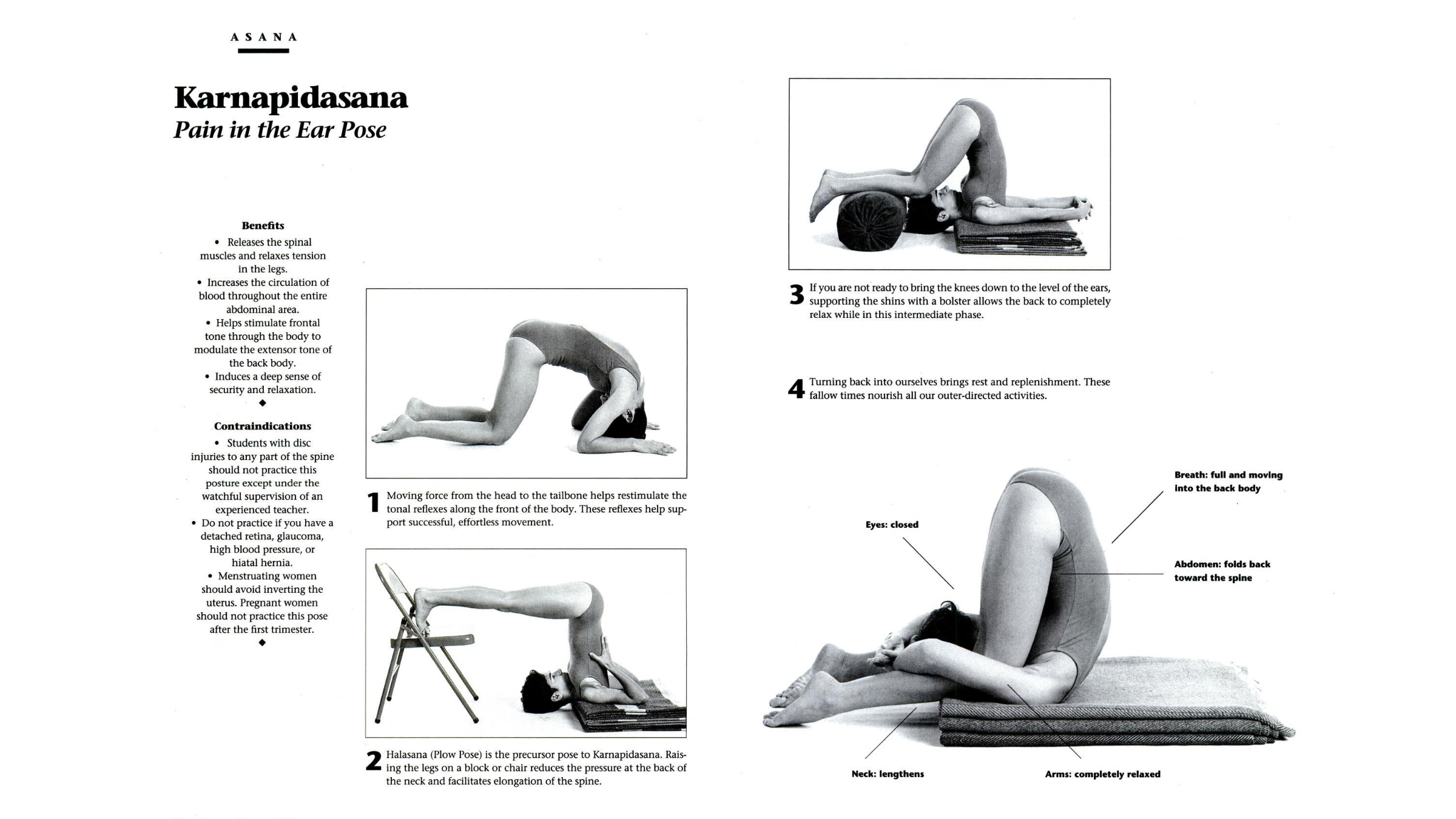
Kneel in Child’s Pose with the forehead on the floor. Place your hands in front of you with the elbows on either side of the head. Initiate a push from the tail and spine to roll forward to the top of the head, allowing the vertebral column to round into a curve. Continue rolling onto the back of the skull as if to look back at your navel (Figure 1). Then push the head against the floor to roll back through the spine into Child’s Pose again.
Use relaxed, folded arms and legs to support but not to initiate the movements.
This exercise will create a tone through the tissue and viscera that is different than the kind of tone experienced by contracting the muscles. Repeat 10 times, feeling how the frontal tone of the body supports the anterior spine. Then relax for a few moments in Child’s Pose before sitting up.
Beginner’s Inversion Practice
Karnapidasana is usually practiced after Shoulderstand or Plow Pose. To prepare for any of these postures, the shoulders should be supported by three to four folded blankets while the head rests on the floor. After staying in Sarvangasana for three to five minutes, lower the legs slowly into Plow Pose. If the hamstrings are so tight that they cause the pelvis and lumbar spine to round, raise the feet onto a folded chair, block, or bench until the spine can elongate freely (Figure 2). Raising the legs will also reduce pressure around the back of the neck and skull. Unlike Karnapidasana, Plow Pose should be practiced with the spine in a vertical line. Reach up through the sitting bones and press down through the outer edges of the shoulders to create more and more space between the vertebrae. This elongation strengthens the back muscles and prepares the spine for Karnapidasana.
On successive exhalations, begin to bend the knees, letting the weight of your exhalation release the spinal muscles. Lowering the knees toward the floor should result from softening and releasing the spinal muscles on each exhalation, not from pulling the knees down with the arms. Keep the toes curled under so you can control your descent, pausing if you observe any sensations of strain in the neck or spinal column.
Because the shoulders are raised three to four inches off the floor by the blankets, do not attempt to bring the knees all the way to the floor. Instead, rest the shins on a bolster or stack of blankets folded slightly higher than the height of the forehead (Figure 3). Completely release the weight of the legs into the support. To release the shoulders, interlock the hands behind your back and extend the arms strongly away from the neck and down into the floor.
Now bend the elbows and place the hands on the back, encouraging the breath to move into the back against the pressure of your palms. Another option is to fold the arms over the backs of the knees. This position is particularly relaxing as the flexion in the shoulders, elbows, and wrists enhances the physiological flexion reflexes. Stay for one to three minutes, continuing to breathe softly into the back. When you are ready to come out, support the spine with your hands and slowly roll down, being careful not to drop the buttocks suddenly off the end of the blankets. Rest for a minute before rolling to your side and sitting up.
Advanced Inversion Practice
While it is important to support the shoulders adequately for Shoulderstand so the cervical spine receives the least amount of pressure, for advanced practice of Karnapidasana you should lower the blanket props considerably (using only one or two blankets). Alternatively, you can avoid disrupting the flow of a practice session by simply moving the shoulders farther onto the blankets so the head and neck are now on the blankets.
This advice may at first seem to run counter to the common (and wise) practice of supporting the shoulders in Shoulderstand. However, Shoulderstand and Karnapidasana place very different stresses on the spine. In Shoulderstand the thoracic spine (upper back) moves in and extends on a vertical axis while the cervical spine (neck) is flexed.
It is very difficult to achieve this spinal extension through the thoracic without decreasing the flexion in the neck by raising the shoulders on folded blankets.
In Karnapidasana, however, the upper back is flexed and rounded, and it is usually more comfortable for the neck to echo the flexion in the thoracic. Experiment for yourself and see if it feels more comfortable in Karnapidasana with less blanket propping. If this approach does not work for you, continue to raise the shoulders on three or more blankets, but don’t bring the knees lower than the forehead.
In the final stages of Karnapidasana the knees will rest on the floor, pressing lightly against the ears (Figure 4). The tops of the feet will rest on the floor behind the head. Close the eyes and allow your attention to move inward. At first breathing may feel difficult as the intense flexion through the frontal body contracts the front of the diaphragm. Some students experience a sense of suffocation.
Usually this is the result of trying to breathe by pushing the abdomen forward (a movement that works against the flexion reflex. In this folded position, the breath will naturally expand more noticeably into the back of the spine. Especially focus on breathing into the kidneys just above the waist on either side of the spine) and broadening and softening the back outward from this point. At the same time, let the abdomen fold back toward the spine and soften through the front of the hip creases so the thighs come closer to the chest.
Stay as long as is comfortable, letting yourself fully absorb the nourishment of this enfolded state. After you roll down out of the pose, give yourself plenty of time to rest in a reclining position. To release the back, bring the knees into the chest with the arms out to the sides; then let the knees roll gently to the right and left several times. Continue to rest with the knees bent, enjoying the deep sense of security and relaxation that often follows after practicing Karnapidasana.