
Published June 28, 2026 05:04AM
Yoga Journal’s archives series is a curated collection of articles originally published in past issues beginning in 1975. This article about Warrior 3 Pose (Virabhadrasana 3) first appeared in the January-February 1995 issue of Yoga Journal.
The Sanskrit verb yuj—the root of the word “yoga”—means “to yoke or harness.” In everyday language, yuj assumed the sense of “unite, connect, add, bring together,” as well as “make ready, prepare, set to work, employ, apply.” Thus, in much of the sacred literature of India, yoga signifies the aim of uniting (or, more accurately, reuniting) the individual soul and the universal soul (Brahman) as well as the preparatory work necessary to bring about this union.
Its oldest application is a relic of a time about 3,500 years ago when Indian warriors rode into battle on chariots. These vehicles typically carried an archer and his driver or charioteer and were drawn by two horses, who had the reputation of being ferocious. “At his deep neigh,” sings one old hymn about the cry of a war horse, “like the thunder of heaven/the foemen tremble in fear.” The charioteer, whose task it was to hitch these spirited beasts to the chariot, needed extraordinary bravery and skill and, as a consequence, his position was highly esteemed.
But the word “yoga” is remarkably flexible and refuses to be bound to one narrow definition. In the classical school of Patanjali, in contrast, yoga is defined as the “restriction of the fluctuations of consciousness,” which is the difficult and risky job of securing the harness on the unruly “horses,” meaning the skittish thoughts and rearing emotions of the mind.
However the supreme attainment is imagined, whether as a blissful merging with the Absolute or the stern quelling of the whirlwinds of mind and nature, yogis agree that yoga is a pragmatic method that largely eschews abstract speculation or philosophizing. This method is generally considered to have two poles—a positive pole that demands intense and persistent exertion and a negative pole that encourages an emotionally detached attitude. The performance of yoga is thus a balancing act between effort and stillness. We must somehow exhibit all the prowess of the charioteer in mastering the horses and yet, as we’re counseled in the Bhagavad Gita, be “indifferent to success or failure.”
This balance is at the heart of asana or yoga postures, one of the chief instruments of self-transformation in the yoga system. The success of any posture is usually measured by Patanjali’s simple criteria of “steady and comfortable.” When we adopt a posture, we want it to be stable but not rigid, restful but not flaccid, so that we release all unnecessary tension and touch the “infinite being within,” again according to Patanjali. The result is a condition of physical and psychological balance or neutrality in which the yogi transcends the constant tug-of-war of the dualities of daily life.
The posture we’re looking at in this article, Virabhadrasana 3, popularly known as a Warrior 3 Pose—provides us with an excellent opportunity to “set to work” developing our balancing skills. Virabhadrasana 3 is named for Virabhadra, the “Blessed Hero” who, according to one version of his tale, was an incarnation of the god Shiva, the archetypal yogi. Virabhadra is definitely not someone you’d like to meet in a dark alley. He’s described as “fierce and terrific,” dripping with blood, sporting a thousand heads, eyes, and feet, wielding the same number of clubs, and holding a blazing bow and battle ax.
The yogis of old, engaged in their relentless assault on the barriers to the soul, at times pictured themselves as the warrior-charioteer preparing for battle with harness in hand, approaching the wild, snorting horses. Outwardly poised and inwardly calm, he is concerned only with the animal’s unpredictable behavior in the present moment; he is artfully balanced between acting and waiting. This balance is not a static thing, but is instead a fluid process, an energetic dialogue between the deep core of the body and the world, which leads to understanding and liberation.
In the words of the Katha Upanishad, “He…who has the understanding of a chariot-driver, a man who reins in his mind, he reaches the end of his journey.”
How to Find Balance in Warrior 3 Pose
On the physical level, there are two things that are vital to balance in a yoga posture. The first is a fixed center or fulcrum in the body around which the posture turns, and through which the energy of the body is organized and channeled. This center of gravity is cradled near the bottom of the pelvic basin (at least for the purposes of this article—remember that the center is not static, but shifts as you lean and reach and bend). This spot is something like the six-inch mark on a foot-long ruler.
The second factor essential for balance is a support or anchor. Different kinds of postures are supported by different parts of the body, such as the legs in standing postures or the arms in Headstand. But in all the postures you should ideally sense a direct link and energetic “feedback loop” between the body’s center of gravity and the support. Moreover, you should sense that the support links your own gravity center with that of the ultimate “ground” or support for everything we do, the Earth. If we are “up in the air” and disconnected from one or both centers, then our “posture” in the world, whether mundane or spiritual, will be neither steady nor very comfortable.
How can you tell if you’ve created such a balanced state? There are two things to look for: a smooth and easy breathing rhythm and a feeling of lightness—which implies weightlessness, luminosity, and joy—in body and mind.
The posture is shaped like a capital T, with the arms, torso, and raised leg making up the long horizontal bar and the standing leg the short vertical support. Though the posture looks simple enough, its execution is quite challenging, and few students initially experience Warrior 3 as “steady and comfortable.” But with practice and patience, it will help us define and then directly experience the meaning of balance in yoga.
Below you’ll find two exercises to begin your practice of Virabhadrasana 3. They will acquaint you with your gravity center and its relationship to the posture’s support (the standing leg) and the ground. Following this are two variations of the posture, the first for beginners and the second for more intermediate students.
Prep Exercises for Warrior 3 Pose
Exercise A
Lie on your back with knees bent and feet flat on the floor. Place the feet hip-width apart and a comfortable distance from the buttocks with your toes slightly turned in. Keep the thighs parallel. (You can tie a strap around the knees to help hold them in place.) Stretch the arms out to the sides at an angle somewhere between 30 to 60 degrees from the midline of the torso, palms turned up.
Feel the back of the pelvis against the floor. This area is mostly the sacrum bone, which is also the base of the spine. Widen the sacrum away from the midline and lengthen the tailbone, like a monkey tail, along the floor toward the heels. Make the back of the pelvis heavy, as if all of its weight is settling down on the floor, but keep the knees light, so they feel like they could float up to the ceiling.
From the inner groins—where the inner thighs join the bottom of the pelvis or perineum—drop a pair of imaginary lines down through the pelvis toward the floor until they converge at a point just in front of the inner face of the sacrum. This is our bull’s eye, the body’s center of gravity.
Now lift the right foot off the floor and circle the knee slowly in wide circles, first in one direction for a few turns, then in the opposite direction. The actual movement here is the rotation of the ball-shaped head of the thigh bone in the hip socket, which cups the ball securely and which is closer to the front of the pelvis than the back. But for the purposes of this exercise, visualize that the head of the thigh bone is rooted deep in the pelvis and that the ball is rolling around and around on the inner face of the sacrum.
Take some time to yoke your awareness to your gravity center. Then, with an exhalation, push out from there through the heel and straighten the leg onto the floor. Do this a few times to really experience the movement from your gravity center through the leg to the heel. Then bend both knees again and repeat on the left side.
Exercise B
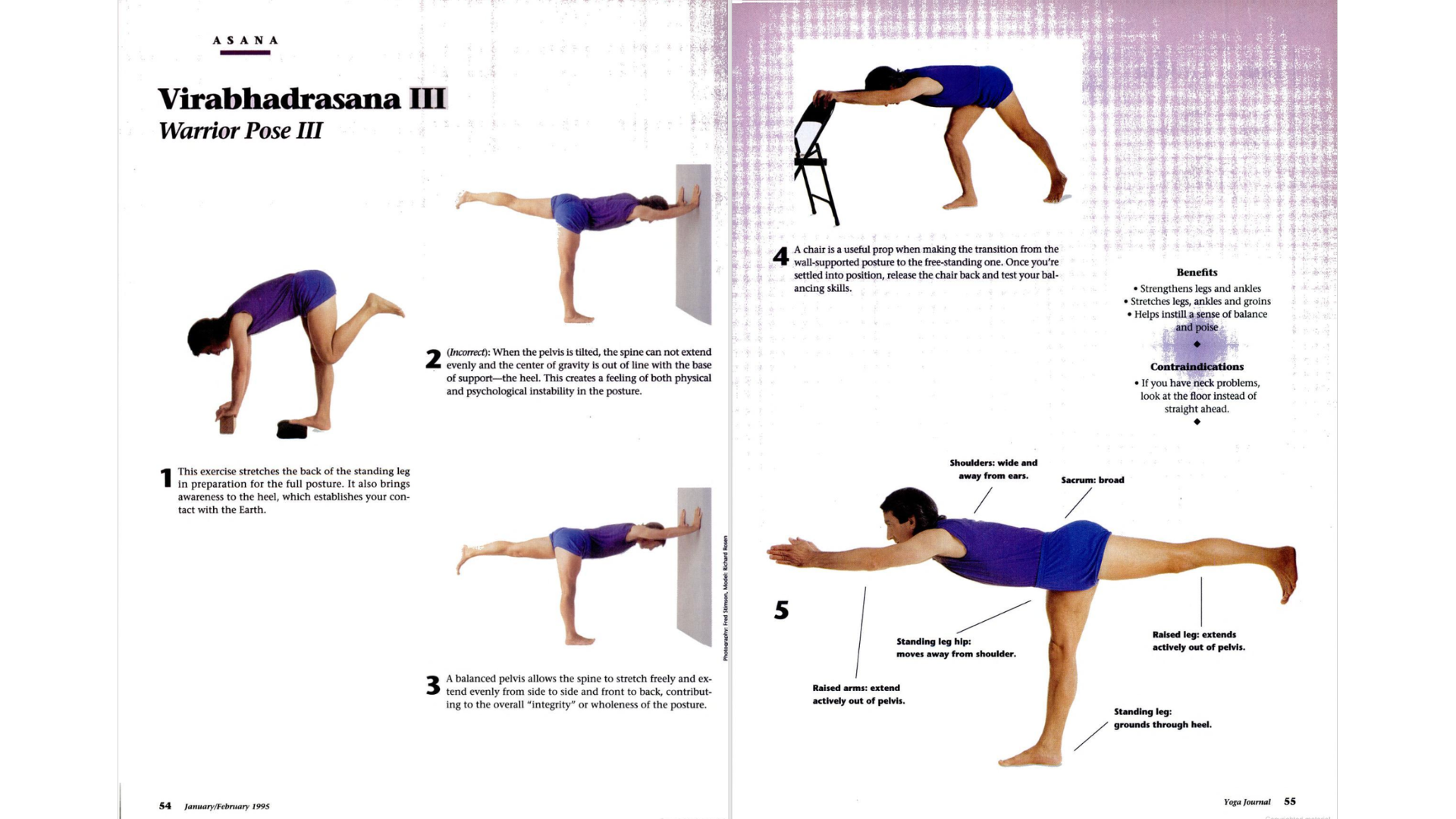
Stand with the ball of the right foot on a sandbag (or other firm support) and the heel on the floor. With an exhalation, come into a forward bend. The ball of the foot should be lifted enough to stimulate the back of the leg, but not so high that the exercise becomes painful. If you can’t touch your hands to the floor, or if you can but your lower back feels strained, then support the hands at a comfortable height (for example, on a block or a chair seat). Bring the left heel to the buttock and hang the left knee beside the right (Figure 1).
Now bend the right knee, keeping the heel on the floor. Exhale and consciously push the right knee back to straighten the leg. (But be careful, especially if you tend to “lock” or hyperextend the knee: As in all standing postures, keep the center of the kneecap looking straight ahead, not allowing it to become “cross-eyed,” or rotated inward.) Try this exercise a few times, and pay particular attention—you’ll understand why soon—to the feeling in the knee and heel.
Bend the right knee again. This time, instead of pushing the knee back, visualize yourself pushing down from the gravity center through the heel and the heel boring slowly through the floor and the 3,900 or so miles of Earth to the solid core of the planet. Receiving the “rebound” as the core pushes back, allow the pelvis to lift. From the height of the pelvis push down more, and so on. In this ways you’ll gradually straighten the leg, not by locking the knee, but by moving its two “end points” farther and farther away from each other, balancing action and receptiveness.
Do this a few times until you feel as if your center is connected to the center of the planet. Then ask yourself: How does my knee feel now? And what about my heel?
Beginner’s Practice of Warrior 3 Pose
Exercise A
You’ll need a wall for this variation. Spread your hands about hip height on the wall, slightly higher if you’re tighter in the shoulders or armpits. Check that the hands are equidistant from the floor and that the index fingers are parallel or slightly turned out. Walk back enough to form a right angle, so the arms and torso are long and parallel to the floor and the legs perpendicular. Keep the ears between the arms and the upper back as broad as possible, so that the shoulder blades widen away from the spine and draw down to the waist.
Bring the feet together, exhale, and bend the left knee into a V shape with the kneecap at the bottom of the V pointing toward the floor. Next bend and straighten the right knee a few times, as you did in the previous exercise, driving the heel deep into the Earth. Make sure that the sole of the standing foot and its toes are not gripping the floor, but open the sole and make the toes lively.
Now shift awareness to your left leg and again push from the gravity center to the heel, so that the left leg stretches out parallel to the floor. It will be much harder to get a handle on pushing through the left leg because there’s nothing to push against except air. So imagine that the wall has somehow crept toward you and that you’re shoving it back where it belongs.
Check the position of the pelvis. It’s common for the standing leg side of the pelvis to slant toward the floor and curl up toward the shoulder, compressing the right side of the spine and torso (Figure 2: Incorrect). To correct this, first shift the center of the pelvis over the standing foot. Then lengthen back through the outer right hip and drop the left hip to bring the front of the pelvis parallel to the floor. When the pelvis is balanced in this way, the spine can extend evenly side to side and front to back (Figure 3).
The thrust of the raised leg out of the gravity center should generate a “counter thrust” from the same point through the spine and arms. Stick your palms to the wall and feed the rest of the body into the raised heel, then stretch the heel toward the opposite wall and feed the body into the hands. Oscillate back and forth between heel and palms, integrating the arms and legs through the center of gravity, as if pushing the walls farther and farther apart. Elongate the tailbone toward the raised leg heel and the top of the breastbone out through the arms.
See if you can now embody both effort and stillness in this position. Like the charioteer, the arms and legs, which the yogis call “organs of action,” steer the tremendous energy that Virabhadrasana 3 unleashes. The “organs of knowledge” or perception, including the eyes, ears, and skin, should receive and observe this energy.
If you have any neck problems, look at the floor, not at the hands. But if you can maintain the width of the upper back and the descent of the shoulder blades to the waist, then bring the head up, lifting the base of the skull off the back of the neck. Hold for one to two minutes and repeat on the left side.
Exercise B
The instructions for the first variation all apply to the second. The differences here are the brace for the hands and the manner of getting into the pose. Place a chair to your right side, spread your feet about three feet apart, and turn your right foot out 90 degrees and your left foot in about 60 degrees. Exhale and rotate your torso to the right—initiating the twist from the gravity center—so the front of the pelvis is about parallel to the chair back. Bend the right knee, reach out for the chair back—you can either grip the back firmly or rest your outer wrists on it, palms facing—then, with an exhalation, push from the gravity center to the heel to straighten the right leg. As you do this, gracefully raise the left leg and slide the chair away from you to straighten the arms (Figure 4).
Once you’re anchored in place, see if you can gradually let go of the chair back. As with all props, the chair is only a temporary measure that should be phased out as you become more steady and comfortable in the posture. Stay for a minute and repeat on the left.
Intermediate Practice of Warrior 3 Pose
Virabhadrasana 3 is traditionally entered from one of its companion variations, Virabhadrasana I (Warrior 1). (You can find an illustration of this posture in any standard yoga manual, such as Light on Yoga by B.K.S. Iyengar or The Runner’s Yoga Book by Jean Couch.)
To enter Virabhadrasana 1, step the feet about one leg’s length apart, turn the right foot out 90 degrees, and the left foot in about 60 degrees. Pivot the hips to face toward the right toes, bend the right knee to a 90-degree angle, and lift the arms over your head. From Virabhadrasana I, exhale and extend the torso out over the bent-knee thigh. At this point, I like to press my right hand to the outside of the knee and the left hand to the inside, and shift the torso slightly to the right to bring the midline directly over the thigh. Then reach the arms out again and lift into the posture with an exhalation. As with all balancing postures, it helps to fix the gaze on a steady point straight in front of you (Figure 5).