
Published September 4, 2026 03:36AM
In Yoga Journal’s Archives series, we share a curated collection of articles originally published in past issues beginning in 1975. This article about hip openers in yoga first appeared in the November 2003 issue of Yoga Journal. Find more of our Archives here.
Several years ago, When I was visiting Mexico, I saw a huge and beautiful tree. Above its powerful trunk, it had for some reason split apart many decades ago. A few years later, when my travels took me back to that same place, I regretfully saw that the tree had broken apart, fallen, and eventually died.
Even though it had a sturdy trunk, its two main branches had grown farther and farther in separate directions, and this expansion had been the mighty tree’s undoing. The tree serves as a lesson for all of us, not just in a challenging hip opener like Pose Dedicated to the Sage Vamadeva II (Vamadevasana II) but throughout our lives.
Duality exists so we can understand unity; without duality, oneness would have no meaning. As in the universe, so in our bodies. Our work in yoga is to understand the dualities inside us and bring them together to create a harmonious, integrated whole.
In sitting postures, for example, the intentional rooting of the sitting bones is what allows the recoil of the energy of the perineum upward. In standing poses, the pressing of the mounds of the toes and the heels into the earth is what allows the upward recoil of the arches and the inner legs. In inversions, when we lift without simultaneously descending earthward, we become either light-headed or wobbly, especially in Headstand (Sirsasana). And in Shoulderstand (Sarvangasana), if we try to lift the spine without simultaneously dropping the shoulders, we become very tense, the neck and throat become hard, and we forgo the benefits to the nervous system the pose can offer.
In any of these poses, trying to lift without the opposing action of grounding gives us little effect; indeed, it may drain our energy reserves. To receive the effects of the pose, we must consciously move in opposite ways simultaneously. And to accomplish this, we must bring our consciousness fully into the present, creating mindfulness.
Indeed, the duality of action is precisely what helps us achieve such a singular state of mind: To rise to the challenge of doing two opposing things at once, we are forced to be focused and unified—yet creative, perhaps moving in ways we have never moved in before.
A Hip Opener That Harnesses Duality
In Pose Dedicated to the Sage Vamadeva II, this inner process of harnessing duality to achieve unity clearly manifests itself. We use one side of the body to pull the pelvis forward and the other side to pull it back in this pose, challenging ourselves to find the still center where we tip in neither direction, where the duality is perfectly balanced.
Pose Dedicated to the Sage Vamadeva II provides a great opportunity to experience this rhythm of expanding away from the center and returning to it. In this hip opener, one hip rotates externally and the other hip rotates internally. These two powerful movements are then balanced as we bring the feet together in a beautiful (and advanced, so optional) Anjali Mudra, centering what otherwise could turn into an unrestrained expansion.
4 Hip Openers to Try Before Pose Dedicated to the Sage Vamadeva II
Pose Dedicated to the Sage Vamadeva II is an extremely challenging pose. Warm up each part of your body and approach the shape with thought, care, and safety in mind.
1. Ankle-to-Knee Pose
Begin with Ankle-to-Knee Pose (Padasthila Janurasana). For most people, this pose offers a safe way to create external rotation in the hip joints without stressing the knees. For that purpose, it is far more effective than Lotus Pose (Padmasana); in my teaching, in fact, it is a prerequisite for Lotus.
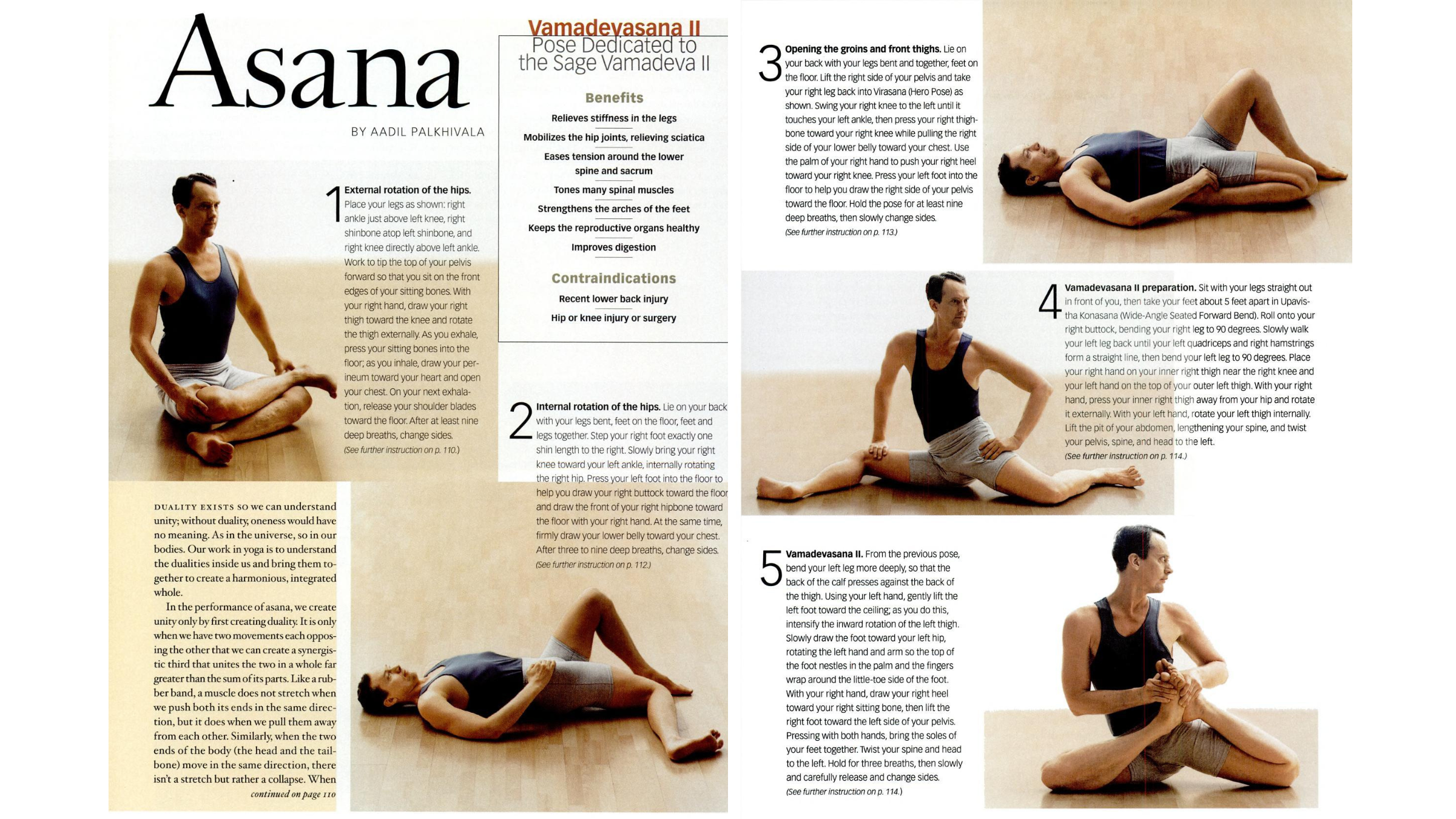
To come into the pose, sit erect with both legs stretched straight out in front of you in Staff Pose (Dandasana). Bend both legs to 90 degrees. Externally rotating your left thigh, place the left knee and ankle as close to the floor as possible, so your shinbone is parallel to the front of your torso.
Place your right shin directly on top of your left, with the outer edge of your right shin just above the anklebone resting on your left inner thigh just above your left knee. Do not bend your legs more than this. Your right shin should be on your inner left thigh just above the left knee, and your right knee should be directly above your left ankle. Spread the soles of your feet, pulling the outer edge of your left foot toward your right foot and the outer edge of your right foot toward your left foot.
Press the fingertips of your left hand into the floor next to your left buttock, cupping your palm, lifting energy up from the earth into your arm and lifting the left side of your chest. Reinforce the lift of the back of your pelvis so your sacrum remains perpendicular to the floor or leaning slightly forward. Placing your right hand on your right thigh, firmly pull your thighbone toward the knee and rotate the thigh externally.
Next, lift the pit of your abdomen and the energy of your pelvis toward your heart center. When you do this, you will feel a sense of lightness in the pelvis, as if weight has been lifted off the hip and space has been created in the joint. Taking advantage of this increased freedom, use your buttock muscles to rotate the right thigh externally.
At the same time, use your right hand to continue rotating the thigh until your inner thigh faces the ceiling and your right knee willingly descends toward your left ankle. These intense rotations in the right hip should be performed during exhalations; the inner actions of lifting the pelvic energy should be performed during inhalations.
Though the work in this pose is primarily intended to increase external rotation in the right hip, many students experience an equally intense stretch in the left hip. Do not be concerned if this is the case for you; it simply means you need more external rotation in both your hips to move further into the pose.
However, if you find this position extremely painful in your hips, or if your pelvis and lower spine are collapsing back, making you feel hunched, you should modify the pose. Try sitting with your back near a wall; slowly wiggle your buttocks back, bringing your sitting bones as close to the wall as possible. Pressing your back against the wall to increase the leverage of your right arm, use the arm to rotate the right thigh externally and to push it away from the hip. If you are still rounding your lower back and experiencing intense hip pain in this variation, straighten your left leg and place your right outer ankle on your left thigh one inch above your left knee.
Whichever version of the posture you choose, drop your shoulder blades and spread them apart. Breathe deeply and visualize your right thighbone rotating externally inside the right hip socket. Open your heart center, allowing your lungs to expand. Stay here for nine or more breaths.
Release by slowly lifting your right knee, pulling the thigh up with your right hand if necessary. Then repeat the pose with your left leg on top of your right. After doing both sides, straighten both legs into Staff Pose and squeeze them together firmly. This will prevent your hips from becoming unstable after such an intense stretch.
2. Windshield Wipers
Although Pose Dedicated to the Sage Vamadeva II requires a strong external rotation in one leg, it requires an equally strong internal rotation in the other. Hence, our second preparatory pose works on creating this internal rotation in the hip joint. This movement powerfully stretches the longest muscle in the human body, the sartorius, which originates on the jutting hip point at the front of the pelvis, reaches down across the thigh, and attaches on the upper inner edge of the shinbone.
This compensation may still be needed to keep your knee stable, so you should approach this pose slowly and very mindfully. Concentrate on your inner knee at every step; if you feel any pain in the knee, immediately take the precautions described below.
Lie on your back with your legs bent, the soles of your feet on the floor, and the inner edges of your feet touching; your heels should be about a foot away from your buttocks. Throughout this pose, do not let your left thigh swing out to the left or in to the right. If you move the left leg, you subtly alter the position of the pelvis and avoid some of the internal rotation work in the right hip.
Now step your right foot one shin length to the right. This is the exact length necessary for your right knee to touch your left heel when you move fully into internal rotation of the right thigh. As you exhale, slowly begin to bring your right knee toward your left heel. As you bring your knee down, lift the outer edge of your right foot so that the sole of the foot remains perpendicular to the shinbone and the relative positions of your foot and ankle remain as if they were in Mountain Pose (Tadasana).
Using your right hand, draw the front of your right pelvic bone toward the floor. Bring your mind inside your right hip; to open the joint, simultaneously draw the right side of your lower belly toward your head and press your right thighbone toward the knee. As you do so, you will feel the thighbone moving slightly away from your pelvis, creating more room for internal rotation. Once this room has been created, use an exhalation to bring your right knee as close as you can to the floor, aiming to place it against your inner left heel. If you experience any pain in your inner right knee, lift the knee slightly and put a support underneath it, then press the knee down into the support.
Remain in the pose for three to nine breaths, releasing your hip on each exhalation and pulling the energy of the pelvis toward your heart on each inhalation. Then, slowly release: Gently lift the right knee and walk or slide the right foot toward the left until both feet are together.
Repeat the pose on the other side, then stretch your legs out on the floor with your knees straight. To restabilize the hip joint after you’ve opened it in such a powerful and perhaps unfamiliar way, squeeze your legs together and hold this action for three to five breaths.
3. One-Legged Reclining Hero Pose
Our next pose, One-Legged Reclining Hero Pose (Eka Pada Supta Virasana), opens the front of the thighs and the groins. To come into this pose, lie on your back with your legs bent, feet together on the floor and heels about a foot away from your hips. Lift your right pelvis, tilting your body to the left, then draw your right foot and shin into Hero Pose. (Caution: This pose should never be done with the other leg straight; straightening the leg distorts the pelvis and compresses the sacroiliac joints.) Slowly move your right knee to the left until your right inner thigh touches your left ankle. Exhaling, push your right thighbone toward your right knee while drawing the right side of the pit of your abdomen toward your head. Place the heel of your right palm on your right heel and push the heel toward your right knee. Press your left foot into the floor to help recoil your right pelvis and buttock toward the floor, intensifying the stretch on the front of your right thigh.
Finally, work to bring all five toes of your right foot onto the floor and spread them apart. Keep your throat relaxed and breathe deeply, stretching your groin on each exhalation and opening your chest on each inhalation. If you find you can’t move the right leg fully into Hero with your back on the floor-or if the intensity of the stretch in the front of your right thigh is intolerable-do the pose by reclining on a bolster that supports your buttocks and your whole torso and head. (The bolster lifts your pelvis and decreases the stretch on the front of your right thigh.) To further decrease the intensity of the pose, put an extra bolster under your chest and head. If you don’t have bolsters handy, you can ease the intensity simply by lifting your back and head and coming up onto your elbows. Whichever variation you choose, hold the pose for at least nine breaths. Then slowly tilt your pelvis to the left, release your right leg, and repeat on the other side.
4. Wide-Angled Windshield Wipers
To move into Pose Dedicated to the Sage Vamadeva II, sit on the floor with your legs spread wide apart in Wide-Angled Seated Forward Bend (Upavistha Konasana). Lifting your left buttock off the floor, roll onto your right but-tock, bringing your outer right leg to the floor and your inner left leg toward the floor.
Slowly bend your right leg to 90 degrees so that your right shinbone is perpendicular to your right thighbone, and carefully walk your left leg back until your left quadriceps and right hamstrings form a straight line. Then bend your left leg so that your left shinbone is perpendicular to your left thighbone. Draw the outer edges of each foot back so that your feet and ankles are active, as in Mountain.
Place your left hand on your upper left thigh and your right hand on your inner right thigh, just above your right knee. Pressing your right hand into your right leg, rotate the leg externally. Using that pressure, lift your spine and elongate the right side of your waist toward the front of your right armpit. Then slowly rotate your left hip internally with the left hand.
Contracting and lifting the perineum to bring its energy up through your body, twist your spine to the left and let your head follow your spine (Figure 4). From this position, bend your left leg more deeply, bringing your left heel toward your left sitting bone so that your calf presses against the back of your hamstrings.
How to Practice Pose Dedicated to the Sage Vamadeva II
Reach the palm of your left hand over the instep to grasp your foot. Then, carefully rotating your left thigh internally even more, gently but firmly lift your left foot, drawing it toward the front of your left hipbone. As you bring the foot up, rotate your left hand and arm so that the top of the foot nestles into your palm and your fingers wrap around the little-toe side of the foot.
Next, bend your right leg more deeply and grasp your right foot by reaching your right hand over your right instep. Inhaling, lift the energy of your perineum up the spine; exhaling, lift your right foot toward the front of your left hip while pushing your left foot to the right, bringing your feet together.
As the feet join, lift the energy of your spine and twist your body to the left, looking over your left shoulder (Figure s) Release both shoulder blades down your back and spread your elbows wide. Continuing to press your left foot to the right and to rotate your left thighbone internally, counterrotate your pelvis to the left. This will create an intense stretch in the deep muscles of your left hip joint, especially the rotators.
Quiet the mind and hold the pose for three breaths. Then slowly and carefully release your legs, bringing both feet down to the floor. Return to Wide-Angle Seated Forward Bend, then do Pose Dedicated to the Sage Vamadeva II on the other side.
As you move deeply into this pose, the effects on the lower abdomen are similar to wringing dirty water out of a towel. To wring out a towel, your two hands must rotate in opposite directions. In the same way, when one leg is rotated externally and the other leg is rotated internally, the lower abdominal organs are squeezed and wrung out, removing residual toxicity.
Integrating Your Explorations
As you work in Pose Dedicated to the Sage Vamadeva II, you will feel the duality of the action in your legs creating a singular inner strength in the pelvis, as well as in the humble unified Anjali Mudra that occurs when the soles of your feet greet each other. As you enter deeply into this pose, you will begin to discover in your body the meaning of the words of the Indian sage Sri Aurobindo:
“The Two who are one are the secret of all power, / The Two who are one are the might and right in things.”