
Published August 17, 2026 10:55AM
Yoga Journal’s archives series is a curated collection of articles originally published in past issues beginning in 1975. This article about Lord of the Fishes Pose (Ardha Matsyendrasana I) first appeared in the May-June 1992 issue of Yoga Journal.
Awareness of the lower abdomen is especially important in sitting twists such as Lord of the Fishes Pose (Ardha Matsyendrasana I). In this seated spinal twist, the tendency is to twist from the upper abdomen by squeezing the diaphragm and contracting the rib cage.
Yoga is, among other things, the exploration of our relationship with this unbounded space—both outside us and inside us. One important way we experience the space that surrounds us—the outer world—is through the physical effects of gravity.
As Ida Rolf declares, “The gravitational field of the Earth is easily the most potent physical influence in any human life.” In our practice of hatha yoga, we learn how not to be defeated by the forces of gravity, but to make them work for us in positive ways. In our practice we often take the same configuration of the body and position it differently in space.
Yet the experience of each pose is unique because gravity affects us differently in each one. Not only do we feel the muscles stretching in different directions and with different intensities, but our physiological or emotional response is different as well.
When we move from investigating our physical relationship with the space outside our body to exploring the dynamics of the space inside our body, we enter a different realm. For as we learn to release tension and create more space within the body, we begin to make contact with an internal source of energy which feels infinitely expansive, yet totally self-contained.
How to Practice Your Seated Spinal Twist
In the following preparatory exercises using a chair, we will attempt to broaden the base of the lower abdomen and allow the spine to grow from there. Then the diaphragm can remain soft and wide.
1. Sage’s Pose
For the following variation of Sage’s Pose (Marichyasana III; often practiced as a preparation for Lord of the Fishes), place the back of your chair against a wall or other support to prevent it from slipping. Then sit on the floor with the right side of your rib cage touching the front edge of the chair seat, your legs extended in Staff Pose (Dandasana), and your sitting bones at the edge of a folded blanket or bolster about two to four inches high. Bend your right knee and place your right foot on the floor close to your right sitting bone. Your outer right leg should now be resting against the seat of the chair with your right shin vertical.
Make sure you are sitting close enough to the chair that your right leg does not drop out to the side. Shorter people may need to sit on a higher lift so that the chair seat gives adequate support to the outer leg. Now turn toward the chair and extend your left arm toward the back of the seat.
Let your upper left arm rest against your right knee as close to the back armpit as possible. Take hold of the back edge of the chair seat with your left hand and place the fingertips of your right hand on the floor behind you. If you can’t reach the floor without rounding your spine, use a block under the hand.
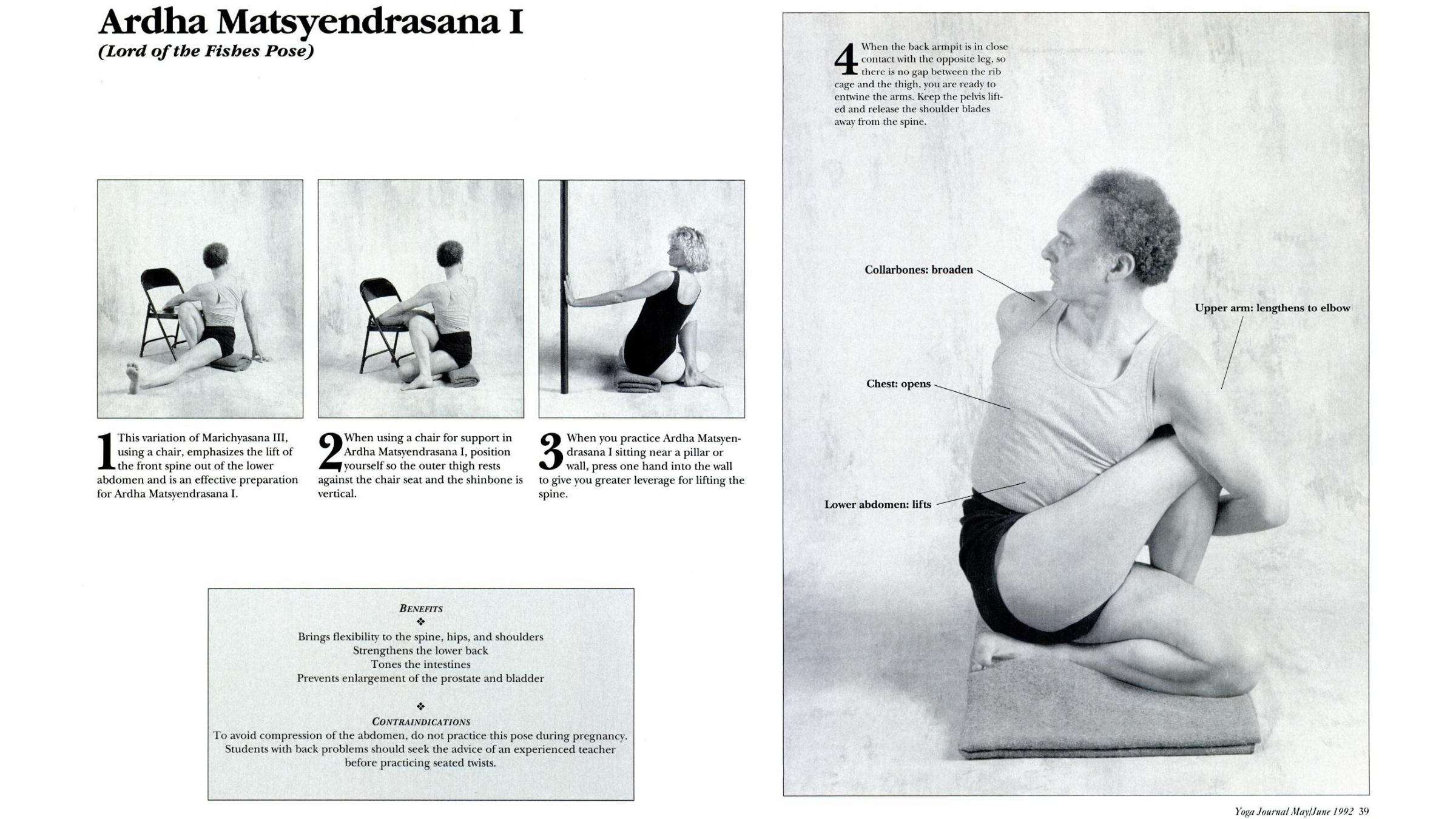
Then lean back as though you were hanging from the left arm. Release the left shoulder blade away from the spine and lift the lower abdomen out of the pelvic basin, so the twisting movement starts from the base of the spine. As your chest lifts, roll your right shoulder back and walk your right hand farther behind you (Figure 1). Repeat this adjustment several times, each time moving deeper into the pose. Then release on an exhalation and practice the pose to the opposite side.
2. Lord of the Fishes with Chair
For the following variation of Lord of the Fishes Pose, again place the back of a chair against a wall or other support to prevent it from slipping. Then sit on the floor with your sitting bones at the edge of a folded blanket or bolster about two to four inches in height. Sit with the right side of your rib cage touching the seat of the chair and your legs extended in Dandasana. Bend your right knee, and place your right foot flat on the floor close to the right sitting bone. Bend your left leg and bring your left foot on the blanket under your buttocks so your sitting bones are resting along the inside edge of your left foot. Ideally, the left sitting bone should be pressing the inner left heel, and the right sitting bone should be in contact with the base of the left big toe, so that your pelvis is balanced over the arch of the left foot. (If this is not possible, you may need to place an additional support under your left buttock to keep your pelvis level with the floor.)
When you are sitting squarely on your left foot, cross your right foot over the left leg and place it on the floor parallel to the outer left thigh. Draw the right foot back as far as possible, bringing the toes of the right foot in line with the left knee.
Now adjust your position so that your outer right thigh is in contact with the seat of the chair. You may want to place a folded blanket or mat over the front edge of the chair to support the outer right leg and to keep the right shin vertical. Then extend your left arm to take hold of the back edge of the chair seat.
Take a few moments for your body to adjust to this new position. Release any tension in your left shoulder and let your whole torso drop away from your extended left arm. Now press with your right hand against the chair seat or against a leg of the chair, to help you lift the lower abdomen out of the pelvic basin and deepen into the twist. Repeat this adjustment two or three times, keeping the diaphragm broad and the breath soft. Then release and practice the pose to the other side (Figure 2).
3. Lord of the Fishes with Wall
The next variation of Lord of the Fishes uses a wall (or pillar) for support. Start by sitting about 12 to 15 inches away from the wall, with your back to the wall and your legs extended forward in Staff Pose. Sit with your sitting bones at the edge of a folded blanket about two or three inches high. Then bring your left foot under the sitting bones (as previously described) and cross your right foot over to the outer left leg. Bring the toes of the left foot in line with the right knee if possible.
Notice how the right leg drops away from the torso and the inner right foot tends to come off the floor. Bring your left hand to your outer right leg and draw the right thigh toward the torso, so that the right shin comes to a more vertical position and the sole of the right foot is in full contact with the floor.
Release any tightness in the outer right hip and draw the right thigh closer and closer to the abdomen, using both hands if necessary. (At this point, some students may feel a clenching or gripping sensation in the right inner groin muscles. If you are unable to soften the inner groin and the discomfort persists, try placing a firmly rolled facecloth deep in the right hip crease to create more space in the hip joint and to release the pressure on the groin.)
When the right leg is in position, cross the left arm over the right knee so that the back of the left arm comes into contact with the outer right thigh as near to the back armpit as possible. Keeping the left elbow bent, lengthen the upper left arm out toward the elbow to close the gap between the left side of the rib cage and the right thigh. Then bring your right hand onto the wall at shoulder height and press against the wall to help lift the spine and deepen the twist.
Start the movement with the pelvis, rolling the pubic bone down to release the groins and lifting the lower abdomen out of the pelvic basin so the navel area is freed from behind the bulk of the right thigh. Let your left shoulder blade release away from the spine and move toward the left elbow, so your rib cage turns to face the wall. Remember to keep your breath soft and your diaphragm wide, lifting out of the pelvis on the inhalation and deepening the twist on the exhalation. Hold this position for a minute or two, then release and repeat to the other side (Figure 3).
4. Lord of the Fishes Pose
Sit at the edge of a folded blanket with your sitting bones resting on your inner left foot (as previously described) and your right foot flat on the floor alongside the outer left thigh. Hook your left arm over the outer right knee, and bring your right hand onto a wall or other support.
As you press your right hand into the wall, shift your weight forward onto the right foot, so the weight of the whole upper body is balanced over the right arch. Let your left shoulder blade release away from the spine, and move toward the left elbow, deepening the twist of the rib cage and bringing the back of the left armpit in closer contact with the outer right knee. When you have completely closed the space between the left side of the rib cage and the right thigh, you are ready to entwine the arms. Swing your left arm around the right leg and extend your right arm in a wide circle behind your back. Take hold of your right wrist with the left hand, and draw your forearms down as you lift the spine (Figure 4).
When the arms are locked behind the back, the gross movements of the outer body are no longer possible. Like a fish, you are without either arms or legs and must learn to move with the subtle currents of the inner body.
Press the ball of the big left toe back against the right sitting bone, and lift the pelvis toward the right thigh. Soften and widen the inner groins, so the upper back can widen as well. Letting the shoulder blades release their grip on the back rib cage, broaden the collarbones and turn your head to look over your right shoulder.
If the head of the upper left arm bone (humerus) presses forward in the shoulder joint, movement in the shoulder will be restricted. To create space in the left shoulder joint, let the head of the upper arm bone ease back toward the center of the joint. Then the back of the upper left arm will extend farther toward the elbow, and you can adjust your left hand to hold higher on your right wrist.
Once you have moved deeper into the pose, let the outer body—and in particular the pelvis—remain perfectly still. Let the movement come from the inner body, lifting the front spine out of the broad circular space of the lower abdomen. Do not let the inner body overpower the outer body. If you pull the lower abdominal muscles too heavily toward the right, the pelvis will drop back and the sacrum will collapse. To counteract this tendency, roll the front right hipbone toward the right thigh to stabilize the pelvis, as you draw the lower abdomen in the opposite direction.
Then the lift comes from deep within the core of the lower abdomen, not from the work of the surface muscles. Just as the outer body should not constrict the inner body, the inner body should not overwhelm the outer body. When the outer body is worked aggressively, there is rigidity in the poses and the danger of tearing muscles and injuring joints. When we focus only on the inner body, disregarding the external structure of the pose or working too heavily with the breath, we are more susceptible to physiological disturbances.
Ideally, we want the outer body to work in harmony with the inner body-the outer body providing support and stability, the inner body providing release, lightness, and the expansiveness of space. When this balance is achieved, there is no longer a distinction between inner and outer.