
Published May 29, 2026 12:59PM
“Take a deep breath in,” I say as I slowly walk between mats, even though I am unable to take a deep breath for myself.
The pressure in my abdomen and pelvis builds. It feels like my insides are on fire—not unlike a persistent UTI that won’t go away. I just emptied my bladder before class, but suddenly I’m being signaled to go again. My legs feel weak from numbness and tingling radiating into my feet. The pain makes it hard to breathe, to walk, to think clearly.
On most days, this is my reality as a full-time yoga teacher and studio owner.
For nearly two years, I haven’t gone a single day without relief from constant pain in my glutes, pelvis, and lower abdomen. I get sharp, stabbing flares that can stop me mid-sentence or mid-step. There’s a deep, aching pressure in my back and hips that never fully lifts. Some days it feels like my body is quietly bracing against something it can’t release. Other days, it’s loud and impossible to ignore, disrupting my sleep, movement, and even simple moments like sitting at a table or having a conversation.
I teach people how to feel better in their bodies, yet live in one that doesn’t always let me. I teach people how to move out of pain. Then I go home and manage my own.
Learning to Live with Chronic Pain
Pain has been a quiet constant in my life since I was a teenager. Long before I ever stepped onto a yoga mat, I was learning how to live around discomfort—how to push through, ignore it, explain it, minimize it.
When I was 25, I was diagnosed with endometriosis, a chronic inflammatory disease that can have widespread effects on the body. We’re still not sure if what I’m currently experiencing is tied to the endometriosis, but it’s starting to feel connected. There’s still a lot I don’t understand about what’s happening in my body.
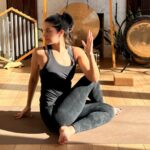
What I do know is that yoga didn’t erase my pain, but it changed the way I relate to it—and over time, how I practice. And because teaching is an extension of that practice, it’s changed the way I show up in the room, too.
5 Ways Chronic Pain Has Changed My Yoga Practice
Some days, the hardest part of teaching yoga isn’t the sequencing or the energy in the room. It’s deciding whether I can sit cross-legged on the floor without making my pain worse. I’m still learning how to live in this body—how to listen, adapt, and meet it where it is each day. Here’s what I know so far.
1. My practice is less about performance
There was a time when my practice felt like something I needed to prove. When I first started doing yoga, I thought—like most people—that it was mainly about the physical postures. So I pushed myself into places I wasn’t ready to explore. I wanted to be seen as strong enough, flexible enough, capable enough to be at the front of the room.
Naturally, that mindset carried into my teaching, until chronic pain disrupted it. Now, there are days I can’t demonstrate much at all. Days where getting up and down off the floor requires careful thought. Days where my body doesn’t match the image of what a yoga teacher is “supposed” to be. Days where I cannot do most of the poses I’m cueing. My practice had to shift.
Now, it’s less about how something looks and more about how it feels—and often, whether it feels manageable at all. Because of that, I no longer feel the same need to perform for other people. I cue more than I show. I rest when I need. I let my students be in their bodies instead of watching mine.
2. I lead with advocacy
Last summer, I took a 50-hour myofascial release training with Tiffany Cruikshank in Boston as part of my 300-hour teacher training. Within the first 20 minutes of sitting at the arranged tables and chairs, my body was already asking for relief.
I struggle to sit comfortably for any length of time—especially on soft surfaces—without worsening the nerve pain in my glutes, legs, and feet. I’ve gotten used to asking for accommodations in places like restaurants or friends’ houses. But in a room full of yoga teachers, I hesitated. I felt embarrassed asking for something different. Still, I knew the alternative: pain, distraction, and disconnection from the experience I had invested time and money to attend. So, I asked for a different setup. It was about honoring what I needed instead of defaulting to what was expected.
That same approach shows up each time I’m on my mat. I reach for whatever props I know will make a difference, even when the teacher says we only need two blocks. I choose other variations of poses when the suggested ones make my symptoms worse. And I encourage my students to do the same.
“I’m here to guide you and offer options,” I tell them. “But you know your body best. You get to decide what you need to feel supported.”
3. I don’t always get to plan
I’ve always been someone who thrives on routine. But living with chronic pain, I don’t get to plan what kind of practice I’ll have ahead of time. I can’t predict how the combination of medications and supplements I take each morning will affect me, or what my level of pain or fatigue will be.
I recently read something that said a healthy person would need to stay awake for three days just to feel a fraction of the fatigue many people with endometriosis live with. Some days, that feels accurate. My symptoms and energy levels fluctuate, which means my practice does, too.
During a flare, I usually crave something slow and supportive—restorative shapes, myofascial release, time on the floor. On quieter days, I might move through a more fluid, dynamic vinyasa practice. Practicing this way has forced me to embody ahimsa, or non-violence, not as a concept, but as a daily decision to show up for myself in love.
4. Chronic pain has redefined what “strength” actually means
There’s an unspoken expectation that yoga teachers are the picture of health—flexible, strong, pain-free. But I’ve built a career in a body that has never fit that image.
Don’t get me wrong, I am strong. Just not in the way most people might assume. I can’t do many “advanced” asanas, or poses, and I don’t practice yoga for hours each day. Some days, I don’t practice the physical aspect of yoga at all. An older version of me would have felt like a fraud owning a yoga studio and teaching full-time without a consistent practice of my own. Like many people, I once defined strength as physical capability, endurance, and intensity.
Now, I understand it differently. Strength is showing up, listening, and adapting. It’s letting go of comparison, respecting my limits, and remembering the cost of overdoing it.
Strength isn’t doing everything—it’s knowing when not to do.
5. I’ve become a more honest yoga teacher
Living in my body makes it hard to pretend.
I don’t demonstrate every pose. I don’t always feel good. And I don’t try to hide that anymore. Sometimes I have to cancel classes because I don’t have the physical or emotional capacity to be present. Even when it comes with guilt, I remind myself to listen to my body the same way I ask my students to listen to theirs.
Because the practice doesn’t end when I roll up my mat—it follows me everywhere. In my classes, I want students to explore what works for them—to use props, to rest, to adjust as needed. That kind of space starts with how I show up for myself, both inside and outside the studio. I’m there to guide, not to perform. And I trust people can feel that difference.