
Published June 17, 2026 12:38PM
Yoga Journal’s archives series is a curated collection of articles originally published in past issues beginning in 1975. This article about Boat Pose first appeared in the July-August 1996 issue of Yoga Journal.
Boat Pose (Paripurna Navasana) is one of those postures that we all know we should practice more often…but never do. It has, I guess, an image problem: It’s often presented as a core-strengthening exercise, and we assume that to stay afloat we have to “gut” our way through by gripping the muscles that span the belly between the lower front ribs and the mid-front base of the pelvis, or pubis.
But reliance on these superficial muscles to maintain this posture will surely sink the Boat and frustrate future voyages; rather, we must summon reinforcement from much “deeper” muscles—deeper, that is, relative to the front of the torso—that bind the lower spine (lumbar) to the inner thighs, right where they join the pelvis. These muscles, which traverse the true “heart” of the body in the pelvic bowl, are the “keel” of your Boat, a “truss” that secures the lift of both legs and torso by drawing their bony attachments together. If you build it, the core strengthening will come.
To help us get a handle on this action, the line of movement we’ll be working with is the shortening of the distance between the pubis and the 12th thoracic vertebra (abbreviated T12); in other words, the pubis moves up and into the torso, while T12 moves oppositely, down and in toward the pubis.
Building Your Boat
You’ll need two bath towels and maybe a strap (you can use blankets if towels aren’t available). Roll each towel into a small bolster, one to put under your neck and the other for your lumbar.
Each should support its area of spine comfortably and not distort the natural curves—make sure neither is too thick or too thin. My rolls, for example, are both about four inches in diameter.
Lie on your back with the rolls in place, knees bent, feet about hip-width apart and flat on the floor, heels a comfortable distance from the buttocks. I like to prop my knees together and secure them with a strap, so the thighs are angled slightly inward, but you can hold the thighs parallel if you prefer.
Bring your fingertips to your navel and poke gently down along the midline of the belly until you hit a hard bone that’s the pubis. Explore this area with your fingers and, once the pubis is in focus, release the arms to the floor, palms turned up, just as in Corpse Pose (Savasana).
Next, shift your awareness to the back torso and spine. In your imagination, trace the curves of the spine from the tail bone (coccyx) at the tip of the sacrum to the base of the skull and back again a few times. Then, starting once more at the tail, allow your mind to climb up and over the lumbar roll and, just slightly above where the spine contacts the floor, mark a spot for T12.
Remember that imagined movement is only effective if the physical body is quiet, so don’t do anything: Simply lie on the floor (my students love this part) and let the image saturate your awareness.
Now pretend there’s a string stretched between the pubis and T12: It runs from the front base of the pelvis diagonally up and back through the torso to the vertebra. Then thread a small bead—you choose the color and shape—on each end of the string, near each bony attachment. Watch these two beads creep like snails along the string toward each other, though amazingly they never meet but continue unhurriedly on their path, forever.
You don’t, of course, need to stay in this position forever. After 10 to 20 minutes, roll to one side with an exhalation and push off the floor. You may not connect with this image immediately, so give it a chance with daily practice. If you tend to fall asleep, lie with your calves supported on the seat of your yoga chair, front edge of the seat snug against the back of the knees. You’ll know that the circuits are clearing if the torso spreads wider on the floor, muscle strain diminishes, and your breathing becomes deeper and smoother.
Preparing for Boat Pose
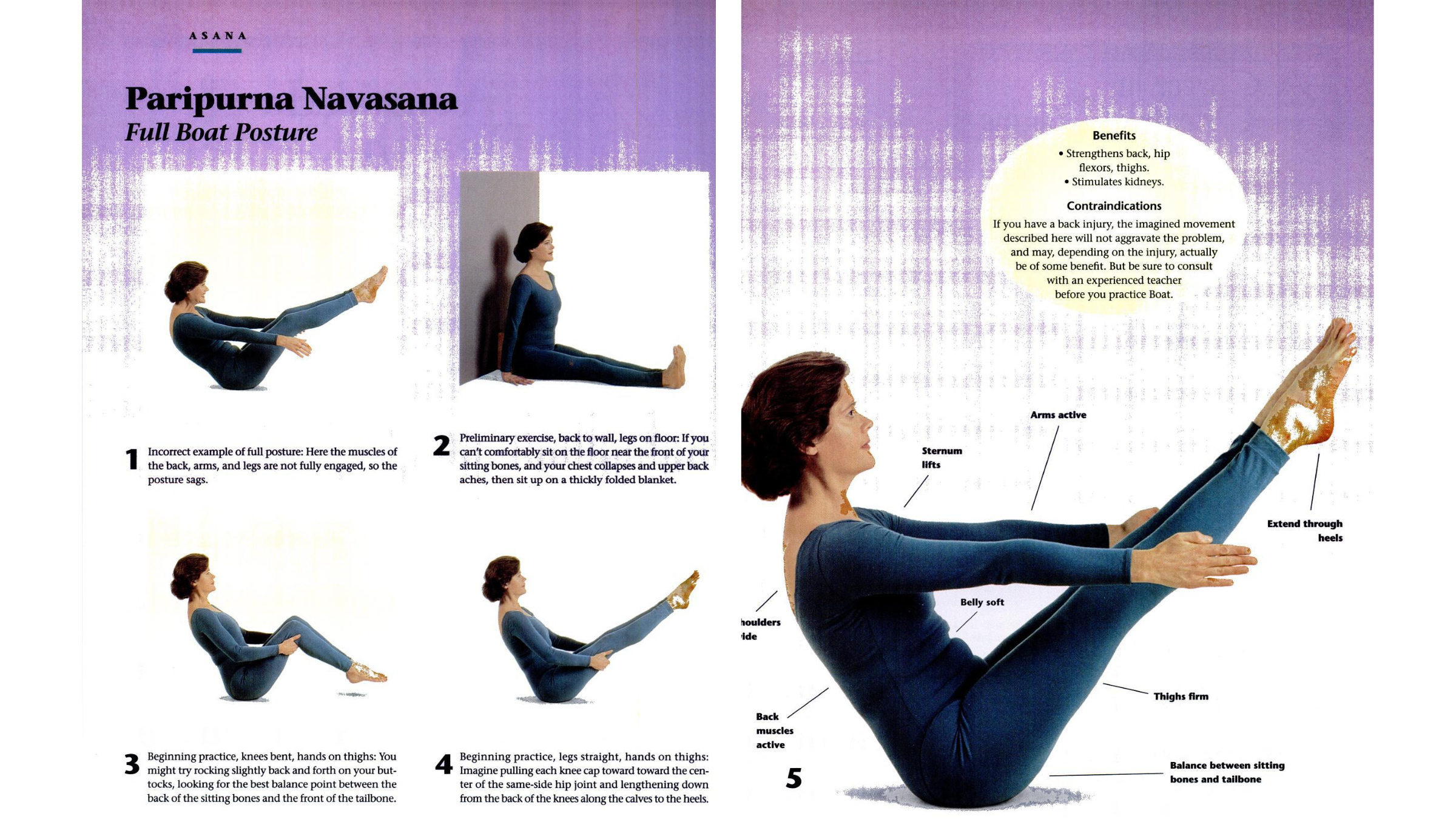
Now let’s put together our Boat Pose around the picture of our line of movement. Naturally, there are other muscles that contribute to the smooth sailing of Boat, including the various small and large muscles of the back, which pull downward toward the coccyx and keep the front torso long and lifted, and the heavy muscles of the inner and front thighs, which straighten the knees and help the abdominals suspend the legs. If these muscles fail, then the full posture will spring several leaks: The torso rounds back and the chest collapses, the knees buckle and the legs quiver, and the balance on the buttocks is shaky (Figure 1).
For this exercise, you’ll need your yoga wall and a block (and a blanket if you have tight back thighs). We’ll begin with a posture that’s actually the starting position for Boat Pose—Staff Pose (Dandasana), which refers to the central axis of the torso, the “front” spine.
Staff is not only our embarkation point, it’s also a good preparation for Boat Pose. If you look at the two postures, you’ll quickly notice that they have similar configurations, except that the angle between the legs and torso in Staff is 90 degrees, while it’s slightly less in Boat.
But much of what goes on in Staff—the action in the spine and sacrum and in the legs—we can directly transfer to Boat.
Sit with your back to the wall, legs extended forward, and wedge the block between the wall and the sacrum (Figure 2). I put the edge of the block (rather than its wide face) against my sacrum, its long axis perpendicular to the floor. Pad the block with a towel or sticky mat if it digs uncomfortably into your sacrum.
If you’re tight in the back of the legs, and can’t sit comfortably near the front of your sitting bones, sit up on, and near the edge of, a thickly folded blanket. And if you have any problems with your sacrum, or sacroiliac joints, don’t use the block until you clear it with an experienced teacher.
Firm the front and inner thighs, and anchor them down against the floor. If you can’t find the inner thighs, insert a book (a yoga book works best!) between the thighs and squeeze. Elongate the back of the heels and stretch the balls of the feet toward the ceiling, toes lively (if you tend to hyperextend your knees, don’t let the heels come off the floor).
Open your palms on the floor beside your hips, arms straight, and push strongly down through the index-finger side of the hand (if this is difficult, try your fingertips with elbows bent). Use this contact to help boost the top of the sternum and pull the shoulder blades (scapulas) down the back.
Now exhale and lean the torso back, stopping with the shoulders and back of the head maybe two or three inches from the wall—you can dip the chin a bit toward the chest to keep the eyes looking straight ahead. Maintain the pressure of the thighs on the floor, the length between the pubis and navel, and the navel and the top of the sternum.
Nudge the sacrum into the pelvis, away from the block, and the scapulas into the ribs. Check that your belly is still relaxed.
Now inhale and raise the arms parallel to the floor, palms facing up. With the collarbones wide, reach out from the scapulas through the fingertips. Stay for 30 seconds to a minute, then exhale and swing the torso back to vertical.
Beginning Boat Pose
Come away from the wall and put the block off to the side. From Staff Pose, bend your knees, put your feet on the floor, and cup the back of your thighs with your hands, elbows slightly bent. Exhale and again prepare to lean the torso back (about 30 to 35 degrees from the perpendicular, for those of you who passed high school geometry; this time, though—since the block is no longer bracing the pelvis—rock onto the buttocks between the back of the sitting bones and the front of the coccyx. The feet will lift a few inches off the floor (Figure 3). For an extra challenge, keep the palms on the floor throughout the exercise.
Wait with the knees bent for a minute or so, recreating all the preliminary work except with the arms. If, after this time, your Boat feels shipshape, exhale and slowly extend the knees to straighten the legs. Actively pull each knee cap toward its same-side hip joint.
Press the back of the thighs actively into the hands and, at first, bring the feet to about face level (Figure 4). Gradually elevate the feet, or at least the toes, a few inches higher than the head so that the legs, again for those of you with a protractor, are angled about 60 to 65 degrees relative to the floor behind them. Wait another minute, or maybe 30 seconds if you’re in danger of going under.
If you can row no further for now, on an exhale, lower the legs to the floor and return the torso to vertical. But if your Boat still feels seaworthy, inhale and stretch your oars—I mean arms—out beside the knees. Stay for 20 to 30 seconds, then with an exhale, return to Staff.
Continuing Practice
If you managed that last part of the beginning practice, you’re very close to completing Boat Pose. You might want to practice entering the posture from the bent-knee position for awhile, increasing your stay to about a minute. When you feel confident with this approach, you can try to set sail directly from Staff.
Shift into and out of Boat with an exhale, simultaneously rocking the torso back and hoisting the legs. Keep the hands on the floor for the first few times to steady the posture, until the torso and legs are well established, then bring the arms up. Finally, move the torso, legs, and arms together, gliding gracefully into Boat (Figure 5).