
Published June 19, 2026 04:51AM
Yoga Journal’s archives series is a curated collection of articles originally published in past issues beginning in 1975. This article about Pinsha Mayurasana (Forearm Stand) first appeared in the May-June 1979 issue of Yoga Journal.
In his Yoga Sutras, sage Patanjali defines asana as “easy comfortable pose.” At first glance, this goal may seem impossible to attain in Pincha Mayurasana (Feathered Peacock Pose or Forearm Stand); but, like other balancing poses, once balance is achieved, a dynamic feeling of lightness and vitality is experienced.
Pincha translates as “chin or feather” and mayura means “peacock.” Thus, the asana, or pose, is one in which the practitioner resembles a peacock with uplifted feathers. Pincha Mayurasana is often confused with Vrschikasana, or Scorpion. The major difference between them, however, is that in the latter the feet are dropped to the head while in the former the legs are held straight.
My first experience of balancing in Pincha Mayurasana in the center of the room was exhilarating. This accomplishment created an exquisite sense of freedom in me. Freedom from fear is a heady experience, one which the practice of yoga can regularly reveal, as one moves toward holism of body, mind, and spirit.
My understanding of yoga was enhanced by this pose when I simultaneously realized the effortlessness of balance as well as the concentration and work required to maintain the pose. I felt balanced, not just physically—in my interaction with gravity, the small space between falling backward or forward—but mentally—in my awareness in the pose and awareness of the pose. I was the subject experiencing the asana, and yet l was the asana, the object of my own experience. This dynamic balance between opposites creates a stillness within so that the inner nature is free to experience the moment. This freedom to experience the moment is what yoga is all about.
The constant practice of yoga discipline affords one freedom from the past and encourages one to give up expectations of the future. Release from past and future, as imaged and actualized through asana, is true balance. It is experienced as a state of total joyous being. Paradoxically, this state must be worked for and, yet, can never be attained but only experienced spontaneously. One definition of asana, from the ancient Indian Upanishads, states,”Being firm in the unshaken spiritual wisdom constitutes posture.” Practicing Pincha Mayurasana with control, grace and ease teaches one that the body can become a perfect instrument of the soul.
How to Come Into Pincha Mayurasana
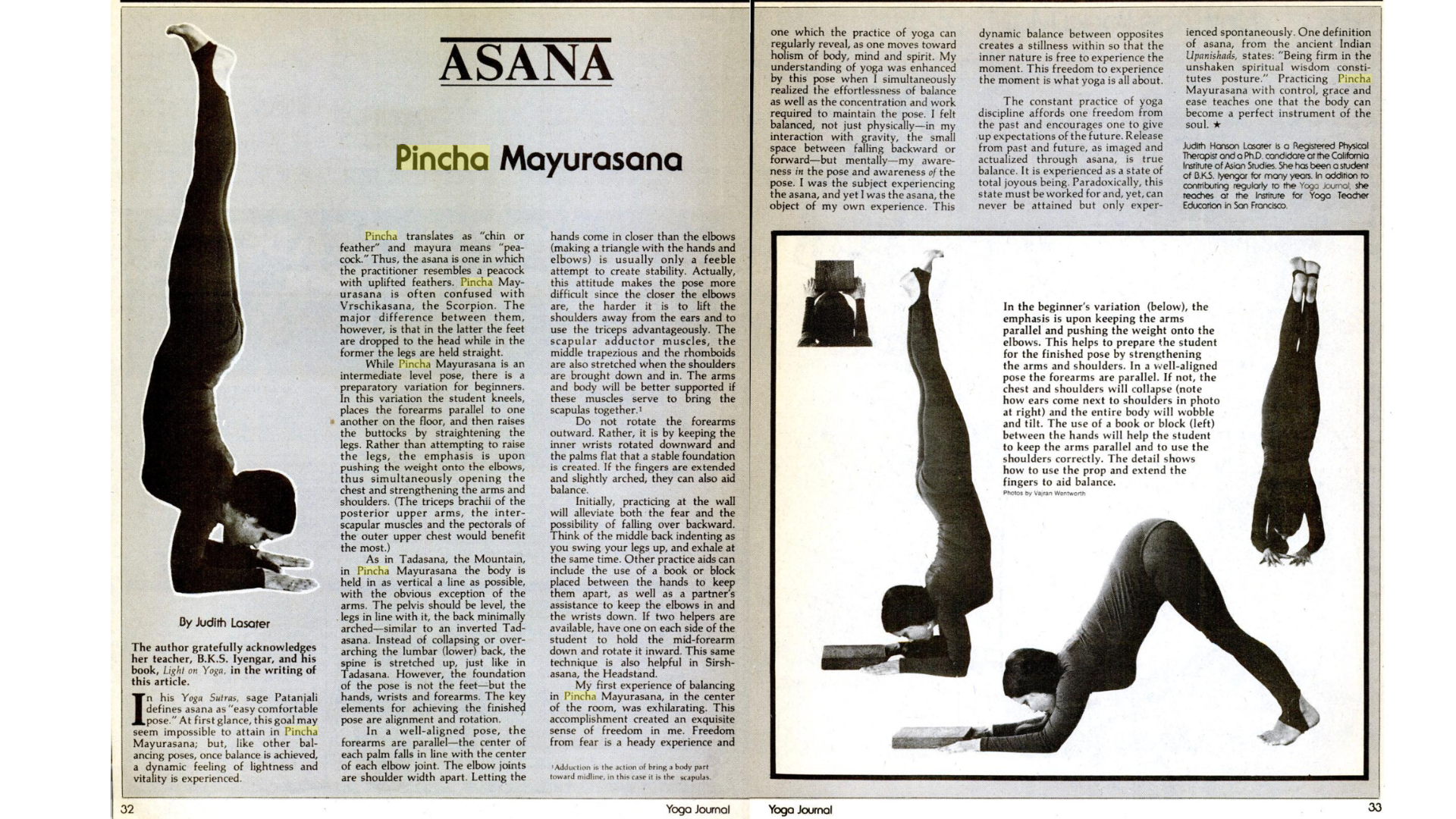
As in Tadasana (the Mountain), the body is held in as vertical a line as possible, with the obvious exception of the arms. The pelvis should be level, the legs in line with it, the back minimally arched—similar to an inverted Tadasana. Instead of collapsing or overarching the lumbar (lower) back, the spine is stretched up, just like in Tadasana. However, the foundation of the pose is not the feet but the hands, wrists, and forearms. The key elements for achieving the finished pose are alignment and rotation.
In a well-aligned pose, the forearms are parallel with the center of each palm falling in line with the center of each elbow joint. The elbow joints are shoulder width apart. Letting the hands come in closer than the elbows (making a triangle with the hands and elbows) is usually only a feeble attempt to create stability. Actually, this makes the pose more difficult since the closer the elbows are, the harder it is to lift the shoulders away from the ears and use the triceps advantageously.
Also, do not rotate the forearms outward. Rather, it is by keeping the inner wrists rotated downward and the palms flat that a stable foundation is created. If the fingers are extended and slightly arched, they can also aid.
The scapular adductor muscles*, the middle trapezious, and the rhomboids are also stretched when the shoulders are brought down and in. The arms and body will be better supported if these muscles serve to bring the scapulas together.
Although Forearm Stand is an intermediate level pose, there is a preparatory variation for beginners. In this variation, the student kneels, places the forearms parallel to one another on the floor, and then raises the buttocks by straightening the legs. Rather than attempting to raise the legs, the emphasis is upon pushing the weight onto the elbows, thus simultaneously opening the chest and strengthening the arms and shoulders. (The triceps brachii of the posterior upper arms, the inter-scapular muscles and the pectorals of the outer upper chest would benefit the most.)
Initially, practicing Forearm Stand at the wall will alleviate both the fear and the possibility of falling over backward. Think of the middle back indenting as you swing your legs up, and exhale at the same time. Other practice aids can include the use of a book or block placed between the hands to keep them apart, as well as a partner’s assistance to keep the elbows in and the wrists down. If two helpers are available, have one on each side of the student to hold the mid-forearm down and rotate it inward. This same technique is also helpful in Sirsasana (the Headstand).
*Adduction is the act of bringing a body part toward midline, in this case, the scapulas.