
Insights into the unexpected benefits of a traditional pose.
(Photo: Magnific)
Published August 17, 2026 06:07AM
Yoga Journal’s archives series is a curated collection of articles originally published in past issues beginning in 1975. This article about Baddha Konasana (Restrained Angle Pose or Bound Angle Pose) first appeared in the January-February 1977 issue of Yoga Journal.
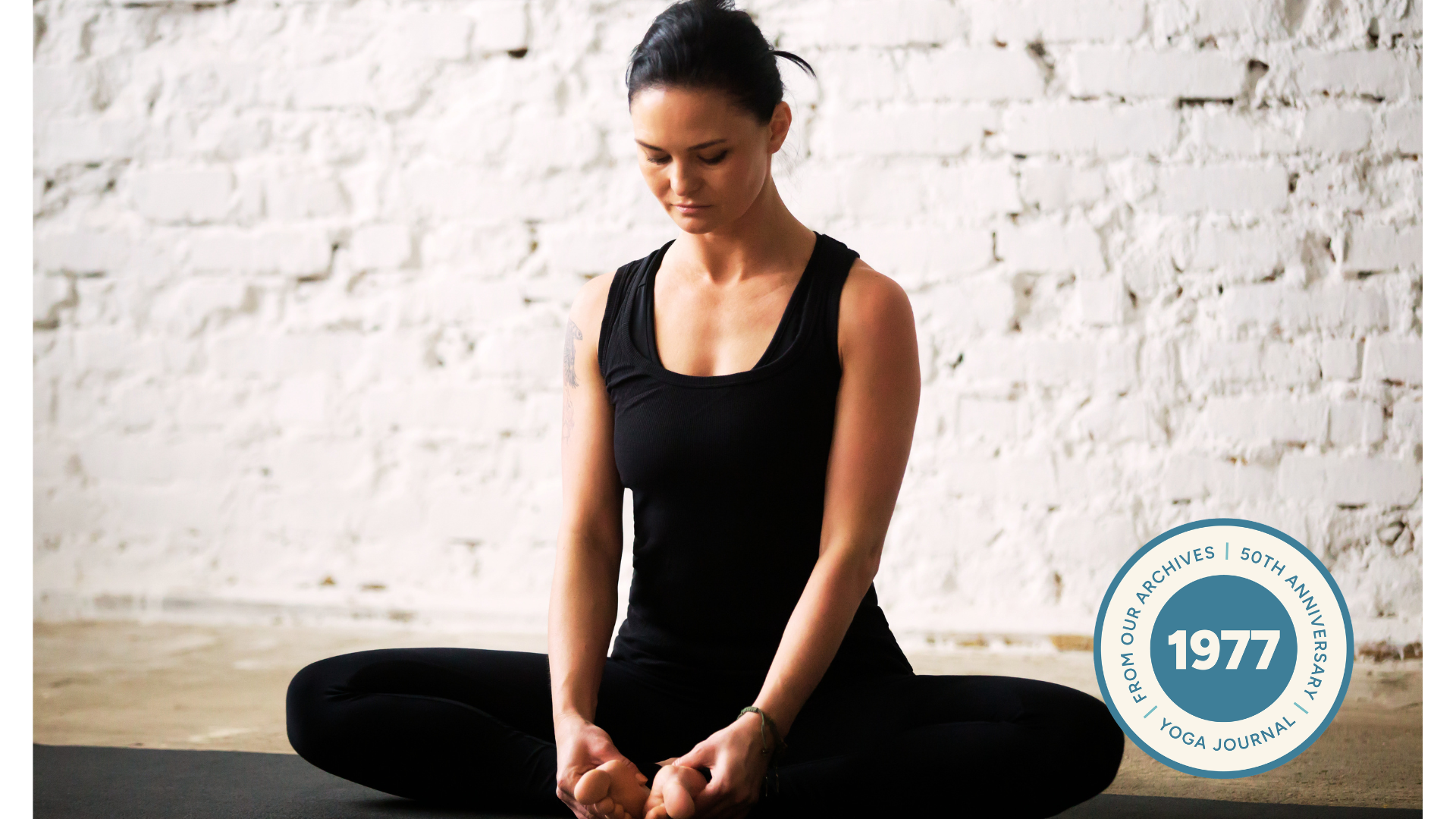
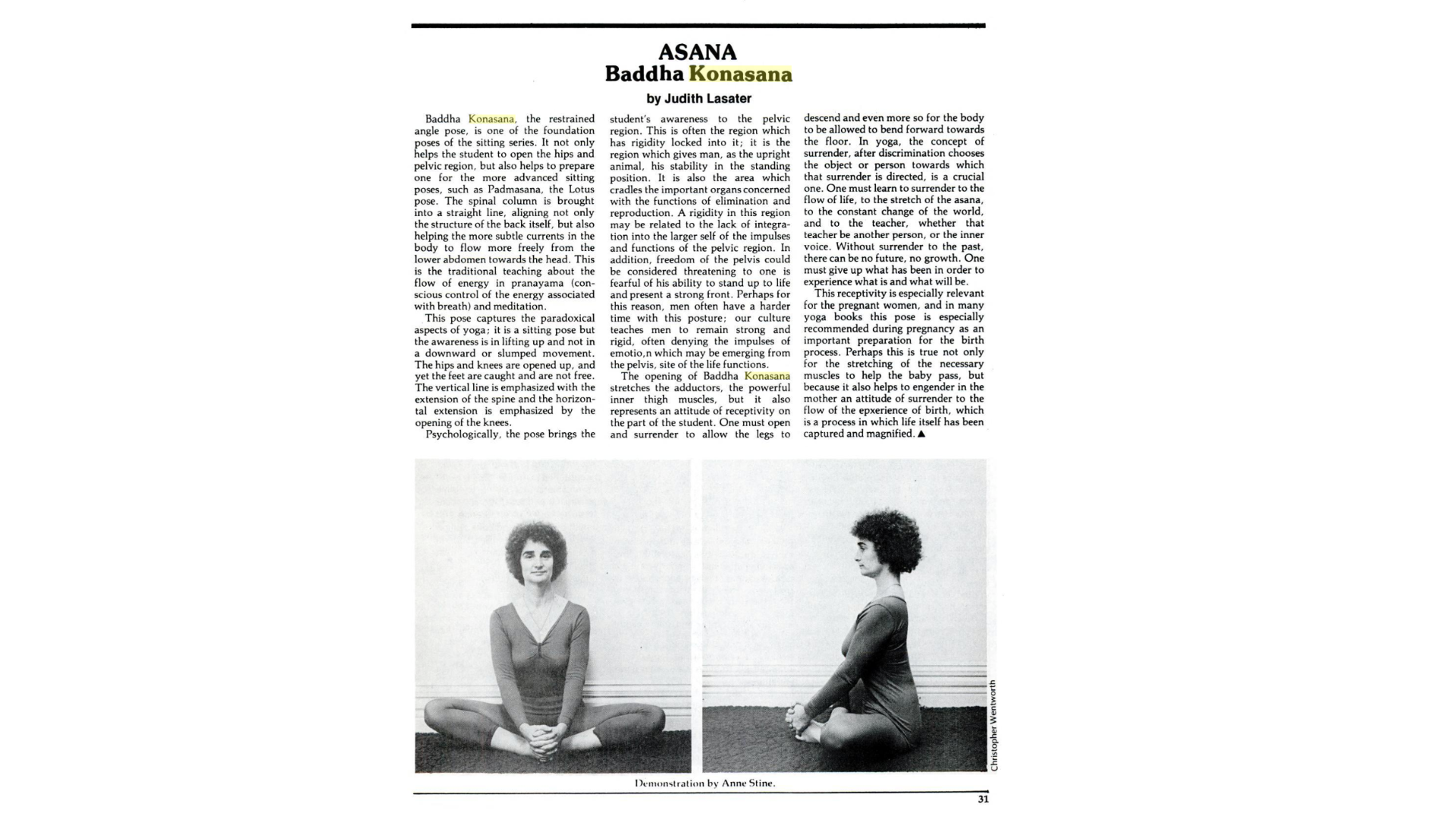
Baddha Konasana, the Restrained Angle Pose, is one of the foundational yoga poses and captures the paradoxical aspects of yoga—it is a sitting pose but the awareness is in lifting up and not in a downward or slumped movement. The hips and knees are opened up, yet the feet are caught and are not free. The vertical line is emphasized with the extension of the spine and the horizontal extension is emphasized by the opening of the knees.
The opening of Baddha Konasana stretches the adductors, the powerful inner thigh muscles, but it also represents an attitude of receptivity on the part of the student. One must open and surrender to allow the legs to descend and even more so for the body to be allowed to bend forward toward the floor. In yoga, the concept of surrender is a crucial one. One must learn to surrender to the flow of life, to the stretch of the asana (pose), to the constant change of the world, and to the teacher, whether that teacher be another person or the inner voice. Without surrender to the past, there can be no future, no growth. One must give up what has been in order to experience what is and what will be.
It not only helps the student to open the hips and pelvic region, but also helps to prepare one for the more advanced poses. The spinal column is brought into a straight line, aligning not only the structure of the back itself, but also helping the more subtle currents in the body to flow more freely from the lower abdomen towards the head. This is the traditional teaching about the flow of energy in pranayama (conscious control of the energy associated with breath) and meditation.
Psychologically, the pose brings the student’s awareness to the pelvic region. This is often the region which has rigidity locked into it; it is the region which gives man, as the upright animal, his stability in the standing position. In addition, freedom of the pelvis could be considered threatening to one who is fearful of his ability to stand up to life and present a strong front. Perhaps for this reason, men often have a harder time with this posture; our culture teaches men to remain strong and rigid, often denying the impulses of emotion which may be emerging from the pelvis, site of the life functions. It is also the area which cradles the important organs concerned with the functions of elimination and reproduction. A rigidity in this region may be related to the lack of integration into the larger self of the impulses and functions of the pelvic region.
Receptivity is especially relevant for the pregnant women, and in many yoga books this pose is especially recommended during pregnancy as an important preparation for the birth process. Perhaps this is true not only for the stretching of the necessary muscles to help the baby pass, but because it also helps to engender in the mother an attitude of surrender to the flow of the experience of birth, which is a process in which life itself has been captured and magnified.
Model Anne Stine.