
Published July 26, 2026 06:11AM
Yoga Journal’s archives series is a curated collection of articles originally published in past issues beginning in 1975. This article about Bow Pose (Dhanurasana) first appeared in the September-October 1983 issue of Yoga Journal.
Traditionally, the archer’s bow symbolizes potentiality, the capacity to respond. At rest, the bow has little tension in it, and therefore expresses little potential. But as the bowstring is pulled back, its power increases enormously. In the hands of a skilled archer, it now expresses the ability to send an arrow toward its target with great force and accuracy.
Like archery, yoga is also about actualizing potential power—the potential spiritual power we each have within us. Each of us is a vast reservoir of latent creativity, will power, intelligence, forgiveness, love, compassion, and other spiritual attributes that yoga can help us to manifest. For example, when we choose to practice a pose such as Dhanurasana or Bow Pose, we are deliberately choosing to do something difficult, thus asserting our freedom and strengthening our power of will.
Yoga is also about learning to direct the “arrow” of our attention so that every part of us—body, mind, and spirit—is focused and able to propel us toward the target we seek. That target is the true Self, and through yoga we can learn to direct our attention to it with skill and precision.
Another enduring lesson we can learn from yoga is how inseparably mind and body are connected. For example, in order to practice Dhanurasana, we first make a conscious decision with the mind; the body immediately complies, and the mind, in turn, is affected by the body’s action. But in order to obtain the full benefits of this reciprocal mind-body influence, we must allow ourselves to merge with the asana during practice.
Too often we practice poses as if they were something external to us, like different “coats” we put on and wear because they are good for us. But in order to affect us profoundly, so that our yoga becomes something we live rather than just practice, an asana must be evoked, expressed, and allowed to manifest itself through us from somewhere deep inside. When we practice Dhanurasana in this way, letting ourselves become one with it, practice gains an extra dimension. It becomes a living thing instead of merely a mechanical exercise. Then we are not just studying the pose—we are becoming it.
The idea of becoming what one learns, of transforming oneself into a living expression of truth, is at the core of yoga. But this self-transformation does not involve changing who we are. We are not striving to acquire something we presently lack. The truth is that we are already centers of love and wholeness, needing only to recognize and manifest what we have—and have always had—within us. Dhanurasana is a powerful symbol of our ability to become who we truly are. When practiced in this way, Bow Pose becomes an expression of our own divinity.
Benefits of Bow Pose
Dhanurasana, or Bow Pose, is a popular asana with a host of benefits. As B.K.S. Iyengar notes in Light on Yoga, regular practice of it tones and rejuvenates the abdominal organs, strengthens the muscles and discs of the spine, increases the spine’s flexibility, and develops better standing posture by strengthening the muscles of the back. In addition to producing physical benefits, forming the entire body into the shape of a bow—a powerful symbol—can strongly influence the mind and emotions. As C. G. Jung and others have observed, the body is closely linked with the unconscious mind, and making a bow with the body evokes that symbol from the unconscious.
Most of our daily activities emphasize the front of the body and involve either facing, bending, or reaching forward. Dhanurasana counteracts this frontal emphasis by involving all the muscles of the back of the body. These muscles include the hamstrings in the back of the thigh, the buttocks (gluteus maximus), and virtually all the muscles in the back of the trunk. In addition to strengthening these muscles by requiring them to work against gravity, the pose stretches the pectoralis muscles of the upper outer chest, as well as the biceps brachii, the large muscle of the front of the upper arm.
Another benefit of Dhanurasana is that it requires flexibility in the quadriceps femoris muscles on the front of the upper thigh. These muscles, some of the most powerful in the body, can become tightened by a lot of physical activity. By practicing Dhanurasana, you can keep them stretched, thus allowing the pelvis more freedom of movement. This extra freedom in the pelvis, in turn, can alleviate strain in the lower back, especially during walking.
Bow Pose is generally regarded as beneficial for many kinds of back pain. My own students rarely complain of back pain in this pose. Back pain is much more likely to occur in the sister asana of this pose, Urdhva Dhanurasana or Upward-Turned Bow, which is practiced by lying on the floor on one’s back, with one’s feet on the floor, and lifting up into an arch.
How To Practice Bow Pose
Dhanurasana is usually taught as a beginning pose, but you should not attempt it at the beginning of a practice session. Other poses should be practiced first in order to ensure that the body is warm and prepared for the movement. For example, a series of standing poses and the Dog Pose would be beneficial before Bow Pose.
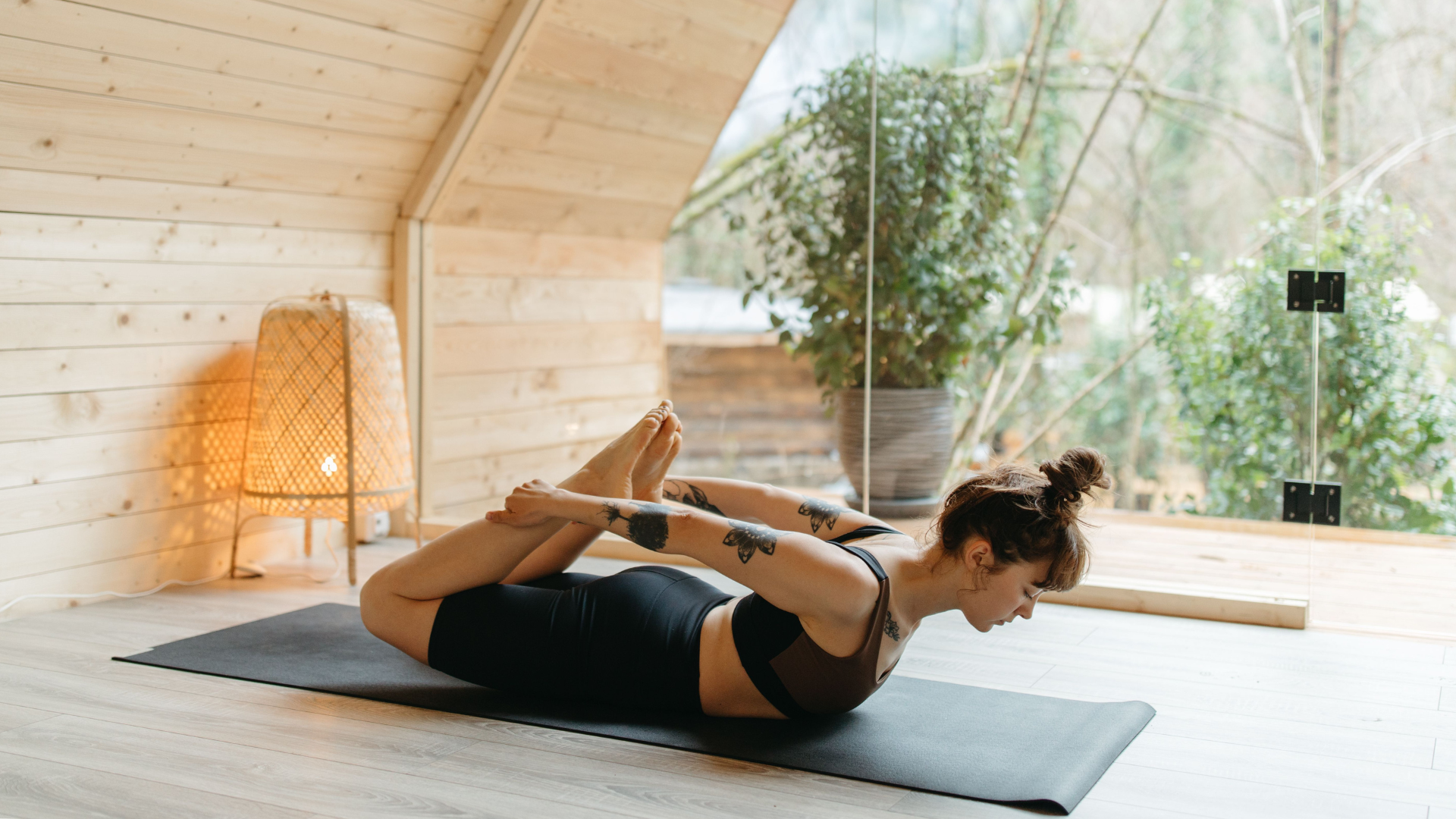
When practicing, use a folded blanket or mat of some kind under the pelvis to prevent discomfort on the hip and pubic bones. To begin, lie down on the folded blanket or mat. To make sure that the front of the body is stretched out well on the floor, lift up the rib cage a couple of inches and stretch it out forward, giving a long line to the top of the body. You might want to spend an extra minute stretching the legs out, one by one, to make sure the front thighs are stretched and flat on the floor. Now bend the knees, press the front thighs down, and catch the ankles.
Place the forehead on the floor, breathing quietly. Then, on an exhalation, lift up into Dhanurasana. Hold for several breaths, taking care not to rock back and forth. Slowly come down, take a few breaths, and repeat.
When lifting up into the pose, remember that the shoulders and the knees should be at approximately the same height. Some students tend to lift the legs higher; others lift the shoulders higher. Try to lift both together so that the spine receives an even action. Practicing in front of a mirror might help, but if you are unable to decide for yourself whether you are lifting too much from the legs or shoulders, have a friend watch your pose. Similarly, you might tend to lift one leg higher than the other. Again, a mirror or a friend can be helpful in understanding if there is an imbalance in the legs.
You can try variations of the pose by changing the position of the hands. More flexible students can move the hands down the shin to affect a tighter arch. Other variations include placing the hands on the inside of the ankles, instead of on the outside. If you attempt this latter variation, be sure that the shoulders are rolling out together, the thumbs are pointing up, and the palms are facing out. Students frequently try this variation without rolling the shoulders and upper arms out, which actually closes the shoulders instead of opening them.
It is important to press the thighs firmly against the ground in preparation for Dhanurasana. Attempting this pose with the thighs off the ground produces too much curvature and causes strain in the lower back (lumbar spine). The correct position requires the thighs to be firmly pressed against the ground. If your body is too stiff and you cannot get your thighs flush with the floor before beginning, you can prevent strain in the lumbar spine by stretching one leg at a time, attempting to get the thigh down only just before you lift up into the pose.
Many students like to include Dhanurasana in the day’s practice as one beginning backbend in a series of backbends. If you experience any discomfort in the back after practicing Bow Pose or other backbends, you might find it helpful to follow them with a few gentle twists and the Dog Pose, after which you can continue with the rest of the session.