
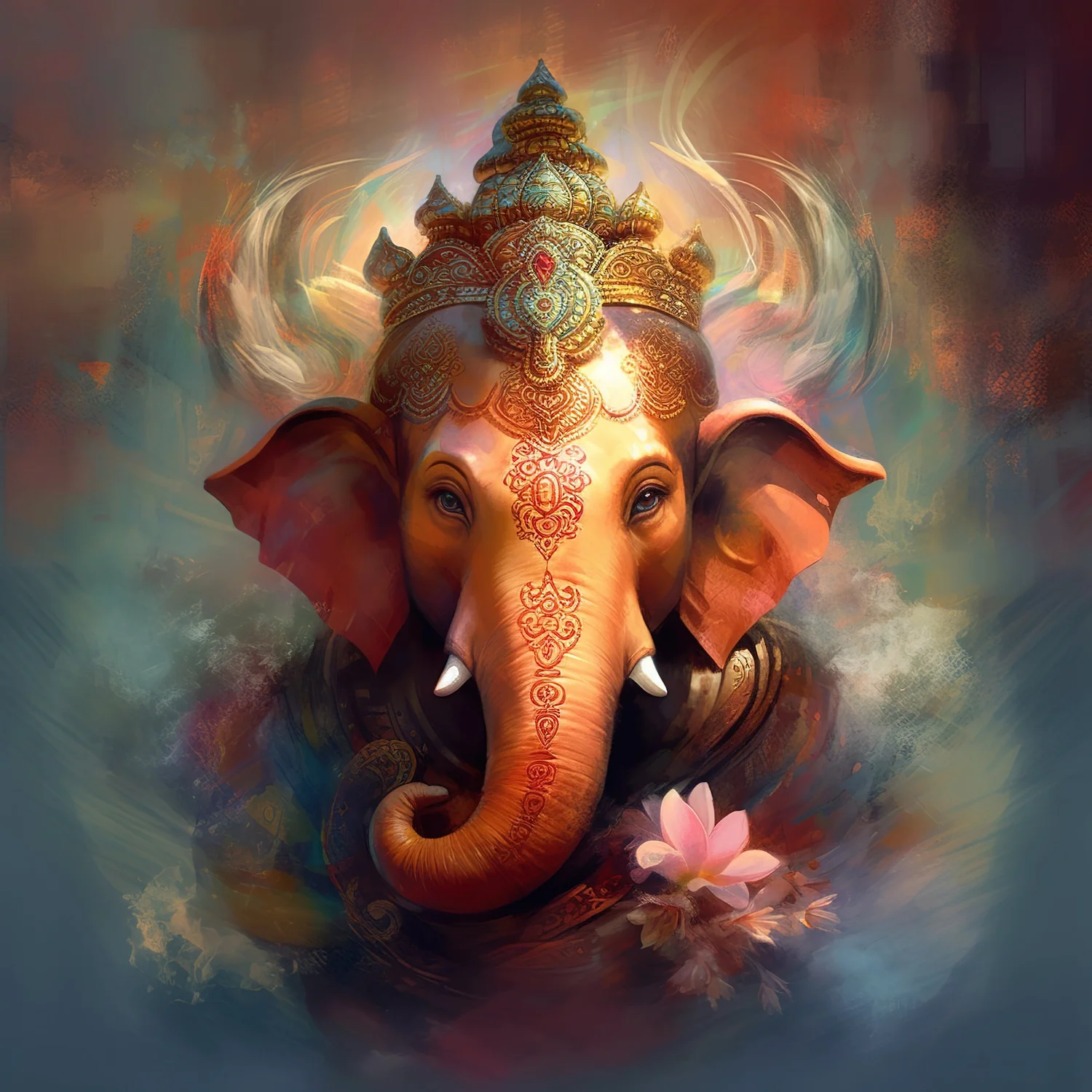
Ganeśa, also written as Ganesha or Ganesh, is one of the most beloved deities in Hindu traditions. Instantly recognizable by his elephant head, big belly, one broken tusk, and mouse vehicle, he is associated with learning, auspicious beginnings, prosperity, intelligence, and the forces that interrupt or obstruct our plans.
He is also known as Gaṇapati, Vighnahartā, Vighneśvara, Ekadanta, and Vināyaka. Ganeśa is traditionally invoked before a trip, the start of a ceremony, an examination, a business venture, a house move, a course of study, or really, any moment that asks us to step into the unknown.
He is often described as the remover of obstacles.
However, this overly familiar description can lead us to a contemplation: are we always asking for difficulty to disappear, or are we asking for the wisdom to know how to meet it?
For me, Ganeśa reminds us that a new moment in life asks for more than enthusiasm. It asks for buddhi: discernment, intelligent understanding, and the ability to recognize what a particular moment requires.
The God of New Beginnings
Ganeśa is present in many of the ordinary and significant transitions of life. He may be invoked before weddings and journeys, at the opening of a home or business, before examinations, during study, and at the start of ritual practice.
This doesn’t mean that Ganeśa guarantees an easy outcome. Instead, he marks the importance of beginning consciously.
Every new undertaking contains an element of uncertainty. We may have chosen a direction we are still a little unsure about, or we may have prepared carefully for something and still wonder whether we are ready. Or maybe we’re excited for what’s ahead but also carrying fear, doubt, or an attachment to what is familiar.
Ganeśa is that part of us that can stop and acknowledge this reality. We pause before crossing a threshold. We ask for steadiness, attention, and the intelligence to proceed well.
A useful prayer might not be: “Oh, God, please make this easy for me.”
It might be more like: “Help me recognize what this new space requires.”
Names and Symbols of Ganeśa
Ganeśa’s iconography is both playful and profound. His large ears suggest attentive listening. His substantial belly is often associated with the capacity to contain and digest life’s many experiences. His mouse vehicle creates a striking contrast in scale: the great elephant-headed deity travelling with a small, quick, restless creature.
His names offer further ways of approaching his symbolism:
Gaṇapati: leader or lord of the gaṇas, often rendered as “lord of the hosts”
Vighnahartā: remover of obstacles
Vighneśvara: lord of obstacles
Ekadanta: the one-tusked one
Vināyaka: a widely used name of Ganeśa, especially familiar in the context of Vināyaka Caturthī
Together, these names suggest more than a little good luck. They lead towards intelligence, adaptability, authority, learning, and a mature relationship with the difficulties that arise in human life.
When Difficulty is the Teacher
Ganeśa is commonly known as Vighnahartā, the remover of obstacles. He is also associated with Vighneśvara, the lord of obstacles. The two names actually work well together.
Obstruction can meet us on the path. Just as fear can prevent action, confusion can cloud judgement, habitual patterns can keep us stuck, or self-doubt can make us abandon something before it’s even properly begun.
Yet, not everything that slows us down is necessarily bad.
A delay can actually show us that we are underprepared. A recurring problem may expose an assumption that needs revising. Frustration can reveal how strongly we are attached to a particular result. Resistance may indicate that our direction, motivation, or expectations need further examination.
This is not about glorifying difficult times. Some situations need changing; some boundaries need protecting; some burdens should be put down. And yoga asks us not to react automatically. It asks us to pause and observe.
Instead of asking, “How do I get rid of this?”, what if we asked:
“What am I not able to see right now?”
That question brings us close to buddhi: the capacity to distinguish, assess, and respond with intelligence rather than impulse.
Gaṇapati and the Ṛgveda
The title Gaṇapati has a long textual history. The well-known Vedic opening,
gaṇānāṃ tvā gaṇapatiṃ havāmahe
“We call upon you, Gaṇapati, lord of the hosts,” Ṛgveda 2.23.
In its original context, it addresses Brahmaṇaspati, also called Bṛhaspati, associated with sacred speech, prayer, and the potency of utterance.
In that context, they were not addressing the elephant-headed Ganeśa familiar to us today.
Later, Gaṇapati became one of Ganeśa’s best-known names, and this verse came to be widely used. Neither cancels the other. The verse has its earlier Vedic setting. It also has a later devotional life with Ganeśa.
For me, the important point is not to undermine a familiar chant or correct anyone’s devotion. It’s to remember that when we inherit a mantra, we inherit more than a translation or a comforting idea. We inherit a history.
And that history asks us to listen carefully, distinguish what we know from what we assume, and value practice while remaining willing to learn more from the sacred texts themselves.
Texts are transmitted. Names gather new associations. Mantras enter different ritual settings. Devotional practices develop around material that has a much older textual history.
Authenticity is not always about keeping every layer frozen in time. It can also include the careful interpretation and continued use of a tradition across generations.
For those studying yoga, Sanskrit, or mantra, this is an important principle. A mantra is not simply an English translation or a phrase found online. It carries sound, textual context, a history of use, and modes of respectful transmission.
Vyāsa, Ganeśa and Learning
A much-loved traditional account connects Ganeśa with the writing of the Mahābhārata.
Vyāsa requires a scribe for the great epic, and Ganeśa agrees, on the condition that Vyāsa dictates continuously. Vyāsa accepts, but makes a condition of his own: Ganeśa must understand each verse before setting it down.
I adore this story as it shows that knowledge should not merely be accumulated or repeated. It should be considered, tested, practiced, and gradually assimilated.
This is especially relevant in modern yoga culture where we have almost immediate access to translations, lectures, online courses, postural demonstrations, and fragments of philosophy. We can gather a vast amount of information without really understanding any of it.
Serious study is slow. We read, practice. Maybe start asking better questions. And even reread the material after experience has changed us.
The story of Ganeśa writing for Vyāsa is a later traditional episode associated with the Mahābhārata. This lets us appreciate it for what it is: a later tradition that expresses Ganeśa’s enduring connection with learning, writing, and intelligence.
The Meaning of the Broken Tusk
In the Vyāsa–Ganeśa story, Ganeśa’s pen breaks while he is writing. Rather than stop, he breaks off one of his own tusks and uses it to continue. This is one traditional explanation for the name Ekadanta, “the one-tusked one.”
The image is memorable because it reflects the nature of practice.
We may begin with a plan, a timetable, a teacher, a healthy body, or a clear idea of how something should unfold. Then conditions change, our body changes, and responsibilities shift. Maybe a relationship ends, a teacher leaves, or a plan simply no longer works.
The task isn’t always to restore the original conditions. Often, it is to discover how to continue with intelligence and integrity within the conditions that are now present.
Ganeśa and yoga
Ganeśa is not a central figure in Patañjali’s Yoga Sūtras, and yoga philosophy should not be simplified into a catalogue of deities, symbols, and inspirational slogans.
Yet Ganeśa’s symbolism can be held alongside several important yogic ideas:
Buddhi: discernment, intelligence, and sound judgement
Viveka: the capacity to distinguish clearly
Svādhyāya: self-study, including the sustained study of texts and oneself
Abhyāsa: committed, repeated practice over time
The obstacles, habits, and fluctuations that arise within any sincere path of practice
Seen in this way, Ganeśa is not merely an image placed at the beginning of a yoga class or on an altar. He invites inquiry.
What am I carrying into this new phase?
What have I missed examining?
What needs my courage instead of avoidance?
What needs patience rather than aggression?
These questions are a part of practice and life.
Gaṇeśa Caturthī
Gaṇeśa Caturthī, also known as Vināyaka Caturthī, is the festival associated with Ganeśa’s birth or appearance. It takes place on the fourth lunar day of the bright fortnight of the month of Bhādrapada, usually during August or September.
The festival is celebrated through pūjā, offerings, sweets, devotional music, chanting, family gatherings, temple worship, and, in many places, large public celebrations. In traditions where a mud or earthen Ganeśa figure is installed for the festival, the celebration concludes with immersion back into the earth.
This has a moving rhythm: invocation, celebration, and release.
Received with devotion. It is honoured. And then it is returned to nature.
Even joy, the festival suggests, is not something we possess. It moves through us.
A living tradition
A tradition may preserve, adapt, remember, reinterpret, and renew itself. It has texts and rituals, teachers and communities, scholarship and devotion. It does not need to become historically flat to remain meaningful. Perhaps that, too, is a teaching of Ganeśa: we do not have to demand that everything be simple before we begin to meet it with sincerity.
Before you begin
Remember, we aren’t calling Ganeśa because we want a life without challenge.
We invoke him at the start of something, or when we forget the intelligence that comes with steadiness and care already living within us.
Before beginning something new, what if you paused to ask:
What is my intention?
What am I bringing with me?
What needs do I need to let go of?
What needs more of my attention?
What would it mean to proceed intelligently?
Then we begin, not because the path is certain, but because hopefully, we have learned to take the next step with greater awareness.
Frequently asked questions
Who is Ganeśa?
Ganeśa, also spelt Ganesha or Ganesh, is an elephant-headed deity associated with beginnings, learning, intelligence, prosperity, and obstacles. He is widely invoked before important new undertakings, including journeys, ceremonies, study, business ventures, and changes of home.
What does Ganeśa represent?
Ganeśa is associated with auspicious beginnings, learning, discernment, prosperity, adaptability, and the ability to meet difficulty intelligently. Different traditions emphasize different aspects of his mythology and symbolism.
Why is Ganeśa called the remover of obstacles?
Ganeśa is known as Vighnahartā, “remover of obstacles,” and is often invoked before a new endeavour. His connection with obstacles also invites reflection: some difficulties need to be removed, while others reveal a need for preparation, patience, or clearer understanding.
What does Gaṇapati mean?
Gaṇapati is a Sanskrit title often translated as “lord of the gaṇas” or “leader of the hosts.” It appears in Ṛgveda 2.23, a hymn principally addressed to Brahmaṇaspati/Bṛhaspati. In later Hindu traditions, Gaṇapati becomes one of Ganeśa’s principal names.
What is Gaṇeśa Caturthī?
Gaṇeśa Caturthī is a Hindu festival celebrating Ganeśa. It occurs on the fourth lunar day of the bright fortnight of Bhādrapada, usually in August or September. Observances may include pūjā, offerings, sweets, chanting, music, family gatherings, temple worship, public celebrations, and immersion ceremonies.
Is Ganeśa important in yoga?
Ganeśa is not linked to yoga or to Patañjali’s Yoga Sūtras. However, his associations with discernment, learning, self-study, sustained practice, and thoughtfully meeting challenges make his symbolism relevant to many yoga practitioners.
Did Ganeśa write the Mahābhārata?
A later and widely loved tradition says that Ganeśa wrote the Mahābhārata as Vyāsa dictated it. Scholars generally regard this episode as a later addition; it is not found in the main text of the Critical Edition.
Why does Ganeśa have one broken tusk?
Ganeśa is called Ekadanta, “the one-tusked one.” Hindu traditions offer several explanations. In the famous Vyāsa–Ganeśa story, he breaks off his tusk to continue writing after his pen breaks.
Continue your study
We do not invoke Ganeśa because we expect a life without obstacles.
We invoke him at the threshold because we want the intelligence to meet them well.
If you would like to explore yoga philosophy, Sanskrit, and traditional yoga teachings more deeply, you can explore my courses, mentorships, and writing on yoga practice and philosophy.
About Tara Mitra
Tara Mitra is a C-IAYT-certified yoga therapist and lineage teacher within the Krishnamacharya–Desikachar tradition, with 23 years of practice and 18 years of teaching experience. She is also a Level 2 Ashtanga yoga teacher.
Her teachings draw from Patañjali’s Yoga Sūtras, Vedic chanting, the Upaniṣads, Āyurveda and the broader teachings of the Krishnamacharya tradition. She offers courses, teacher education and mentorship for dedicated students and teachers of yoga, alongside Dr Vigneshwar Bhat, a Vedic Priest and Scholar, and Dr Rob Lamport, a Gonstead Chiropractor.
Her work is rooted in the study, practice and responsible transmission of traditional Indic knowledge within a living lineage.
Explore upcoming mentorship, courses and programs at Tara Mitra Yoga.