
Published September 30, 2026 10:46AM
In Yoga Journal’s Archives series, we share a curated collection of articles originally published in past issues beginning in 1975. This article about Seated Twist first appeared in the November-December 1982 issue of Yoga Journal. Find more of our Archives here.
Named for a character in the Indian epic Mahabharata, Seated Twist (Bharadvajasana) is a beginning level seated spinal twist especially adaptable for the less supple, for older students, as well as for pregnant women. Twisting asanas in general stretch the ligaments holding vertebrae together, thus creating a greater range of motion at all vertebral segments. This greater range allows the student to practice other poses with more freedom, and improves posture by eliminating areas of minor tightness.
It is important in Seated Twist, as in all twists, that the base of the movement be level; the student should have both buttocks on the floor while allowing the pelvis to twist. The pelvis joins the hip joints at its lower end, and the sacrum (part of the spinal column at its middle and upper end. Thus the pelvis is the communicating link between the trunk (spine) and the lower extremities (legs). When the pelvis is not allowed to twist, it creates a strain at the pelvic-sacral junction or joint, called the sacroiliac joint after the ilium bone of the pelvis. If the pelvis is held stationary and the spine is twisted, torque is created at the S-I joint because this joint has relatively little support from surrounding tissues. It is especially relevant for women to remember to let the pelvis twist, as women are especially subject to S-I strain because their joint is less deep and lacks the stability of the male S-l joint. In addition, the hormonal changes of menses, pregnancy and lactation may loosen the joint’s natural ligamentous support. As long as the base—the pelvis—is level to the floor, which prevents tilting the spine, the pelvis can be moved into the twist as if it were a continuation of the spinal column, thus preventing strain at the sacroiliac joint.
Most students of yoga speak of the emphasis yoga gives to the spine—to maintaining its health and suppleness. One way of creating health in the spine is to free it by freeing the pelvic girdle and shoulder girdle. The major joints of shoulder and hip greatly affect the freedom of the spine. If the shoulders are tight, one slouches, which disturbs the spine; if the hip joints are unevenly tight, a sway back (lordosis) can be created. If one portion of the spinal column is disturbed, the entire column must compensate in order to support the body. When the shoulder and hip joints are free, unevenness of the spine disappears, allowing it to “spring” into its natural, gently curving shape. This is true in Seated Twist, in all twists, and in the practice of yoga in general.
Too often students approach yoga as an artificial discipline imposed upon an unwilling body and mind to force them into a desired mold. While it is true that yoga is a discipline, at times quite a difficult one, the discipline comes not in shaping and forcing, but in letting go and releasing. Yoga does not attempt to change the path of the self, since it is already perfect. Instead, yoga removes the roadblocks to following the path. One does not change to practice yoga, one becomes more oneself. And who is that? Yoga teaches that we are the eternal Atman—that the soul of God lives within us. To attempt to change that, to even think one could is asmita, or egoism, one of the greatest of roadblocks. Yet many practice the asanas with effort and force instead of patience. Through persistence and practice, the asana will express itself through the body and mind, which are in harmony.
The physical expression of surrender is not weakness, but softness. The mental expression of surrender is exhalation. When practicing Seated Twist, the movement should be done gradually, with an exhalation, letting the spinal column adjust to the changes. The exhalation can be made during movement, or preceding it. Most importantly, Seated Twist should be practiced with the attitude of letting the body-mind express its natural beauty and the freedom of its essence.
How to Practice Seated Twist
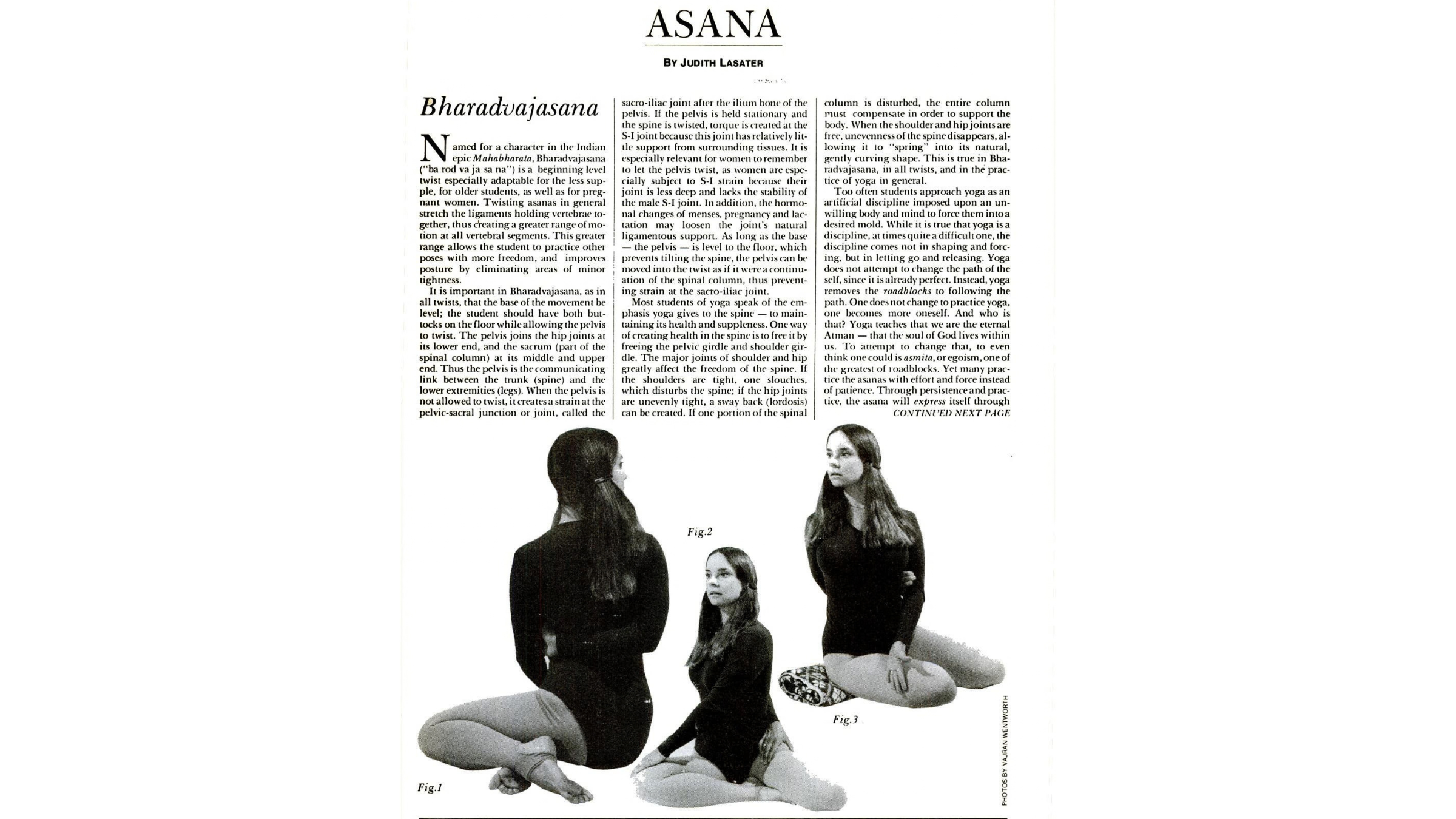
Sit on the floor with both legs straight in front. With an exhalation, bend the knees to the left side of the buttocks. The left ankle should fit into the arch of the right foot.
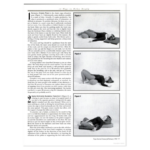
Make sure both buttocks are on the floor. It is better to have the knees wider apart than one of the buttocks elevated. The sitting position of Figure 2 may also be tried if the other is too difficult, or a folded mat may be placed under the right buttock. Exhaling, lift the right arm straight up over the head; keeping it as high from the floor as possible, bring it around the back to catch the left arm just above the elbow. Be sure to turn the right shoulder out, not letting it drop toward the chest. Reach the left arm across the body, placing the palm down and hooking it under the outside of the right knee. If this is too difficult, then hold the right leg as is shown in Figure 2. Keeping the buttocks on the floor while allowing the left pelvis to slide forward, begin the twist from the base and slowly twist to the right. All movements should be done on an exhalation. The head may be turned with the spine or in the opposite direction to look over the left shoulder, but make sure the eyes are kept parallel to the horizon. Hold for several breaths and come out while exhaling. Repeat on the opposite side.
A Note to Teachers
Seated Twist is suitable for students of all levels; beginners can practice with the aid of a wall (not shown). The student sits with the shoulders at right angles to the wall at shoulder height and slightly farther apart than the width of the shoulders. Exhaling, the students then pushes gently on the wall to twist. This is especially helpful in moving the thoracic or midback area, where many students experience tension and immobility, and is excellent during later pregnancy when the student cannot practice other twists. By using the wall, the pregnant student gets a leverage she is unable to get when placing the hand across the abdomen.
To avoid the problem of the buttocks being uneven, the student may use a blanket as in Figure 3, or may vary the sitting position as in Figure 2.
The author gratefully acknowledges her teacher B.K.S. Iyengar and his book Light on Yoga in the writing of this article.