
Published October 18, 2026 04:51PM
In Yoga Journal’s Archives series, we share a curated collection of articles originally published in past issues beginning in 1975. This article about how to create upper arm strength through yoga first appeared in the May-June 2005 issue of Yoga Journal. Find more of our Archives here.
My yoga students rarely complain, but when they do, it’s often about a lack of arm power. Over and over I hear, “What can I do to strengthen my upper arms? They feel so weak in Downward Dog, Chaturanga, and Handstand!” As it turns out, many yoga poses help strengthen weak arms—and make strong arms stronger. Some basic exercise physiology principles will show you how.
Anatomy of the Upper Arms
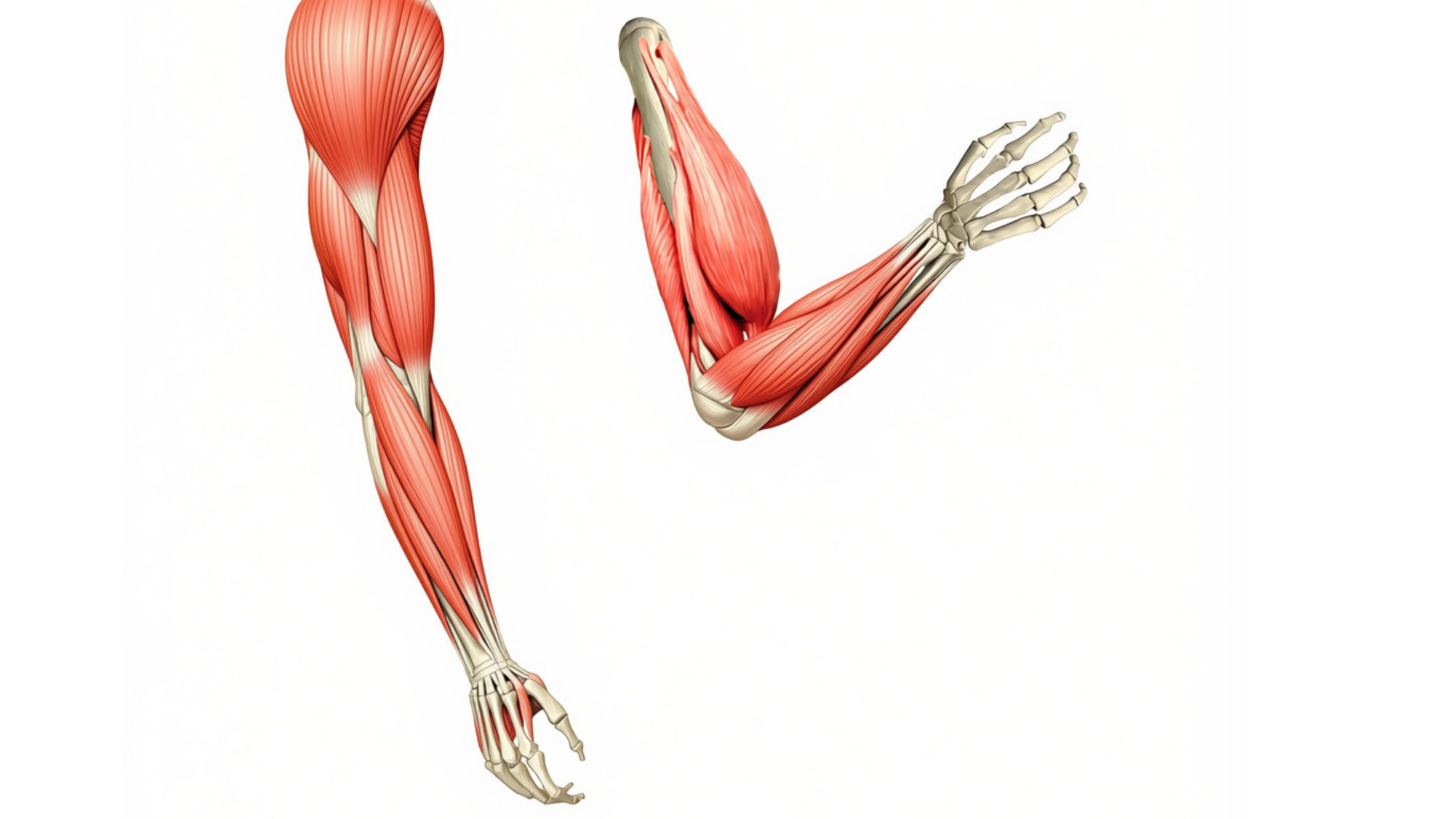
First, a quick review of the anatomy of the upper arm, which includes the biceps brachii and the triceps brachii.
The biceps and triceps perform opposite actions at the elbow, often in conjunction with each other. The biceps bend the elbow. The triceps straighten the arm. Think of driving a car with a stick shift. The triceps pushes the shifter away from you, and the biceps helps pull it back.
In yoga poses, the two muscles often contract at the same time, stabilizing the elbow. You might be able to see or feel this in poses that require you to bear and balance weight on your arms, including Sirsasana (Headstand) and Pincha Mayurasana (Peacock Pose or Forearm Balance).
Biceps
The biceps fills most of the space between the shoulder and elbow; if it’s well developed, it forms a noticeable bulge on the front of your upper arm. Biceps, which is Latin for “two heads,” refers to the muscle’s two sections; each has a tendon that attaches to the outer edge of the shoulder blade just above the shoulder joint. The other end of the biceps attaches to the radius, one of the two forearm bones, near the elbow.
You mainly use your biceps to bend your elbow, which you do dozens of times a day, whether you’re lifting something heavy, bringing a cup to your mouth, or pulling on a dog’s leash. You also use your biceps to help flex your shoulder when you lift your arm forward and then overhead. Finally, you use your biceps to help rotate your palm when you turn a doorknob or screwdriver.
Triceps
The triceps sit along the back of the upper arm. As the name implies, the triceps has three heads. Two originate on the humerus, or upper arm bone, and one originates on the outer edge of the scapula, just above the shoulder socket. The other end of the triceps attaches to the ulna, the second of the two forearm bones.
You mainly use your triceps to straighten your elbow—pushing a lawnmower or a heavy door or lifting yourself out of a chair by pressing into the armrests. The long head of the triceps also helps you perform shoulder extension, the position you use in Sarvangasana (Shoulderstand) and Setu Bandha Sarvangasana (Bridge Pose).
How to Build Arm Strength With Yoga
If you struggle to move from Plank Pose to Chaturanga to Upward-Facing Dog Pose (Urdhva Mukha Svanasana), you might wonder whether you should lift weights to build strength. And if you choose to go that route, you might try an exercise called the triceps press: holding a dumbbell overhead, bending your elbow to bring the weight to the back of the shoulder blade, and then straightening the arm again. This exercise would certainly strengthen your triceps—but not in the exact way you need.
Following are options for strengthening your upper body for these and other yoga poses. Work with versions you can happily practice about three times a week. If a strengthening exercise or pose is too hard, frustrating, or painful, you probably won’t practice it regularly enough to produce results. Practicing a strengthening move once a week doesn’t build much strength.
1. Practice the Poses That Challenge You
Research shows that the best way to strengthen muscles for any activity is to work them in the precise position—and in the same pattern of teamwork with other muscles—the activity requires. To build Plank-to-Chaturanga-to-Upward-Facing-Dog strength, you need to closely mimic the positions and actions the poses require.
The same principle holds for building a different kind of triceps power called isometric strength. In isometric actions, the muscle works but doesn’t change length, and the joint it’s influencing doesn’t change position. You need this kind of strength in many yoga poses that don’t involve bending and straightening the elbow against weight resistance, including Downward Dog, Handstand, Headstand, and Pincha Mayurasana.
If you’re already strong enough to practice the poses we’ve been discussing, the best ways to build power are through more repetitions and longer hold times.
2. Yoga Push-Ups With a Chair
If you’re not strong enough for that yet, practice modified versions that come as close as possible to reproducing the action of the full pose.
You can begin to condition your triceps isometrically by practicing a Downward Dog variation with your hands on the seat of an armless chair with its back legs against a wall for support. When facing the chair, walk your feet about three feet from the chair and push your hands onto the chair seat, straightening your elbows, lengthening your spine, and pushing your hips back in the shape of Downward Dog. (You’ll probably feel some stretch in the calves.)
Then lift your heels and shift your shoulders forward over your wrists into Plank Pose, forming a straight line from your heels to your ears. Move back and forth between Downward Dog and Plank a few times. As you practice this over several weeks, aim to gradually build endurance until you can hold each pose for at least a minute.
You can build the strength you need for the Plank-Chaturanga-Upward Dog sequence by turning these into yoga push-ups. Keep your elbows close to your sides, bend them just a few inches, and then straighten them again. These yoga push-ups are easier than the full version but will still prepare you.
3. Increase Your Hold Times
When you’re strong enough, move to the floor for your Downward Dog to Plank transitions. You can also practice yoga push-ups, and eventually full ones, from Plank position.
In all this work, be sure to keep a straight line through your legs and torso, without sagging in the middle. If you can’t hold the line, practice with your knees on the mat to create a straight line from your knees to your ears. When you practice with proper alignment, you target the muscles you want to strengthen. Otherwise, you recruit less anatomically optimal muscles to do the work. Again gradually increase your hold times to build your isometric triceps strength.
By doing Downward Dogs, Planks, and push-ups a few times each week, you build strength in your triceps that will allow you to practice most other poses with much greater ease.
4. Cross-Train
While it’s easy to use yoga to build triceps strength, building biceps strength is a different story. Biceps are very important in daily life, but they don’t get much work in yoga, which doesn’t include a lot of lifting or pulling. You may occasionally grasp your feet and bend your arms to pull yourself deeper into forward bends, or work your biceps in Headstand and Pincha Mayurasana. But that doesn’t really constitute a strength workout for the biceps the way Sun Salutations do for the triceps.
If you want to do some biceps weight lifting to complement your yoga, start by purchasing a small hand weight (two to five pounds). Leave it by your phone and do a few lifts as you chat. Start with your arm down at your side; keeping the upper arm in the same position, bend your elbow to bring your hand up to your shoulder. Start with 10 repetitions, and gradually build to three or four sets of 10. After a while, you’ll want to try a heavier weight.
Why Arm Strength Matters Beyond the Mat
Through our first three or four or five decades, most of us take for granted the ability to lift, push, and pull objects as we interact with the world. But if you don’t regularly challenge your strength in these activities, you tend to lose it. In my years of physical therapy practice, I’ve worked with many folks in the later decades of life who can’t lift a bag of groceries, get themselves up off a chair, or push open a heavy door. The key to avoiding this fate is working those upper arm muscles regularly, at least a few times a week. Your reward will be strong muscles that help you progress in yoga and help you live actively and independently all through your life.