
Published August 4, 2026 01:08PM
Yoga Journal’s archives series is a curated collection of articles originally published in past issues beginning in 1975. This article about Elbow Balance Pose or Forearm Balance (Pincha Mayurasana) first appeared in the July-August 1988 issue of Yoga Journal.
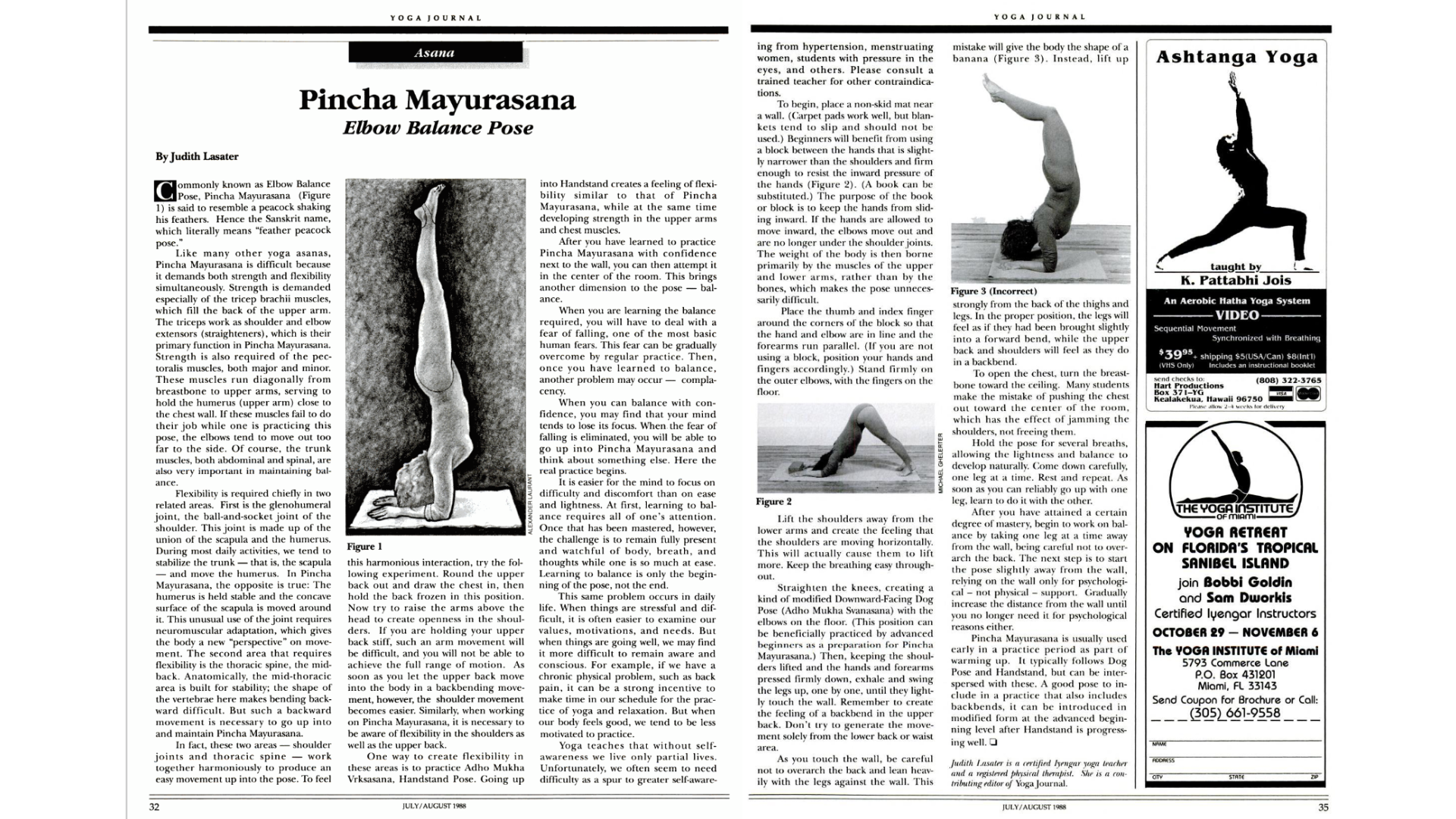
Commonly known as Elbow Balance Pose, Pincha Mayurasana is said to resemble a peacock shaking his feathers. Hence the Sanskrit name, which literally means “feather peacock pose.”
When you are learning the balance required, you will have to deal with a fear of falling, one of the most basic human fears. This fear can be gradually overcome by regular practice. Then, once you have learned to balance, another problem may occur—complacency. When you can balance with confidence, you may find that your mind tends to lose its focus. When the fear of falling is eliminated, you will be able to go up into Pincha Mayurasana and think about something else. Here the real practice begins.
It is easier for the mind to focus on difficulty and discomfort than on ease and lightness. At first, learning to balance requires all of one’s attention. Once that has been mastered, however, the challenge is to remain fully present and watchful of body, breath, and thoughts while one is so much at ease. Learning to balance is only the beginning of the pose, not the end.
This same problem occurs in daily life. When things are stressful and difficult, it is often easier to examine our values, motivations, and needs. But when things are going well, we may find it more difficult to remain aware and conscious. For example, if we have a chronic physical problem, such as back pain, it can be a strong incentive to make time in our schedule for the practice of yoga and relaxation. But when our body feels good, we tend to be less motivated to practice.
Yoga teaches that without self-awareness we live only partial lives. It is a challenge to bring that self-awareness to our moments of ease and delight as well. Another lesson Pincha Mayurasana teaches is that of poise. Poise is to the mind what balance is to the body, and this pose teaches both physical balance and mental poise. A beautiful Pincha Mayurasana expresses the student’s ability to be in literally any position and yet retain inner awareness.
The development of mental poise is one of the benefits of the asanas in general, but especially of the inversions. For in the inversions, by suddenly turning the body upside down, one must deal quickly with a radically new situation. Visually and kinesthetically, the nervous system must adapt rapidly and completely in order to preserve the integrity of the organism. When one can successfully adapt again and again, one gains a sense of confidence and freedom.
By practicing inversions, we learn that, regardless of our outer circumstances, we can remain grounded in the center of our being. In this case the “outer circumstance” is the body’s position in space. But even when we are not practicing asanas, the “asana” of life itself can give us many opportunities to develop emotional and psychological adaptability. When it is well developed, this adaptability is termed poise.
Practicing asanas for one’s own physical, mental, and spiritual development is admirable, but such practice is more meaningful when the benefits gained are shared with others. One need not teach yoga to be able to do this; in fact, the most powerfully transmitted lessons are the unspoken ones. A successful practice allows the student to spread the poise, balance, and self-understanding gained to family, friends, and world. For this reason it is preferable to measure one’s practice by the quality of one’s life and relationships, rather than by one’s ability and endurance in Pincha Mayurasana.
An asana exists only for a few seconds or minutes. But the awareness and goodwill that can come from its practice can be spread and shared with others almost without limitation. And the transcendence of perceived limitations is perhaps the greatest lesson of yoga.
How to Prep for Pincha Mayurasana
Like many other yoga asanas, Pincha Mayurasana is difficult because it demands both strength and flexibility simultaneously. Strength is demanded especially of the tricep brachii muscles, which fill the back of the upper arm. The triceps work as shoulder and elbow extensors (straighteners), which is their primary function in Pincha Mayurasana.
Strength is also required of the pectoralis muscles, both major and minor. These muscles run diagonally from breastbone to upper arms, serving to hold the humerus (upper arm) close to the chest wall. If these muscles fail to do their job while one is practicing this pose, the elbows tend to move out too far to the side. Of course, the trunk muscles, both abdominal and spinal, are also very important in maintaining balance.
Flexibility is required chiefly in two related areas. First is the glenohumeral joint, the ball-and-socket joint of the shoulder. This joint is made up of the union of the scapula and the humerus. During most daily activities, we tend to stabilize the trunk—that is, the scapula— and move the humerus. In Pincha Mayurasana, the opposite is true: The humerus is held stable and the concave surface of the scapula is moved around it. This unusual use of the joint requires neuromuscular adaptation, which gives the body a new “perspective” on movement.
The second area that requires flexibility is the thoracic spine, the mid-back. Anatomically, the mid-thoracic area is built for stability; the shape of the vertebrae here makes bending backward difficult. But such a backward movement is necessary to go up into and maintain Pincha Mayurasana.
In fact, these two areas—shoulder joints and thoracic spine—work together harmoniously to produce an easy movement up into the pose. To feel this harmonious interaction, try the following experiment. Round the upper back out and draw the chest in, then hold the back frozen in this position. Now try to raise the arms above the head to create openness in the shoulders. If you are holding your upper back stiff, such an arm movement will be difficult, and you will not be able to achieve the full range of motion. As soon as you let the upper back move into the body in a backbending movement, however, the shoulder movement becomes easier. Similarly, when working on Pincha Mayurasana, it is necessary to be aware of flexibility in the shoulders as well as the upper back.
One way to create flexibility in these areas is to practice Adho Mukha Vrksasana (Handstand Pose). Going up into Handstand creates a feeling of flexibility similar to that of Pincha Mayurasana, while at the same time developing strength in the upper arms and chest muscles.
Prep Poses for Pincha Mayurasana
Pincha Mayurasana is usually used early in a practice period as part of warming up. It typically follows Dog Pose and Handstand, but can be interspersed with these. A good pose to include in a practice that also includes backbends, it can be introduced in modified form at the advanced beginning level after Handstand is progressing well.
How to Practice Pincha Mayurasana
Pincha Mayurasana (Figure 1) should be avoided by those who cannot practice inversions, including persons suffering from hypertension, menstruating women, students with pressure in the eyes, and others. Please consult a trained yoga teacher for other contraindications.
1. To begin, place a non-skid mat near a wall. (Carpet pads work well, but blankets tend to slip and should not be used.) Beginners will benefit from using a block between the hands that is slightly narrower than the shoulders and firm enough to resist the inward pressure of the hands (Figure 2). (A book can be substituted.) The purpose of the book or block is to keep the hands from sliding inward. If the hands are allowed to move inward, the elbows move out and are no longer under the shoulder joints. The weight of the body is then borne primarily by the muscles of the upper and lower arms, rather than by the bones, which makes the pose unnecessarily difficult.
2. Place the thumb and index finger around the corners of the block so that the hand and elbow are in line and the forearms run parallel. (If you are not using a block, position your hands and fingers accordingly.) Stand firmly on the outer elbows, with the fingers on the floor.
3. Lift the shoulders away from the lower arms and create the feeling that the shoulders are moving horizontally. This will actually cause them to lift more. Keep the breathing easy throughout.
4. Straighten the knees, creating a kind of modified Downward-Facing Dog Pose (Adho Mukha Svanasana) with the elbows on the floor. (This position can be beneficially practiced by advanced beginners as a preparation for Pincha Mayurasana.) Then, keeping the shoulders lifted and the hands and forearms pressed firmly down, exhale and swing the legs up, one by one, until they lightly touch the wall. Remember to create the feeling of a backbend in the upper back. Don’t try to generate the movement solely from the lower back or waist area.
5. As you touch the wall, be careful not to overarch the back and lean heavily with the legs against the wall. This mistake will give the body the shape of a banana (Figure 3). Instead, lift up strongly from the back of the thighs and legs. In the proper position, the legs will feel as if they had been brought slightly into a forward bend, while the upper back and shoulders will feel as they do in a backbend.
6. To open the chest, turn the breastbone toward the ceiling. Many students make the mistake of pushing the chest out toward the center of the room, which has the effect of jamming the shoulders, not freeing them.
7. Hold the pose for several breaths, allowing the lightness and balance to develop naturally. Come down carefully, one leg at a time. Rest and repeat. As soon as you can reliably go up with one leg, learn to do it with the other.
After you have attained a certain degree of mastery, begin to work on balance by taking one leg at a time away from the wall, being careful not to overarch the back. The next step is to start the pose slightly away from the wall, relying on the wall only for psychological—not physical—support. Gradually increase the distance from the wall until you no longer need it for psychological reasons either.
After you have learned to practice Pincha Mayurasana with confidence next to the wall, you can then attempt it in the center of the room.
The author gratefully acknowledges her teacher B.K.S. Iyengar, and his book Light on Yoga, in the writing of this article.