
Published July 2, 2026 10:34AM
Yoga Journal’s archives series is a curated collection of articles originally published in past issues beginning in 1975. This article about Marichyasana D appeared in the May-June 2002 issue of Yoga Journal.
In the second chapter of Patanjali’s Yoga Sutras, we are introduced to the eight limbs—the ashtanga—of yoga. The eight limbs are presented in a very particular and deliberate order. The yamas, sometimes defined as “restraints,” are the first limb.
The yamas are codes of conduct for your relationship with the world. The word “restraint” is very significant in understanding these codes. Boundaries actually allow for freedom; by creating structure, you create a safe environment in which to develop.
The first yama is ahimsa, nonviolence, or, as I prefer to think of it, kindness. If we can be kind in all our actions and thoughts, we have mastered yoga. The second limb is satya, or truth. Satya follows ahimsa because if our speech is truthful but unkind to others, it is in essence a violent act, and we should not speak such truth. In asana practice as well, truthfulness should never interfere with nonviolence. If a posture causes pain or discomfort, then we are violating the very core of yoga.
In asana practice, we must consider the role of truth both as students and as teachers. The same truth guides us all, but it manifests itself differently in various bodies. What is nonviolent and liberating for one may be binding and harmful for another. The way in which I teach an asana to a student must reflect that student’s current and inherent condition. I don’t teach an asana to a flexible student the way I would teach it to a stiff one.
The art of teaching yoga is recognizing the need to teach yoga to people rather than impose asanas on them. My teacher, Sri K. Pattabhi Jois, teaches a system of hatha yoga based on Patanjali’s ideas that is known as Ashtanga Yoga. This system of yoga is a series of poses taught one by one in a very deliberate order; each pose prepares the body for the next. A certain amount of accomplishment must be present in each asana before moving on to the next.
However, that amount varies from student to student. Ashtanga Yoga is a framework, and it is not intended to thwart a student’s progress. The fact that a pose is a logical part of a series does not mean it is automatically good for all students at all times. If a student is struggling with a pose, the student may still be able to move ahead in the series. A variation of the pose can be introduced that addresses the root of the student’s difficulty, and with time the classical posture will emerge. Like the eight limbs and the individual verses in the Sutra, all the poses are interconnected and support one another.
Growing a Lotus
In each Ashtanga sequence, some asanas especially challenge us and take us out of our comfort zone, demanding that we confront our attitudes as well as deepen our connection to the physical self.
Marichyasana D (Pose Dedicated to the Sage Marichi) is such a pose: a major twist that requires open hips, open shoulders, a supple spine, and, more importantly, the patience and respect that flow from ahimsa and satya. But the Primary Series gives us all the tools necessary to develop Marichyasana D. When practiced regularly, the many standing poses and sitting postures that precede Marichyasana D add up to this amazing asana.
The poses in the Primary Sequence, including Marichyasana D, focus heavily on opening the hamstrings and getting the hips ready for Padmasana (Lotus Pose). If the hips are not open, Padmasana can strain the knees. Students struggling with Padmasana often take their frustrations out on their knees by forcing them into the pose, but that’s like yelling at your children instead of lovingly communicating to get them to do the right thing. The knees must never be forced.
Violating the principles of ahimsa and satya for the sake of getting into the pose ultimately leaves you empty—and often injured as well.
To begin work on the hip opening you’ll need for Marichyasana D, sit in Dandasana (Staff Pose) with both legs out in front of you and your hands beside your hips. Flex your feet and reach out through all 1o toes. Let the tops of your thighs ground into the floor so that the entire back of the legs and both heels are fully in contact with the ground. Press both sitting bones deep into the floor.
From this rooting begin to draw the sacrum into the center of the body, creating a lift in the torso. Lift your back ribs away from your lower back, creating space at the waist. From two inches below your navel, gently draw your lower belly up toward the top of the sternum. From the top of the sternum, expand out into the collarbones. Move the shoulder heads back until they line up with the center of the hips. Drop your shoulders down away from the ears, letting the trapezius muscles at the rear sides of the neck slide down the back as you draw the bottom tips of the shoulder blades into the body.
As the shoulders melt, root the palms of the hands. As the palms press, sit up tall and feel the core of the body become light, as though you were hollow.
Without disturbing the lift of the spine, rotate the left leg out, bend the knee, and take hold of the left foot and shin, reaching from underneath. Flex your foot so the inner and outer ankle lengthen evenly. This way of holding and positioning the foot is critical to the health of the knee.
If you reach over the foot to clasp it, you put unnecessary pressure on the knee. And if you do not flex your foot, it will sickle, overstretching the outer ankle and collapsing the inner ankle. A sickled foot jeopardizes not only the ankle but also the knee. With the foot torqued, the outer knee overstretches and the inner knee shortens.
Keeping the foot flexed and holding it from underneath, sit up out of the lower back. Rotate the left thigh open from deep inside the hip and take your mind into the left sitting bone. Form an energetic connection between the heel and sitting bone by pressing down through the sitting bone as you continue to reach out through the heel. Maintaining these actions, move the knee away from the body. When you activate the heel-sitting bone connection and rotate the femur correctly, you will protect the knee.
This is an important moment to examine the truth of your pose. Observe the shape of the lower back. If it protrudes, you should spend time with this variation and work to strengthen your back muscles by sitting upright. Roundness in the lower back is often due to tight hamstrings and hips. In the case of excessive rounding, where there is pressure on the sacrum, place a folded blanket under your sitting bones.
If you have to work extremely hard in this position to prevent your lower back from rounding and your left hip from screaming, you should probably keep working like this rather than immediately attempting Ardha Padmasana (Half Lotus). But if you are ready for Half Lotus, continue to hold the foot from underneath and bring your heel directly in front of your navel. Maintaining the energetic connection between the left heel and sitting bone, point the left foot and then spin the heel up toward the ceiling by rotating the right thigh from deep inside the hip.
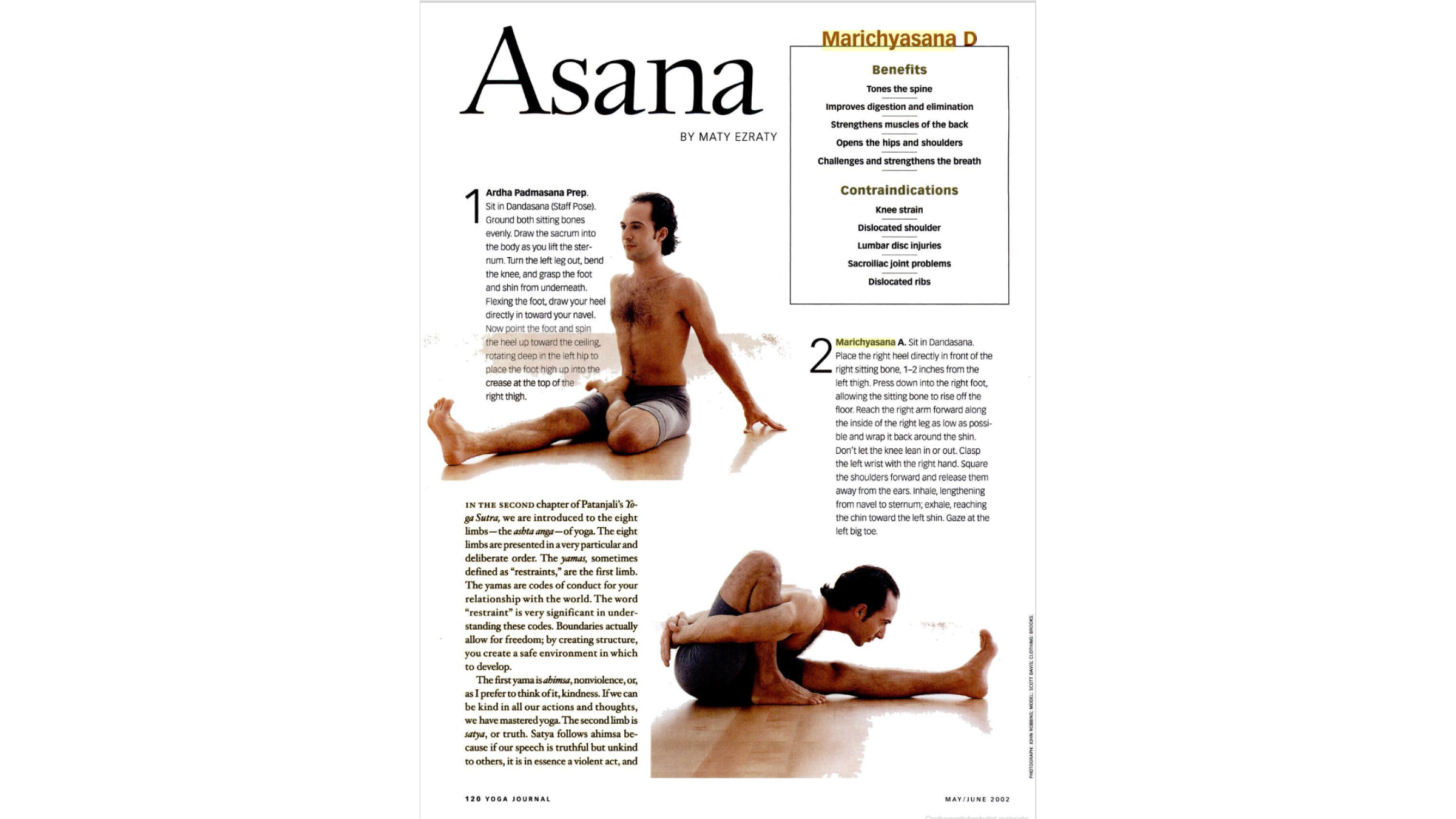
Since you need to place the foot high up into the crease between the hip and thigh for Half Lotus, it is often helpful to hold the foot with the left hand only and use the right hand to move the thigh flesh out of the way as you put the left foot into Half Lotus (Figure 1). If you feel painful pressure on the top of the thigh from the weight of the foot, the foot is not high enough in the crease.
As you enter Lotus Pose, it’s critical to flex the foot and cradle it from underneath rather than from on top.
Now comes the time for more truth. There may be pain in the knee, and you shouldn’t ignore it. Sometimes the pain occurs because the knee can’t reach the floor and is up in the air with no support. Try putting a block or a blanket under the knee and thigh. The support will often help the knee and hip to relax and open.
Other times the knee hurts because the joint needs space. If that’s the case, it may help to roll a very small towel and place it deep at the back of the knee to create space in the joint as you come into Half Lotus. If the pain persists after you try these variations, please practice loving-kindness: Do not force this pose; instead, practice the prep.
Once the left foot is in Half Lotus, press both sitting bones down and draw your sacrum into the body. Also maintain the heel-sitting bone connection and continue to keep your foot from sickling.
As you externally rotate the left thigh, reach your knee away from the hip and down to the ground. Never force the knee down; instead, invite it to extend and give it the time it needs. In addition, make sure that you don’t bring the knee down at the expense of grounding the sitting bones.
Wrapping the Arms
The next step toward Marichyasana D is learning to wrap the arm around the leg in Marichyasana A. Begin again in Dandasana. Bend the right knee straight up and place the right heel directly in front of your right sitting bone. Your foot should be one or two inches away from the left inner thigh and the right calf must be in full contact with the back of the right thigh. If the foot is off to the right of the thigh, the knee will be strained, particularly when you add the wrap.
Keep the left leg in Dandasana. Do not roll the thigh in or out. Draw the right sitting bone off the floor and press down into the right foot as though you are standing on it. The right knee should be pointing straight up, not “pigeon-toeing” in or splaying out. You should maintain all these positions throughout the pose.
Keeping your left hand on the floor on the outside of the left hip, reach your right hand forward along the inside of the right leg as though you want to take this hand past the left foot. Again the right knee will want to splay out. Resist this tendency. The armpit and shinbone should press snugly, with no space between the side of the body and the side of the leg. If there is a lot of space between the right shin and the right arm, the shoulder is at risk, so do not force the wrap. Instead, hold the front foot with both hands and keep working the right knee in toward the body.
If your shin and armpit press snugly together, bend the right elbow and each the right hand around behind you, placing it as far across the back at waist level as you can. Reach the left hand back too and clasp the left wrist with the right hand, keeping both elbows bent. If the fingers don’t touch, hold a strap with both hands and gradually move your hands closer together.
At this moment, take a smooth breath in and reach from your navel all the way up into your sternum. Make the front of your body as long as the back of your body. Draw your shoulders away from the ears and square the shoulders straight forward. Let the bottom tips of the shoulder blades move into the chest, and open across the collarbones, almost as though you are creating a backbend in the upper back. With your next exhalation, reach your torso forward until the chin meets the left shinbone and gaze at the left big toe (Figure 2).
In the finished pose, there is some natural roundness in the lower back, but if the back rounds excessively, it is best not to fold forward. Instead, stay upright and work on lengthening the spine. Extreme roundness of the back in forward bends weakens the lower back muscles. If you stay upright and work on extension, you will get stronger. In fact, you will progress more rapidly than if you bend forward prematurely. Again, you must work with the truth of your pose.
The next pose in Ashtanga’s Primary Series, Marichyasana B, combines Half Lotus and Marichyasana A. If your knee is not ready to practice Half Lotus, you need to practice a variation that will further the hip opening necessary for the final pose. Remember the importance of restraint and of maintaining the integrity of your core. If you neglect the root of the problem—in this case, the hips—you will create suffering. In Marichyasana B, you will harm your knees. So be truthful and work where you need to work.
To further the hip opening needed for Marichyasana B, begin by sitting in Dandasana. Place the left ankle just above the kneecap. Flex your left foot, lengthening evenly through the inner and outer ankle. Now begin to bend the right knee and draw the right foot as close as possible toward the right sitting bone. If the lower back rounds, you have gone too far.
Pressing evenly into both sitting bones, draw the left knee away from the body.
Work to externally rotate the left thigh open as you activate the sitting bone and left heel connection. When you can bring the right heel all the way to the right sitting bone while still sitting upright, with the chest touching the shinbone, this variation is complete. Usually at this point students can approach Half Lotus comfortably, and it is time to attempt full Marichyasana B. If Half Lotus still irritates your knee, seek the advice of a teacher. If you’re ready for Marichyasana B, start with the left foot in the Half Lotus position.
Bend the right knee as in Marichyasana A. Lift the right sitting bone off the ground and stand firmly on the right foot. Making sure the right knee is pointing straight up at the ceiling, extend the right arm in front of you. Take the right arm as far down the shinbone as you can, securing the right leg against the side of the body.
Bend the right elbow and reach back around the shinbone, taking a few breaths to work the right hand around the back as far as possible. Reach back with the left arm and clasp the left wrist with the right hand. Inhale and look up; exhale and draw your chin or forehead toward the ground. The right sitting bone remains lifted. Square the shoulders to the ground and move the bottom tips of the shoulder blades deep into the body.
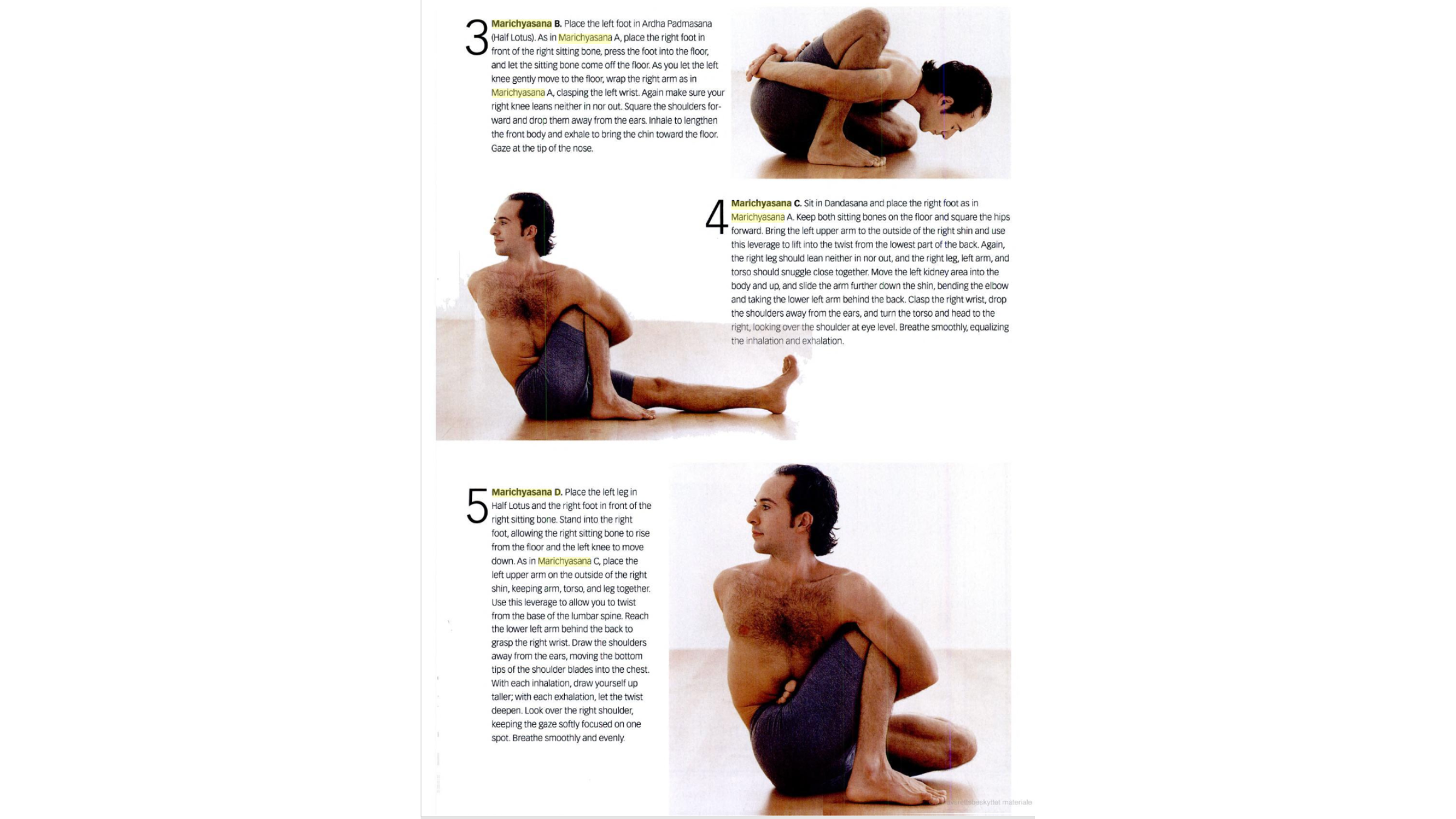
Reach the top of the sternum forward to counter the tendency to round the back (Figure 3). Do not let the wrap pull the right upper arm bone out of place; instead, keep it seated in the socket. The tight fit of the shinbone and armpit and this shoulder action should keep the shoulders safe and the work honest.
Twisting from Your Roots
The next step toward Marichyasana D is working on twisting in Marichyasana. The first rule in twists is to create maximum length in the spine before twisting. The second rule is to twist from the lowest part of the lumbar spine rather than just from the shoulders and head.
To apply these rules in Marichyasana C, begin in Dandasana. Root the sitting bones down and lift the sacrum into the body. Let there be a feeling of elongation from the perineum all the way to the crown of the head. Bring the right knee into Marichyasana A position. Again, it is vital that the right shin and thigh meet. If the foot is off to the right of the thigh, the twist will endanger not only the right knee but also the right sacroiliac joint.
Take the right hand behind you and bring the left upper arm to the outside of the right knee. Slide the arm as far down the leg as you can. The left side of the body, the arm, and the leg should be like pieces of a puzzle fitting together so that no light comes through. Stand into the right foot and square your hips to the front. Keep the left leg from rolling in or out, reach out through the left heel, and press the top of the left thigh and heel into the ground. As the right hip moves forward to square with the left hip, begin to turn from the navel and twist the entire torso to the right. As you root the right sitting bone down, the left kidney area must continue to turn and move into the body
To deepen the pose, move the arm further down the leg. Remember the basic rule of twisting: Length first. Keep lifting from the perineum all the way through the crown of the head. Also utilize the second rule of twisting: Twist from the lowest part of the lumbar spine. Resist the tendency to round the lower back, deepening the action of the left kidney area into the body and up toward the right chest.
Both sides of your waist should be even in length. Two actions will help you achieve this. First, press the arm and leg into each other as you stand more firmly on the right foot. Second, as you press your sitting bones and square the right hip with the left, lengthen your torso as though your waistline is getting two inches longer. Drop the shoulders away from the ears as the bottom tips of the shoulder blades move into the chest. Broaden across the collarbones. As the shoulders drop, resist sinking the whole torso by lifting the back ribs and the core of the body. Again, you must check in with the truth of the pose in your body. If your back rounds or if the torso and leg are separated, stay here until you can sit up straight and join the knee and armpit.
The final step in Marichyasana C is the arm wrap. With the armpit and the knee pressed together, straighten the left arm and spin the entire arm so that the palm turns up to the ceiling. Deepen the action of the arm down the leg by rotating the left kidney side of the back in and around.
Resist the rounding of the left shoulder forward: Work the muscles of the trapezius down your back and sit up from deep inside. Bend the right elbow and reach behind the back. With the left hand, reach for the right wrist or fingers. Once the hands are clasped, it is easier to sit up straight because you have created a natural point of leverage for the body. Resist the tendency of the left shoulder to climb up to the ear by bringing the twist into the upper back. Remember the shoulder work of Dandasana: Take the trapezius muscles down the back, move the bottom tips of the shoulder blades into the body, lift from the top of the sternum, and widen across the collar bones (Figure 4).
Marichyasana D begins much like Marichyasana B, with the left leg in Half Lotus while the right leg is in Marichyasana A. Then it adds the twist.
From Marichyasana, bring the left upper arm to the outside of the right knee, moving the arm as far as possible down the shinbone. Do not let the elbow push your knee toward your midline; instead, create leverage by pressing the arm and leg together to create height in the spine.
Pause here and reflect. Marichyasana D is a beautiful and alluring posture. The temptation for all of us if we’ve made it this far is to complete the pose before considering if this is appropriate. Your true yoga might be to stay right here. In honoring your truth, you will actually make more progress because you are able to work from your roots. You may find it easier to originate the twist from the lowest part of the lumbar spine if you work with the arm by the side of the leg instead of rushing to wrap your arms.
If you have decided that it is appropriate for you to wrap, sit upright with the right sitting bone just off the floor. As you reach the left upper arm down the leg, remember to twist from the lowest part of the lumbar spine, then from the left kidneys, and only then from the upper back, head, and neck. With the arm tight against the right leg, bend the left arm and reach it far behind you and toward the middle of the back. Reach back with your right arm and clasp the right wrist with your left hand. Once you’ve made the clasp, draw your navel up into the sternum and lift the sternum up. Resist rounding in the shoulders. Create a feeling of backbending in the upper back to open and expand the twist (Figure 5).
If your back has rounded, you have skipped over the first rule of twisting.
Consider releasing the wrap and working on the art of the twist. Don’t make the clasp simply from your limbs. The arms are not there to decorate the pose; they must move from their roots in the spine.
Recognizing what is true for you can be difficult, sometimes painful. Particularly if you want to be at a place that in actuality you are not ready for. You would never tell a friend to hike Mt. Everest before attempting a local canyon. You’d also suggest a good pair of hiking boots instead of Birkenstocks.
Direct the same compassion and common sense you would use with a best friend toward yourself.
Practice ahimsa and satya. It is your attitude, your facility with the tools you have, and your knowledge of where you want to go that ultimately land you at your goal. After all, the yoga asanas were intended simply as a map, a road to our true nature. Mahatma Gandhi said that truth is God and God is truth. Apply this everywhere, to everything, from work to play to Marichyasana D. This is yoga.