
And challenge you in other beneficial ways as well.
(Photo: Thomas Barwick | Getty)
Published August 9, 2026 05:05AM
Yoga Journal’s archives series is a curated collection of articles originally published in past issues beginning in 1975. This article about Revolved Triangle Pose (Parivrtta Trikonasana) first appeared in the July-August 1979 issue of Yoga Journal.
Combining the elegance of a twist and the strength of a standing pose, Parivrtta Trikonasana is one of the more beautiful and difficult of the standing series. A good understanding of Uttihita Trikonasana, the Triangle, will prepare the student for Parivrtta Trikonasana, the Revolved Triangle, in which one rotates the torso to face backward, instead of facing forward. ,,,,,,,,
Psychologically, Parivrtta Trikonasana brings the student more into contact with his/her personal unknown—represented by the spine. In the Triangle, it is easy to be concerned with the legs alone, but in the Revolved Triangle pose, the student must become aware of that which s/he cannot see—the spine. Becoming aware of the back is said to facilitate awareness of the unconscious, the unknown, and the feared. Understanding and directing the movement of one’s back, as well as the movement of one’s unconscious, is an important step in integrating the mind.
According to Patanjali, the movement of the mind-stuff, cittam, includes movement on all levels of the mind. (In the West we use the Freudian terms conscious, unconscious ego, id, and superego.) It is only the cessation of movement of mind-stuff that allows one to perceive one’s true nature, termed purusa. Thus it is necessary for the yogi to become aware of, and free from, the unknown conflicts and fears which the unconscious mind holds, and which are impediments to clarity of mind and action.
By re-owning one’s body through the development of a sensitive awareness, the interaction between body and mind is more clearly experienced. No movement is possible without this interaction; asana, therefore, is a mental act which is expressed by the thought of the body, not vice versa. When the body and the mind can work in complete harmony, the asana, or pose, becomes an expression of that perfect harmony.
Perfection expressed is another definition of worship, and worship of the Higher Self is its purest form. Such an act is not possible unless one understands, on all levels of one’s being—physical, mental, and spiritual—the profound connection between one’s physical and spiritual selves. To see the dichotomy of action and thought is to live in a state of separation, but to bring unity to movement and mind in such asanas as Parivrtta Trikonasana is to express the unity of Self and Universe.
How to Do Revolved Triangle Pose or Parivrtta Trikonasana
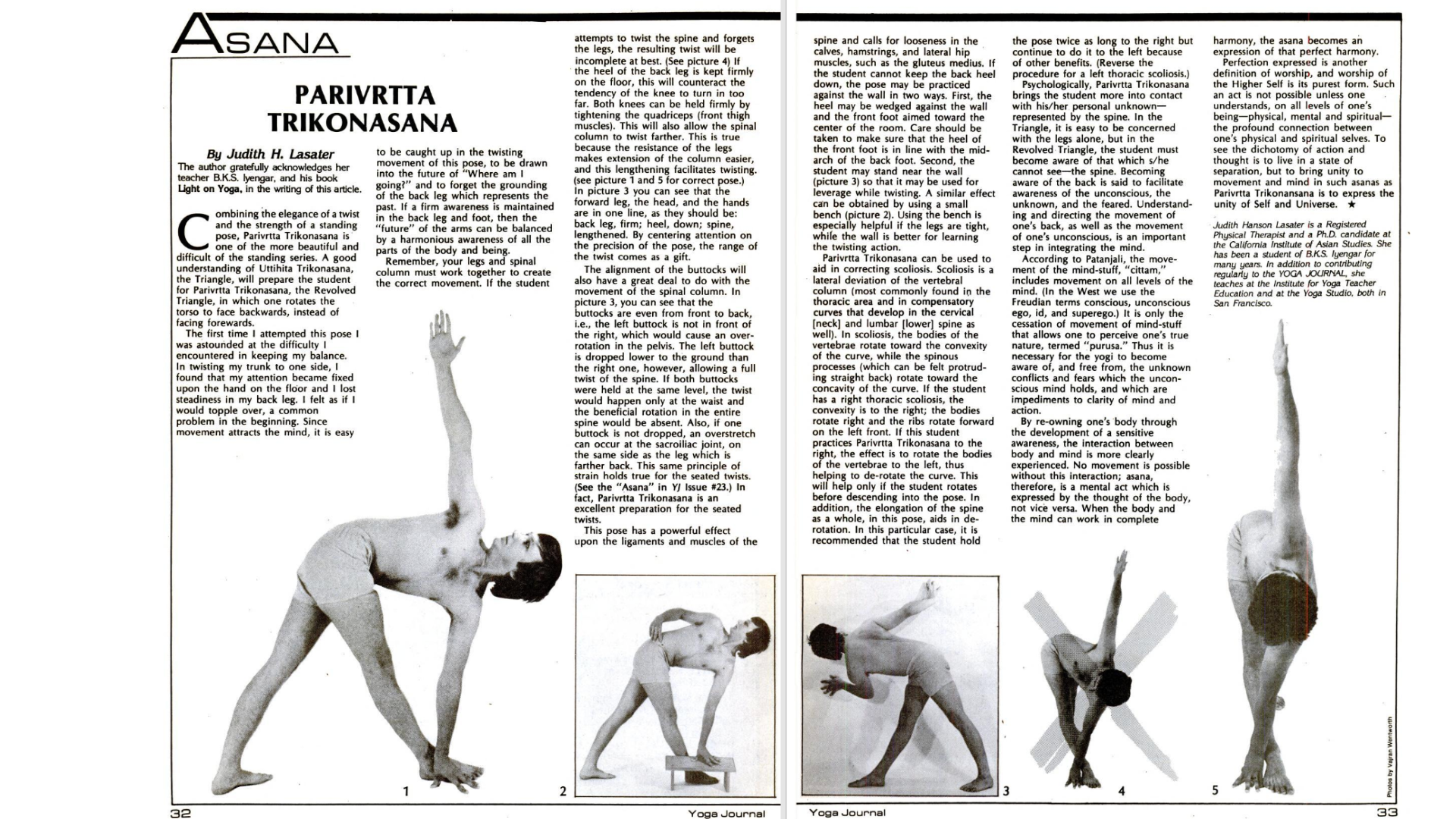
The first time I attempted this pose, I was astounded at the difficulty I encountered in keeping my balance. In twisting my trunk to one side, I found that my attention became fixed upon the hand on the floor and I lost steadiness in my back leg. I felt as if I would topple over, a common problem in the beginning. Since movement attracts the mind, it is easy to be caught up in the twisting movement of this pose, to be drawn into the future of “Where am I going?” and to forget the grounding of the back leg which represents the past. If a firm awareness is maintained in the back leg and foot, then the “future” of the arms can be balanced by a harmonious awareness of all the parts of the body and being.
Remember, your legs and spinal column must work together to create the correct movement. If the student attempts to twist the spine and forgets the legs, the resulting twist will be incomplete at best. (See picture 4.) If the heel of the back leg is kept firmly on the floor, this will counteract the tendency of the knee to turn in too far. Both knees can be held firmly by tightening the quadriceps (front thigh muscles). This will also allow the spinal column to twist farther. This is true because the resistance of the legs makes extension of the column easier, and this lengthening facilitates twisting. (See pictures 1 and 5 for correct pose.) The forward leg, the head, and the hands are in one line, as they should be: back leg, firm; heel, down; spine, lengthened. (See picture 3.) By centering attention on the precision of the pose, the range of the twist comes as a gift.
The alignment of the buttocks will also have a great deal to do with the movement of the spinal column. In picture 3, you can see that the buttocks are even from front to back, i.e., the left buttock is not in front of the right, which would cause an over-rotation in the pelvis. The left buttock is dropped lower to the ground than the right one, however, allowing a full twist of the spine. If both buttocks were held at the same level, the twist would happen only at the waist and the beneficial rotation in the entire spine would be absent. Also, if one buttock is not dropped, an overstretch can occur at the sacroiliac joint, on the same side as the leg which is farther back. This same principle of strain holds true for seated twists. In fact, Parivrtta Trikonasana is an excellent preparation for seated twists.
This pose has a powerful effect upon the ligaments and muscles of the spine and calls for looseness in the calves, hamstrings, and lateral hip muscles, such as the gluteus medius. If the student cannot keep the back heel down, the pose may be practiced against the wall in two ways. First, the heel may be wedged against the wall and the front foot aimed toward the center of the room. Care should be taken to make sure that the heel of the front foot is in line with the mid-arch of the back foot. Second, the student may stand near the wall (picture 3) so that it may be used for leverage while twisting. A similar effect can be obtained by using a small bench (picture 2). Using the bench is especially helpful if the legs are tight, while the wall is better for learning the twisting action.
The author gratefully acknowledges her teacher B.K.S. Iyengar, and his book Light on Yoga, in the writing of this article.