

The word “Guru” is often misunderstood within the modern yoga culture. The concept is usually reduced to personality, authority, or charisma, yet within the traditional sources of Sanātana Dharma (the eternal way of righteous living), Guru is not primarily a person. It’s a principle that reveals how knowledge itself is understood.
Modern examples make the Guru concept hard to understand properly, so we begin with śāstra.
Why Does Every Tradition Speak of Guru?
Before asking “Who is a Guru?”, what if we contemplated,
Why does the concept of Guru appear across multiple foundational texts of Sanātana Dharma?
This idea shows up across distinct textual traditions: Yoga, Vedānta, Upaniṣads, and the Gītā; it isn’t incidental. It points us to the nature of knowledge and transformation.
Guru, in this sense, is not a cultural addition. It is built into the very structure of how Self-knowledge unfolds.
Guru in the Yoga Sūtras
In Patanjali’sPatañjali’s Yoga Sūtras, Guru is mentioned explicitly only once:
sa eṣa pūrveṣām api guruḥ kālenānavacchedāt (YS I.26)
“Īśvara is the Guru even of the ancient teachers, because He is not limited by time.”
Patañjali doesn’t start with a human teacher. He begins with Īśvara: the timeless source of knowledge itself.
So here’s a different way to look at it: the Guru doesn’t “have” knowledge in their pocket. They’re more like a conduit. The teaching comes through them, not from them. Any genuine teacher is plugged into that same current. None of them invented it.
Guru in the Bhagavad Gītā
The Bhagavad Gītā presents the Guru–student relationship through the student’s attitude:
tad viddhi praṇipātena paripraśnena sevayā
upadekṣyanti te jñānaṁ jñāninas tattva-darśinaḥ (4.34)
“Know this through reverence, sustained inquiry, and service.
Those who see the truth will pass that knowledge on.”
Three things that shape the approach:
• Praṇipāta: you come open, not blind submission or pretending you already know everything
• Paripraśna: deep, sustained inquiry: not arguing to win.
• Sevā: helping without wanting something in return.
This is not a model of obedience. It is a model of engaged, intelligent learning guided by those established in truth (tattva-darśinaḥ).
Guru in the Upaniṣads
The Muṇḍaka Upaniṣad makes the necessity of a teacher explicit:
tad vijñānārthaṃ sa gurum evābhigacchet samit-pāṇiḥ śrotriyaṃ brahma-niṣṭham, (MU 1.2.12)
“To know That, one must approach a Guru, one who is well-versed in scripture and established in Brahman.”
Two qualifications are essential:
• Śrotriya: they’re rooted in the living tradition, not only books.
• Brahma-niṣṭha: established in direct knowledge, not theory.
You don’t need a Guru because reality is hidden. You need one because ignorance is sneaky. Self-knowledge takes both right teaching and clear seeing.
The Taittirīya Upaniṣad puts the relationship at the centre of learning:
ācārya devo bhava
“Let the teacher be for you like a deity.”
Yes, this can sound intense, yet it isn’t about worshipping a personality. It’s saying: knowledge changes the whole person, not just the head. So the entire process of learning asks for reverence. Reverence here refers to a willingness to let the pure teaching test and change you, instead of just collecting information and ideas.
Śaṅkara and the Removal of Ignorance
In Advaita Vedānta, the Guru is defined by function, not form: the removal of avidyā (ignorance).
This becomes clear in texts such as the Guru Aṣṭakam (traditionally attributed to Śaṅkara), where each verse ends with the question:
tataḥ kim, “what then?”
Then what? Status, wealth, or scholarship if ignorance runs the show?
The Guru is means of clarity. Without that knowledge, everything else remains incomplete.
The Symbolism of the Guru’s Feet
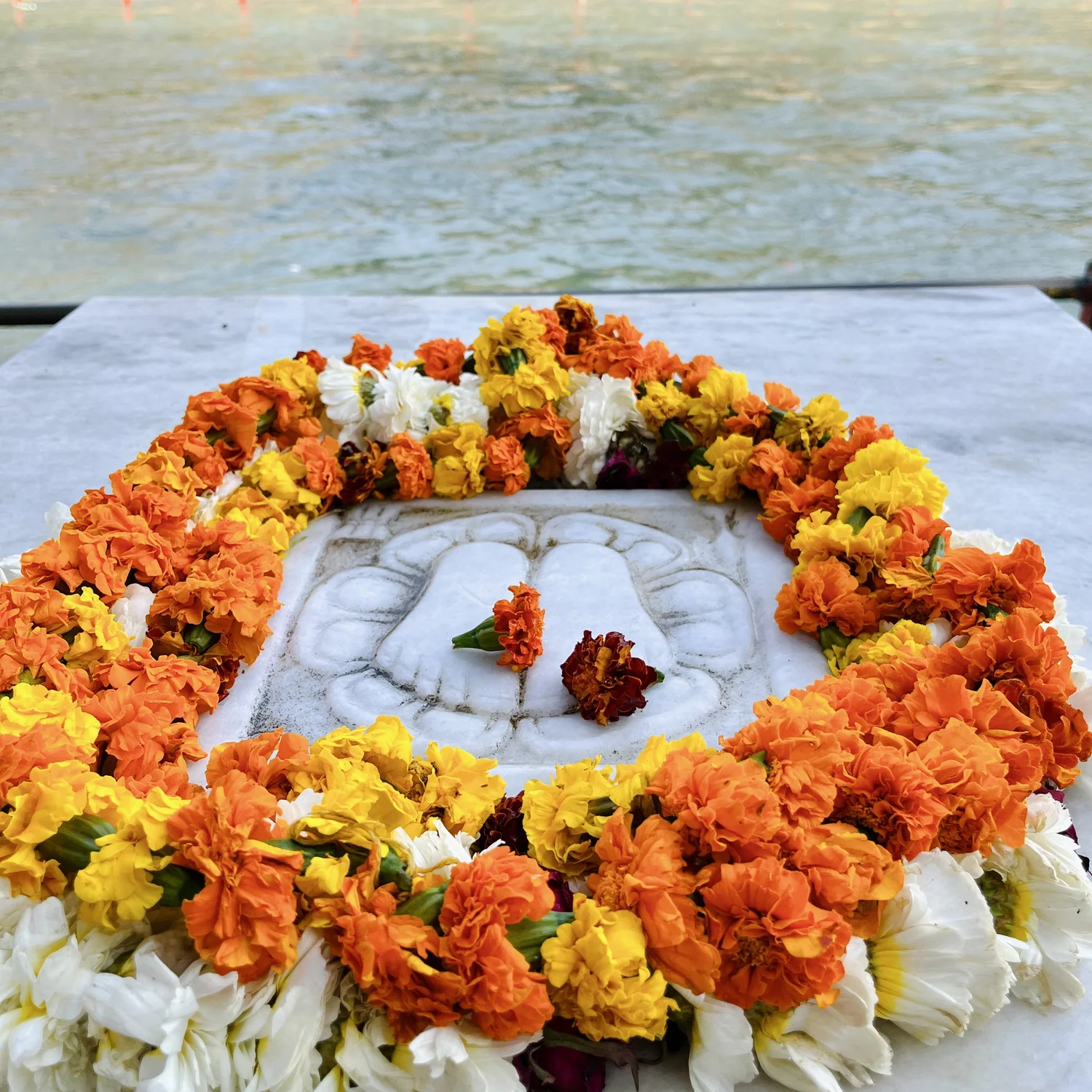
Traditional images depict the Guru’s feet (guru aṅghri padma). It’s easy to misread this. But symbolically, the feet represent the root.
Just as a tree survives by remaining connected to its roots, knowledge remains alive only when connected to its source. Bowing is not about elevating a person; it is about aligning oneself with truth.
So, humility isn’t submission to authority. It’s being willing to let reality be bigger than your current understanding.
A Principle Across Traditions
Step back, and the pattern becomes obvious:
• The Yoga Sūtras present Guru as the timeless source of knowledge (YS I.26)
• The Bhagavad Gītā defines the student’s approach: reverence, inquiry, and service (4.34)
• The Upaniṣads establish the necessity and qualifications of a teacher (MU 1.2.12)
• Advaita texts such as Vivekacūḍāmaṇi emphasise the rarity of guidance and the role of discrimination
• Devotional texts like the Guru Gītā expand the symbolic and devotional dimensions of the Guru principle
The Guru is presented as a consistent principle across all these sources, not a personality. Therefore, knowledge must be transmitted and learned directly, not from YouTube or an article, with real-time, accurate refinement and guidance. That’s the whole point. If this gets changed, the teachings become distorted.
Guru as a Relationship with Knowledge
Ultimately, Guru is not defined by external form but by function.
Knowledge in this tradition is not information. It is the very transformation of perception, identity, and understanding.
If perception has not changed, then knowledge has not yet taken place.
The Guru, therefore, is not someone to follow mindlessly, or someone to reject prematurely. The Guru is the living interface between ignorance and clarity.
Understanding this moves the idea away from personalities to principles, from opinion to śāstra, and from belief to direct knowledge.
Tara Mitra is a C-IAYT certified yoga therapist and lineage teacher within the Krishnamacharya-Desikachar tradition with 23 years of practice and 17 years of teaching. She offers mentorship programs for advanced yoga teachers alongside Dr Vigneshwar Bhat (Vedic priest and scholar), and Dr Robert Lamport (Gonstead chiropractor). Her teaching draws on Patanjali’s Yoga Sūtras, yoga therapy, Vedic chanting and Āyurveda. Her work is rooted in the transmission of authentic Indic knowledge within a living lineage.
Mentorship, courses, and programs at taramitrayoga.com
About This Article
This article explores the Guru concept in yoga as it appears in Sanātana Dharma, drawing on the Yoga Sūtras, Bhagavad Gītā (4.34), and the Upaniṣads. It’s written for yoga teachers, advanced students, and anyone interested in the traditional Guru–student relationship beyond personality worship. Key themes include Praṇipāta (reverential openness), Paripraśna (deep inquiry), and Sevā (selfless service), and how knowledge is transmitted, refined, and guided within the tradition. It forms part of an ongoing series on yoga philosophy and education for contemporary practice.