
Published June 28, 2026 05:05AM
Chances are you’ve heard the term “shadow work.” Pop psychology has dubbed it the process of uncovering hidden aspects of yourself and social media would have you believe it means journaling, speaking to your inner child, or Googling your dreams for analysis. But as with most things, shadow work is more complicated than can be explained in a 90-second video.
Shadow work generally refers to uncovering unconscious emotional aspects of yourself, particularly your trauma and shame. As a concept, it’s intended as enhancing your self-awareness and is largely attributed to the work of 20th-century psychologist Carl Jung.
Jung’s explorations were influenced by Hindu and Vedic teachings that had been in circulation for thousands of years. His writings, riddled with Eurocentric superiority, repeatedly acknowledge the ancient concepts of Brahman or universal consciousness and Atman or the individual, which Jung referred to as “collective consciousness” and “self.”
What Jungian psychology and ancient yogic philosophy teach is that through self-study, you can uncover hidden aspects of yourself. That level of self-exploration goes beyond talking to your inner child or journaling about your darker moments. It encompasses becoming intimately aware of and accepting all aspects of your authentic self. This is understood as an integral part of the larger but lesser talked-about aspect of shadow that explores able to understand our role beyond the individual as part of the universal.
One way to explore your darkness, or shadow side, is through another Hindu concept known as the chakras. Believed to be energy centers located along the central line of the body, the chakras are supported by the practice of yoga, which works to support the clearing of any obstructed chakras. Yet the emphasis is almost exclusively on the front body. When a yoga teacher cues students to “open your heart space,” what they mean is to connect with the Anahata, or heart chakra. The instruction is usually to create an outward flow of compassion and care that radiates outward. Or, more accurately, forward.
The lesser talked-about back side of the body, which symbolically aligns with shadow sides of ourselves, is equally important. The back side of the Anahata chakra, for example, is associated with our past experiences and emotions. Envisioning breath moving into the back of our heart space can support exploring any hidden resistance we hold around the concept of love. When we explore our shadow side, we do not turn away from our pain. We hold it with compassionate awareness.
When we tune into the hidden parts of ourselves through our yoga practice, we become more aware of the self, which in turn enables us to connect with the universal. A primary place to begin with shadow work is the back of the heart chakra, which holds our ability to be compassionate for self and others and can be addressed through heart-opening yoga poses.
Heart-Opening Yoga to Support Shadow Work
Following are heart-opening yoga poses that bring conscious awareness to the back of your heart space. Allow ample time in each pose so you can simply be with whatever you might be holding there.
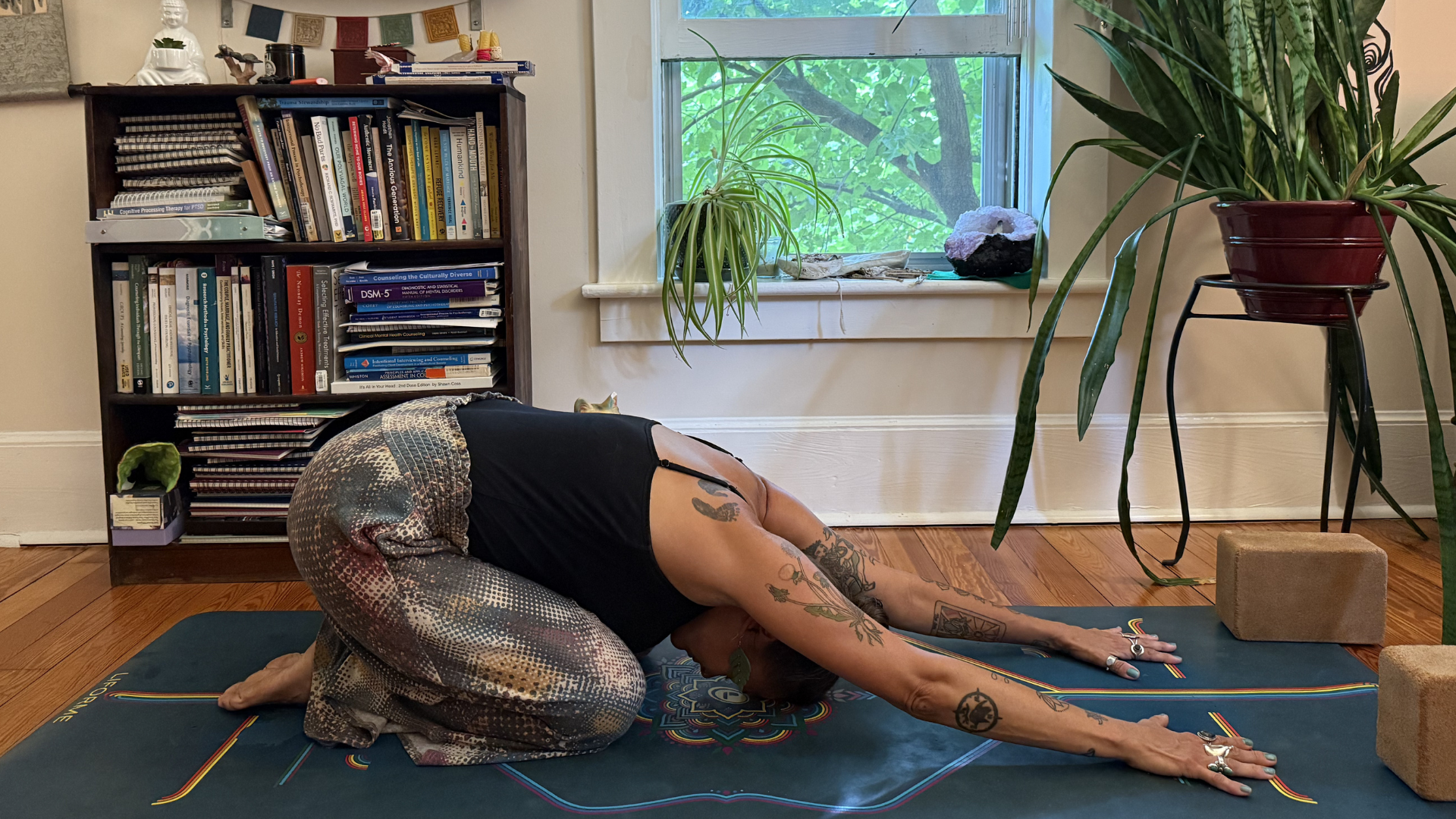
1. Child’s Pose (Balasana)
The name for this pose comes from the Sanskrit word bala, meaning “child.” Consider it a reminder to envision yourself sending understanding to any lingering emotions or patterning from childhood.
How to: Come into Child’s Pose. Keeping your knees together increases the stretch along the upper back body; taking your knees apart provides more stretch for the lower back.
Extend your arms straight toward the front of the mat to open the upper back and armpits. To intensify the stretch along the upper back body, place your hands on blocks.
Focus on: Breathe deeply and envision the breath moving from nose to nape of neck and down the back body, pausing to take in the sensation of the back of the heart.
2. Puppy Pose (Anahatasana)
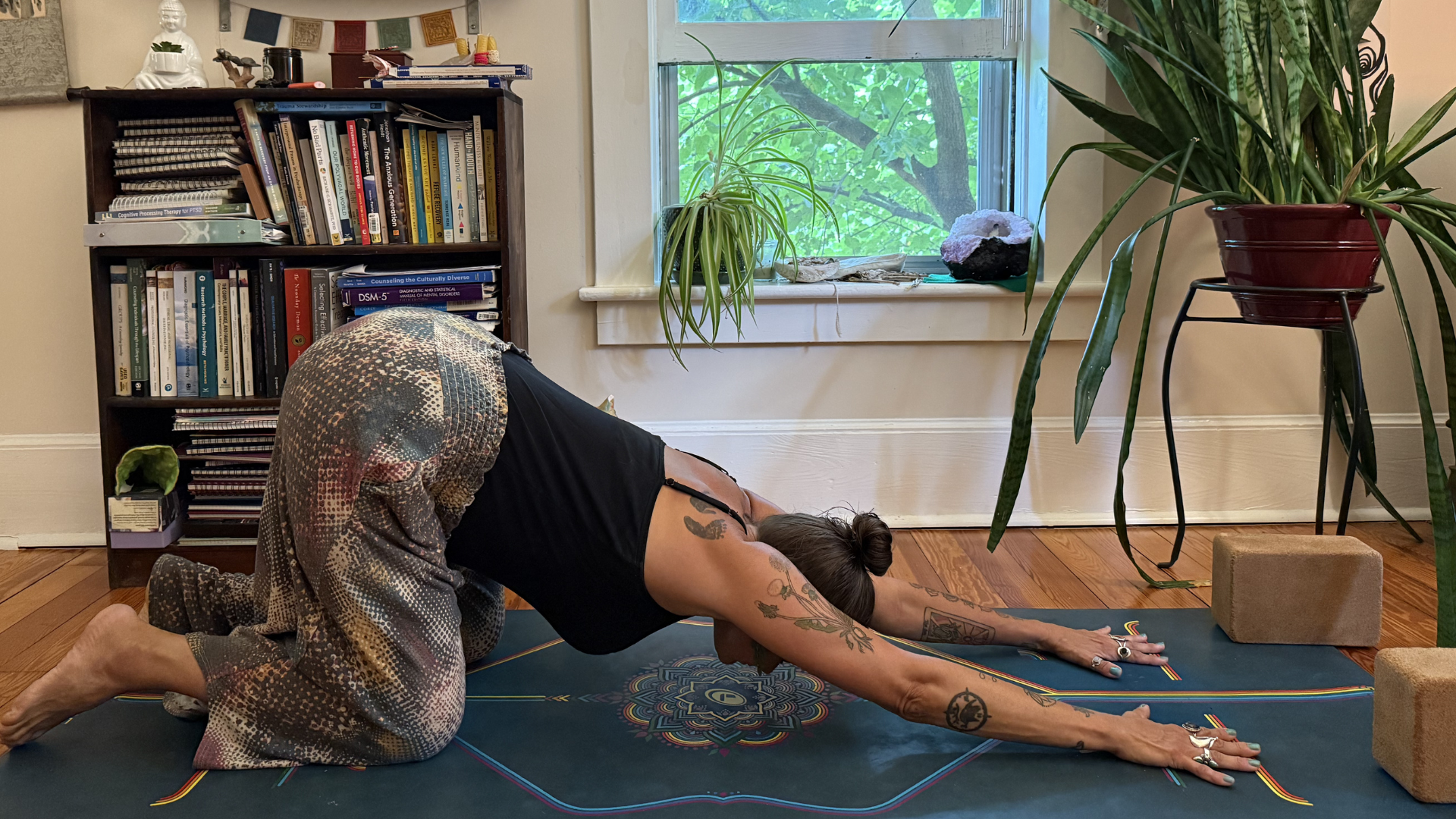
Known as “Melting Heart,” Puppy Pose, or Anahatasana is a similar devotional posture as Child Pose but it’s slightly more intense inversion. Its English name is a whimsical reminder to show yourself the same devotion and compassion as a puppy may as you breathe into the back space of your compassion center.
How to: Kneel on the mat with your knees hip-width distance and walk your hands forward, almost as if you’re coming into Child’s Pose, but keeping your hips over your knees and your tailbone reaching toward the sky. Rest your forehead on the mat or a block and let your chest sink toward the mat.
Focus on: Pull your shoulder blades toward each other and focus on the slight backbend along the back of the chest.
3. Yoga Mudrasana
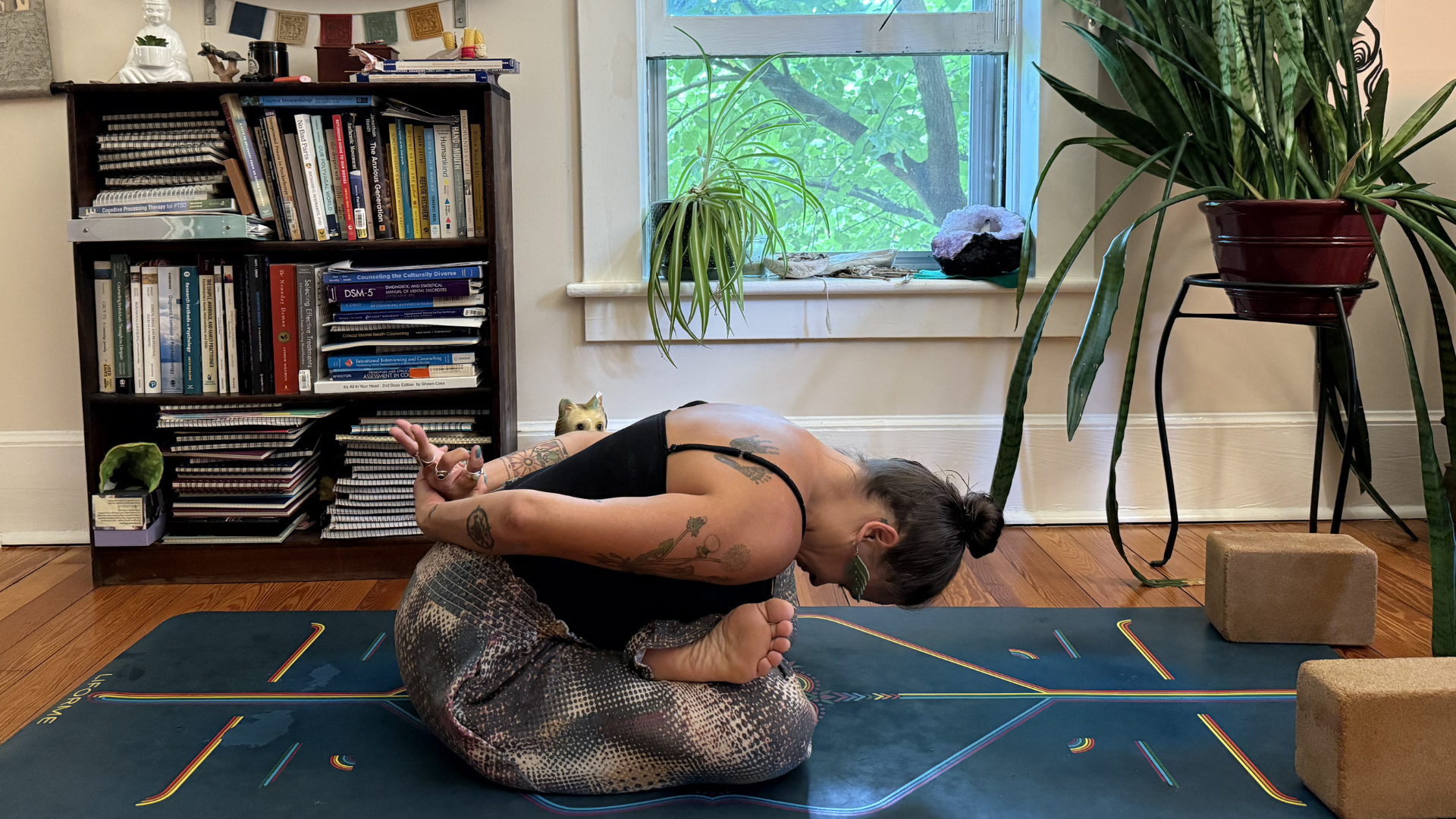
This forward fold stimulates the upward flow of prana, or life energy, from the base of the spine to the uppermost chakras. Moving the heart space forward brings attention and awareness to the back side of the heart.
How to: Begin sitting in either Easy Pose (Sukhasana) or Lotus Pose (Padmasana). Try to release tension in your upper back and shoulders. Reach your arms behind your back and wrap your right hand around your left wrist in a bind or use a strap, belt, or towel to bridge the gap between hand and wrist.
Inhale deeply as you sit tall and lengthen the spine. Exhale slowly as you fold forward while holding the bind.
Focus on: Bring your awareness to the stretch along the back body as well as the sensation of the bind, which for some can recall being held.
4. Eagle Arms
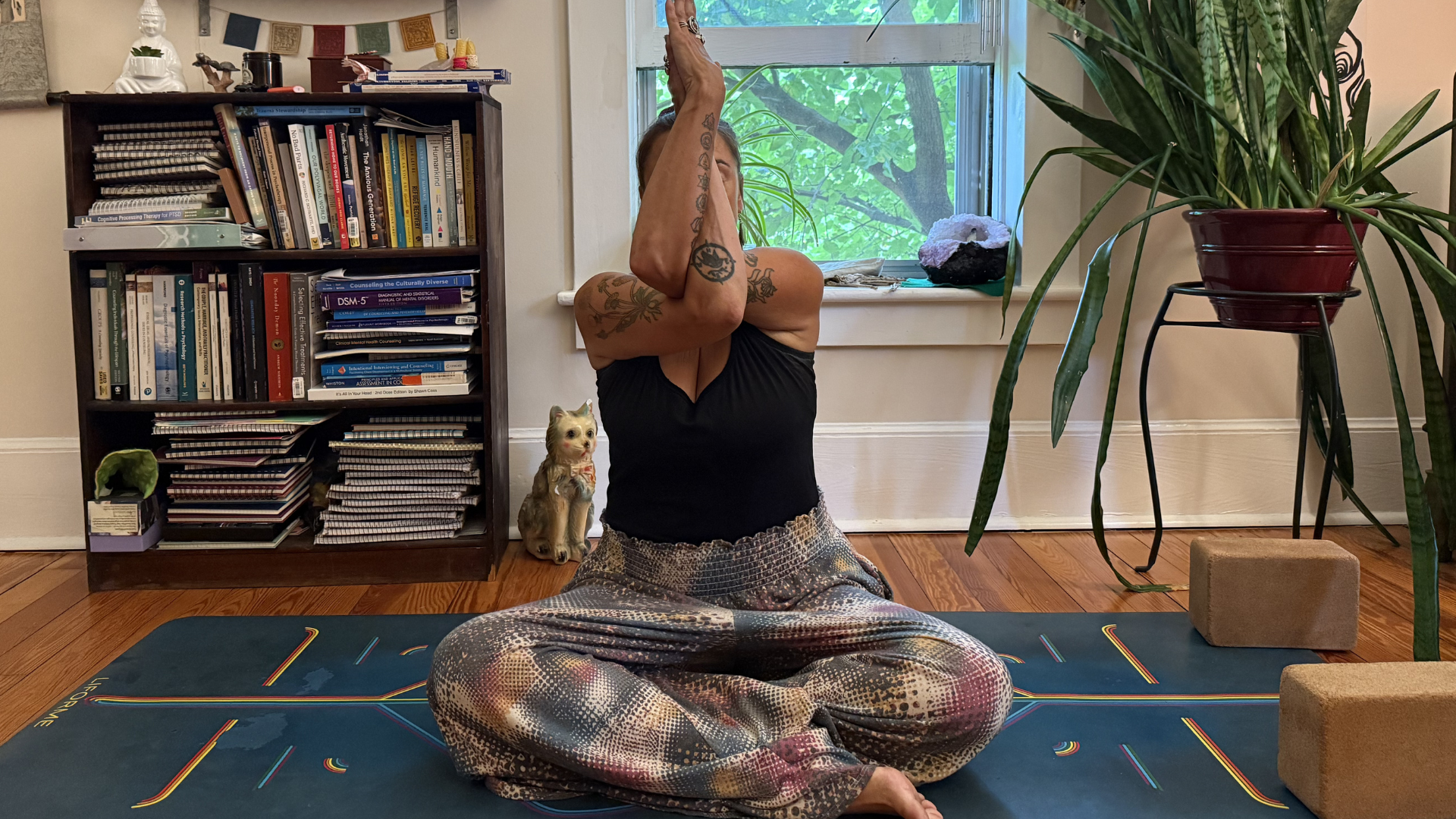
This intense arm bind definitely brings a stretch—and your attention—to the area behind the heart. The shape can be practiced seated or standing.
How to: For the traditional approach to Eagle arms, cross your arms in front of you, stacking your elbows. Bring the backs of your forearms together and lift your forearms vertically, fingers reaching toward the ceiling. Bring your elbows to shoulder height. If it’s available to you, wrap your wrists and try to touch your palms together.
For an alternate approach, cross your arms in front of you, stacking your elbows. Reach your forearms straight ahead, fingers reaching toward the wall in front of you. Bring your elbows to shoulder height.
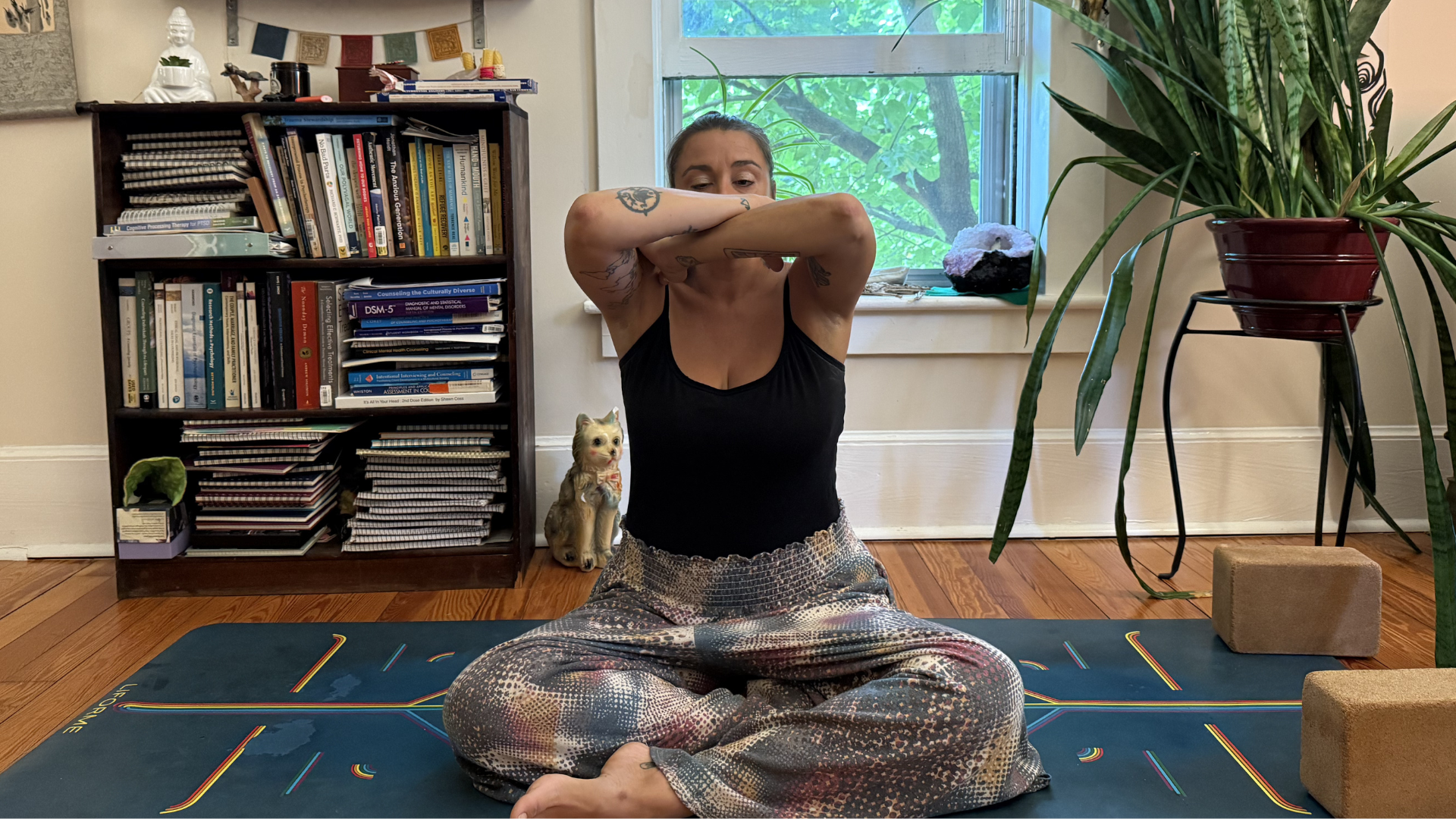
Repeat with the opposite elbow on top.
Focus on: The opening you experience along the back side of the heart space. In the traditional shape of fingertips reaching for the ceiling, one can experience a sense of being hidden behind the arms. In the alternate shape, in which you reach your forearms straight in front of you, it can feel more like a self-hug. They each tap into the back side of the heart space.
5. Cow Face Arms (Gomukhasana)
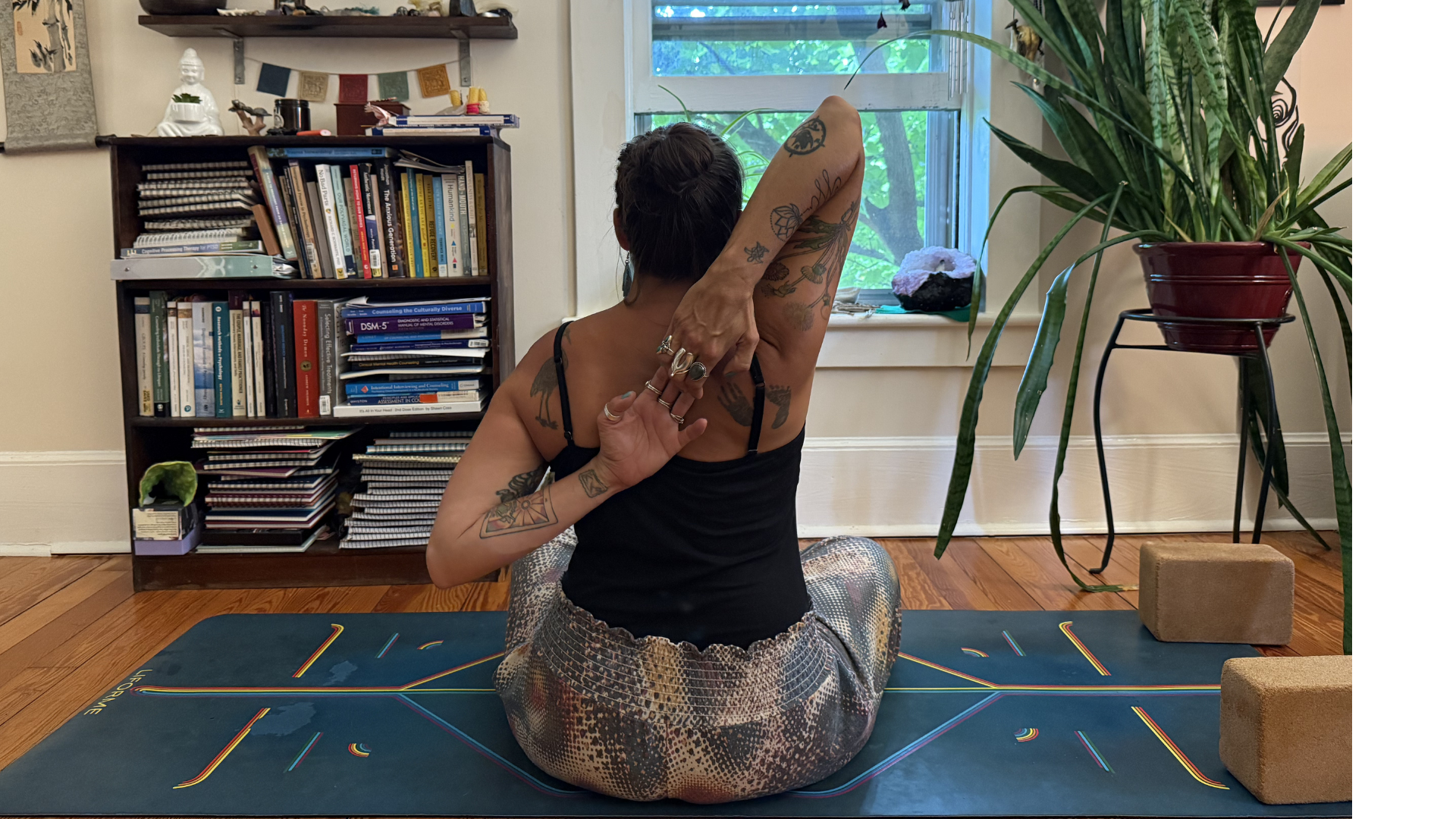
The name Cow Face came about because the position of the elbows in this pose somewhat resembles the ears of a cow. In many Vedic traditions, the cow symbolizes selflessness and humility. Similarly, the challenge of the posture requires a surrender of ego regarding “perfect” alignment. Instead, attention is refocused to the inner self.
Like Eagle, Gomukhasana arms can be practiced with or without the corresponding lower body part of the pose.
How to: Bring one hand to the same-side shoulder blade, elbow pointing toward the ceiling and palm facing your back. Bend your other elbow behind you, elbow pointing toward the floor and palm facing away from you. Grasp your fingers on the opposite hands or bridge the gap with a strap, belt, or towel. Breathe here.
Focus on: Use the sensation of the bound hands or strap along the back body as a destination for your breath and your awareness. Breathe into the space behind your heart.