
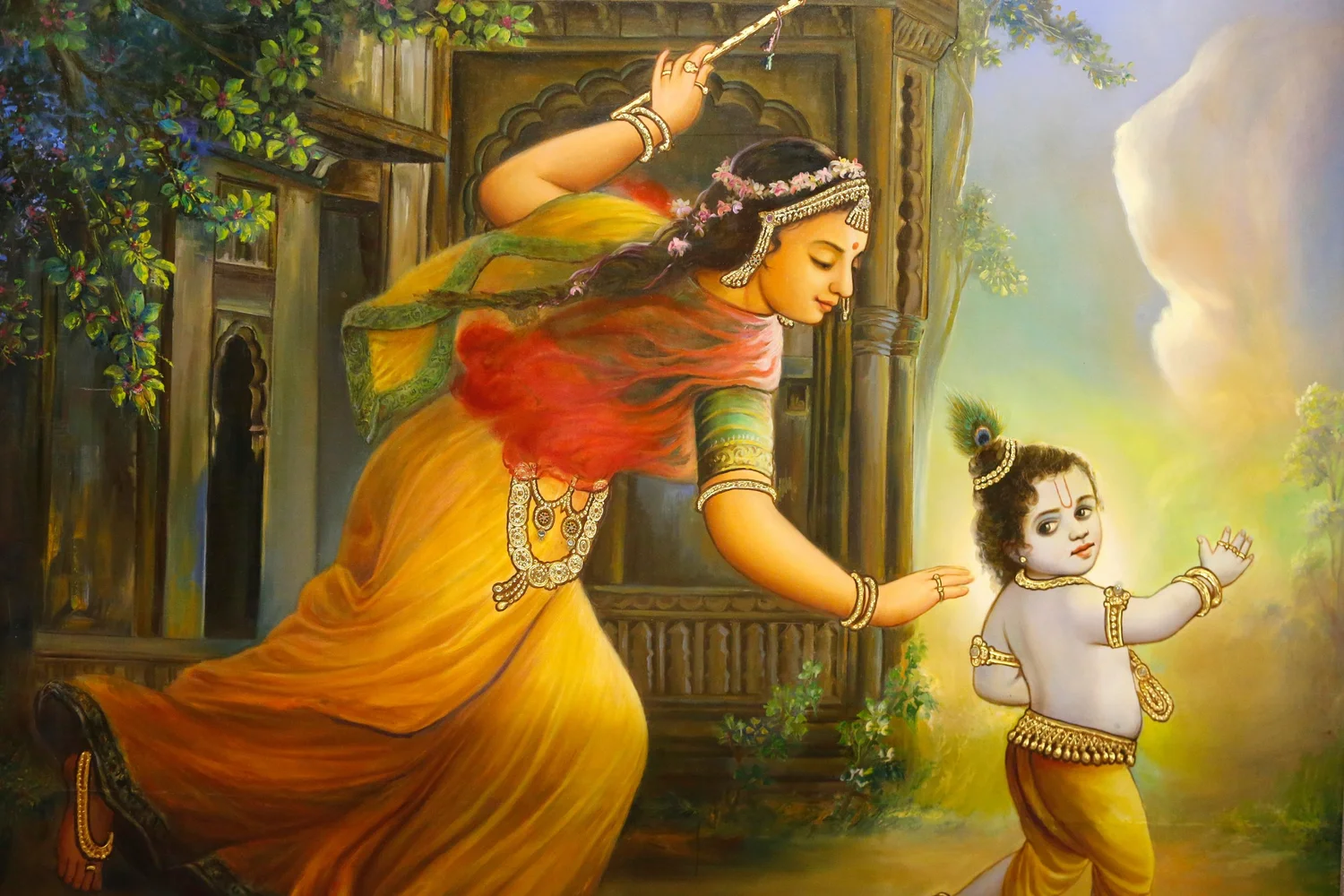
Today is Krishna Janmashtami, the celebration of Krishna’s birth, and one of the most joyful dates on the whole yearly calendar. Temples are lit up tonight from Mathura (north) to Kerala (south), and in communities far outside India. People sing until midnight, fast through the day, break the fast together at the hour Krishna is said to have been born, decorate their homes with tiny painted footprints leading to the door, and offer butter and sweets as his own mother once did. It’s a celebration built entirely around delight, the very same delight that makes Krishna, of all the forms the tradition offers us, the one most often pictured laughing.
the night itself
The story most of us know stops at the image of Krishna as a happy, laughing baby. Yet Janmashtami shares a specific story of what happened on that night.
Krishna’s parents, Devaki and Vasudeva, were held prisoner in Mathura by Devaki’s own brother, King Kamsa, who had been warned that her eighth child would be the one to end his rule. Krishna was that eighth child, born at midnight, inside the prison cell. At the moment of his birth, the guards fell into a sudden sleep, and the cell doors opened on their own. Vasudeva carried the newborn out into a storm and across the rising Yamuna River to the home of his friends Nanda and Yashoda in the village of Gokula, who that same night had a daughter of their own. He exchanged the two children; Krishna stayed in Gokula, safe, and Vasudeva carried the girl back to Mathura, returning to his chains so nothing would appear to have changed by morning.
This is usually where the story stops. But let’s keep going.
one life, so many names
What I enjoy most about Krishna is that he was never really just one character. Over the course of a single life, he collects dozens of names, each a different facet of him, held up to catch a unique light.
As a child in Gokul, he’s Bal Krishna, Nandalala, “son of Nanda”, or Makhan Chor, the beloved butter thief. As a young man among the cowherds of Vrindavan, he becomes Govinda and Gopala, protector of the cows, and Murlidhar, the one who never seems to put down his flute. To the gopis and to Radha, he’s Shyam or Kanhaiya; the dark, playful, impossibly charming one. As he grows into his role in the wider world, he is Vasudeva, Keshava, Hari, Dwarkadhish, Lord of Dwarka, and, on the battlefield with Arjuna, Parthasarathy: the charioteer who becomes a teacher.
These names represent one Krishna encompassing all of his different aspects. I think this might be why so many families, mine very much included, where nearly everyone carries the name of one form of Krishna or another, look to these names when a child is born. You’re not just naming a person. You’re naming an aspiration, a quality you hope grows within them: the playfulness of Kanhaiya, the steadiness of Govinda, the wisdom of Keshava.
where Devī comes in
There’s one more name that belongs in the story, even though it isn’t Krishna’s: Yogamāyā. Māyā is usually translated as “illusion,” but that translation somewhat undersells her. Yogamāyā is better understood as a divine power of manifestation, the force that allows the divine to take form in the world, and that which draws us into relationship with it once it does. She is the reason for Krishna’s childhood in Vrindavan, his bond with Yashoda, and his relationships with the cowherds and the gopis could unfold the way they did.
Sometimes distinguished from Mahāmāyā, a related power: where Mahāmāyā tends to bind consciousness to the ordinary material world, Yogamāyā draws it toward participation in Krishna’s līlā, his divine play. Holding us in the world as it is; the other opens a way into the world as the divine moves through it.
Stories seem to differ on exactly who she is. Some say she is Durgā, with Devī more broadly, or with Ekanāṃśā; others treat her as a distinct, Krishna-centred figure in her own right. What is constant across all stories is that on the same night Krishna enters the world, so does she; his story couldn’t unfold without hers.
why this is important
I think this is the single most fascinating detail in the whole Janmashtami story, and it’s usually the one that gets left out. Krishna and Durgā: the bhakti tradition built around one, the Shakta tradition built around the other, are so often thought of as separate paths that intersect occasionally. But on this specific night, they are the same story, about two children who weren’t really separate to begin with.
Krishna’s entire childhood, the ordinary joy of Gokula, is told because Devī stood between him and Kamsa, first creating the ground on which the rest of his story was possible.
That’s the story I wanted to share with you today. Today represents a night when two forms of the divine arrived together, each one making the other’s story possible, not just a birthday.
Happy Janmashtami to Krishna, and to every name he answers to.
This account follows the Śrīmad Bhāgavata Purāṇa, Canto 10
A Few Things Worth Noting
When is Janmashtami celebrated, and does the date change every year?
Janmashtami falls on the eighth day (Ashtami) of the dark lunar fortnight in the Hindu month of Bhadrapada, which usually lands in August or September on the Gregorian calendar, the date changes each year with the lunar calendar.
What text is the Krishna birth story from?
The fullest account is in the Śrīmad Bhāgavata Purāṇa, Canto 10, with additional details in the Harivaṁśan and the Viṣṇu Purāṇa. Most popular retellings simplify or skip sections of the original full narrative.
Why do some Krishna stories mention a sister, and others don’t?
Yogamāyā rarely appears in mainstream retellings because most versions of the story end at the river crossing to Gokula. The fuller Bhāgavata Purāṇa account continues past that river moment into, to what happens when Kamsa goes back to the prison cell.
How is the Navadurgā Stotram connected to Janmashtami?
The two aren’t traditionally linked by the calendar, Navarātri falls separately. The connection here is thematic: both traditions name the divine through many distinct forms rather than one general image.
About Tara Mitra
Tara Mitra is a C-IAYT-certified yoga therapist and lineage teacher within the Krishnamacharya–Desikachar tradition, with 23 years of practice and 18 years of teaching experience. She is also a Level 2 Ashtanga yoga teacher.
Her teachings draw from Patañjali’s Yoga Sūtras, Vedic chanting, the Upaniṣads, Āyurveda and the broader teachings of the Krishnamacharya tradition. She offers courses, teacher education and mentorship for dedicated students and teachers of yoga, alongside Dr Vigneshwar Bhat, a Vedic priest and scholar, and Dr Rob Lamport, a Gonstead chiropractor.
Her work is rooted in the study, practice and responsible transmission of traditional Indic knowledge within a living lineage.
Explore upcoming mentorship, courses and programs at Tara Mitra Yoga.