
Published September 16, 2026 09:23AM
In Yoga Journal’s Archives series, we share a curated collection of articles originally published in past issues beginning in 1975. This article about Tortoise Pose (Kurmasana) first appeared in the July-August 1986 issue of Yoga Journal. Find more of our Archives here.
Replete with mythological symbolism, Tortoise Pose (Kurmasana) is a seated forward fold that helps to induce mental freedom from outward agitation. The shape of the body resembles a tortoise, representing a withdrawal from externals to the inner silence that is yoga.
To practice this pose, the student must have a fair amount of flexibility in the adductor muscles of the inner thigh and the hamstrings of the posterior (back) thigh. In addition, the external rotator muscle group must be loose enough to allow the forward rotation of the pelvis. These muscles, which are on the side of the hip, rotate the thigh externally when contracted and, when tight, impede all forward-bending movements, like Tortoise Pose.
In addition to stimulating the abdominal organs and lower spine, Tortoise Pose is especially soothing for the mind. But for this soothing to occur, Tortoise Pose—in fact, all forward bends—must be done from the hip joints, and movement must be minimized in the vertebral column. Forward bending that allows undue rounding of the lumbar (lower) and thoracic (middle) back creates a strain on the soft tissues there, namely, the intervertebral discs, as well as the ligaments, tendons, and muscles supporting and surrounding the column. If forward bends are done repeatedly by rounding the back, the soft tissues on the entire posterior side of the body become overstretched and weakened, thus affording less support to the column in the upright posture.
This overstretching is a form of agitation and prevents the mind from becoming quiet in the pose. By bending as much as possible from the hips and minimizing the rounding of the column, one maintains the vertebral curves closer to their natural shape, thereby reducing both physical strain and mental agitation. When one can settle comfortably in the pose, the mind is freed from external influences. This freedom, called pratyahara, is the doorway to meditation.
According to Patanjali—author of the Yoga Sutras, the sourcebook of yoga—the mind is nothing more than a very rapid series of agitations, or vrittis. When agitations cease, the “black box” we label mind also ceases to exist. Not that we cease to exist entirely; rather, we perceive the world in a new way, freed from the limited perception we currently accept as reality, viewed through a limited function called mind. Tortoise Pose can give the student a taste of this “no-mind” by freeing mind from the many external sources of vrittis. When this occurs, the delicious inner silence of Tortoise Pose becomes a magnet that draws one away from movement toward the stillness that is yoga.
To enter this state, and to practice Tortoise Pose well, one must learn the art of letting go, both of muscles and of mind. For the large muscle groups of the thigh and the smaller but strong muscles of the hip to stretch, one must apply constant and firm movement in the direction opposite the one in which the muscles contract. To stretch muscles, one must have determination, as well as the ability to hold a pose and allow the process of release to occur. Neither element—determined positioning nor holding/letting go—can be overlooked. Determined movement without release becomes aggression toward the body: surrender without discrimination becomes collapse.
This same process must be employed in learning to let go of mind. To release ego’s control over consciousness, one must exercise discipline. In addition, one must have faith and freedom from fear if one is to actively participate in the process of opening up, of becoming receptive, of “stretch-ing” the mind into a new shape, a new mode. Tortoise Pose affords just such an opportunity to stretch the body as well as the mind. By keeping this attitude in one’s practice, one can gradually uncover the joy of yoga.
How to Practice Tortoise Pose
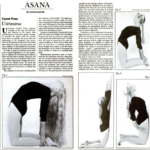
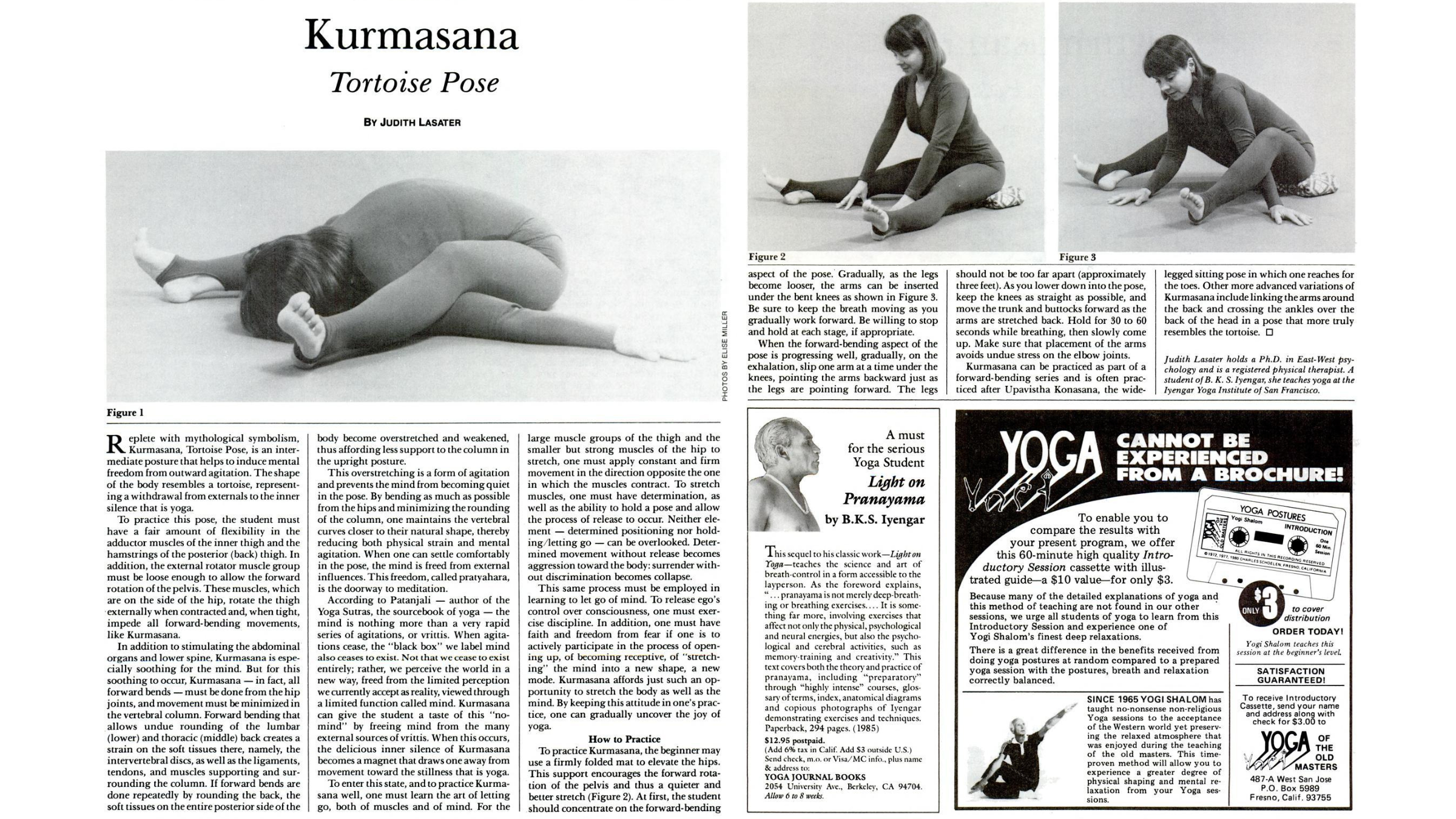
To practice Tortoise Pose, the beginner may use a firmly folded mat to elevate the hips.
This support encourages the forward rotation of the pelvis and thus a quieter and better stretch (Figure 2). At first, the student should concentrate on the forward-bending aspect of the pose. Gradually, as the legs become looser, the arms can be inserted under the bent knees as shown in Figure 3.
Be sure to keep the breath moving as you gradually work forward. Be willing to stop and hold at each stage, if appropriate.
When the forward-bending aspect of the pose is progressing well, gradually, on the exhalation, slip one arm at a time under the knees, pointing the arms backward just as the legs are pointing forward. The legs should not be too far apart approximately three feet). As you lower down into the pose, keep the knees as straight as possible, and move the trunk and buttocks forward as the arms are stretched back. Hold for 30 to 60 seconds while breathing, then slowly come up. Make sure that placement of the arms avoids undue stress on the elbow joints.
Tortoise Pose can be practiced as part of a forward-bending series and is often practiced after Wide-Angle Seated Forward Bend (Upavistha Konasana), the wide-legged sitting pose in which one reaches for the toes. Other more advanced variations of Tortoise Pose include linking the arms around the back and crossing the ankles over the back of the head in a pose that more truly resembles the tortoise.
The author gratefully acknowledges her teacher B.K.S. Iyengar and his book Light on Yoga in the writing of this article.