

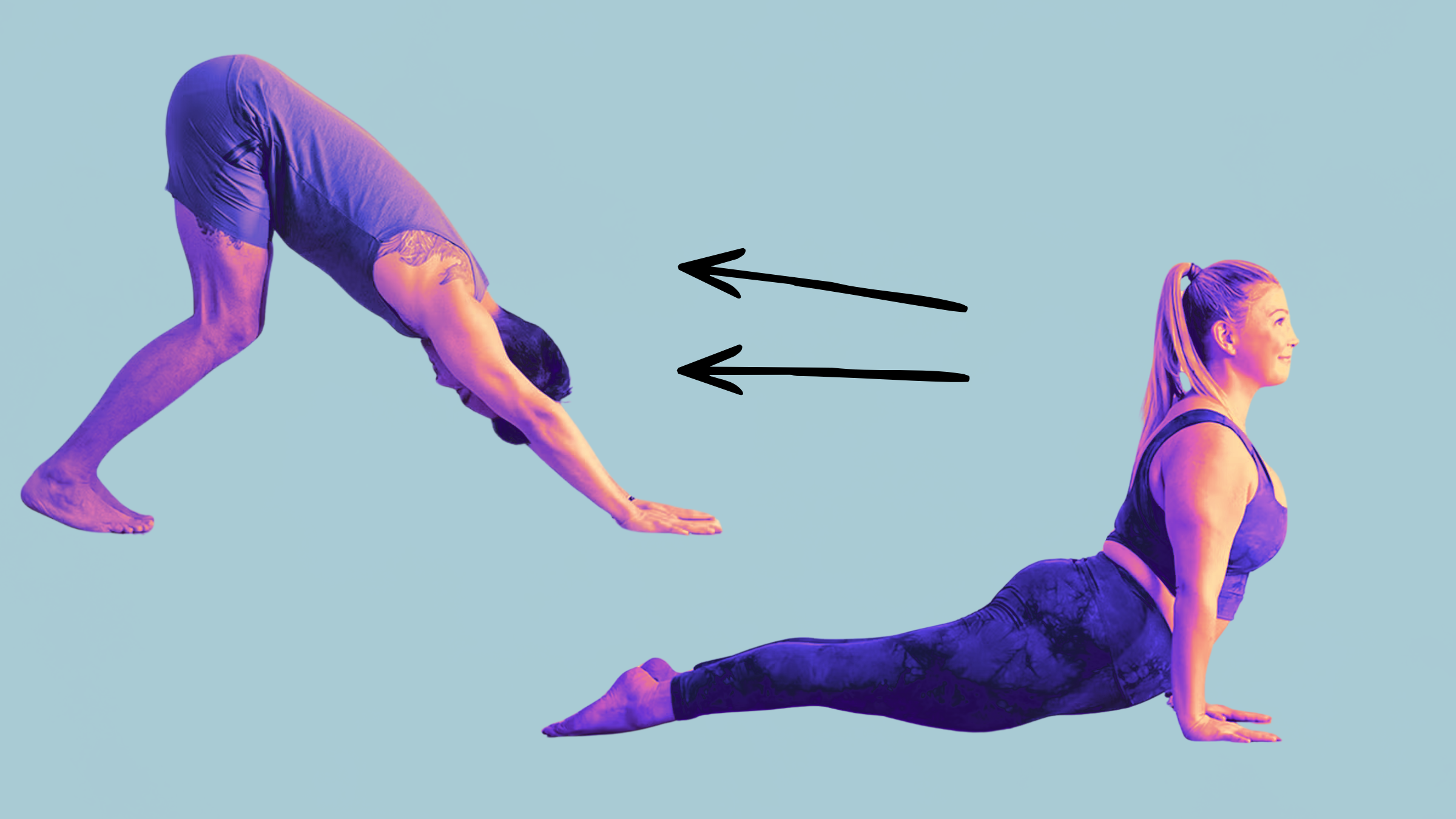
These options make faster-paced classes feel a lot more workable.
(Photo: Andrew Clark; Design in Canva by Laura Harold)
Published May 6, 2026 04:23PM
You’re in Upward-Facing Dog and what happens next is a blur. The teacher cues Downward Dog, so you press your hands into the mat and lift your hips, but then you run into the same roadblock you encounter time and again—that clunky maneuvering of your feet. Somehow, you’re supposed to go from pressing against the tops of your feet with your toes pointing back to tucking your toes and pointing your toes forward. So you stumble your way through it, not exactly sure if you’re doing it “right,” but needing to find some way of getting to Down Dog.
There’s typically not a lot of time in a vinyasa class to explore different ways of moving through this hard-to-love moment. Simply understanding how to roll over your toes can make that tricky part of the flow feel more workable. And there are alternative transitions between the two poses that are less physically challenging. Spending some time exploring them can also help you break out of autopilot and make this part of class feel more playful and rewarding.
4 Ways to Move From Upward Dog to Down Dog
Practice any of these transitions from Upward-Facing Dog and Downward-Facing Dog during class or experiment with them at home. If you’re practicing on your own, warm up for Upward-Facing Dog by moving through Cat–Cow, Cobra, Puppy, or other less intense backbends.
As you move through these transitions, don’t be afraid to slow down so you can notice what feels most supportive (even if that means you miss a few of the following poses during class).
1. Lower Your Knees to the Mat
Putting your knees down in between Upward Dog and Downward Dog takes weight off your hands and arms, giving them a mini-break. It also unloads weight from your feet and helps you avoid the roll-over move. Slide a blanket underneath your knees for additional support.
How to: Come into Upward-Facing Dog. Slowly lower your knees to the mat, tuck your toes, and come to your hands and knees. Press through your hands and lift your hips into Downward-Facing Dog. Straighten your legs as far as feels good, reaching your heels toward the floor.
2. Roll Over One Foot at a Time
This transition often feels more intuitive for students than rolling over both sets of toes at once. However, it’s also asymmetrical. If you practice rolling over the toes of one foot at a time, it’s helpful to vary which foot you flip over first so you feel more “even.”
How to: From Upward-Facing Dog, keep pressing your hands into the mat. Lift your hips as you press onto the tops of both feet. As you keep lifting your hips, roll over the toes of one foot, tuck your toes, and press the ball of that foot onto the mat. Transfer some weight into it, then do the same with the opposite foot. Distribute your weight between both feet as you continue moving into Downward Dog.
3. Roll Over Both Feet at Once
This option can be especially challenging if your feet are tight. You might also feel it in your arms and core, which need to work overtime to offload weight from the feet. It can help if you first mobilize your feet and ankles (try Toe Squat or pointing and flexing your feet against a strap).
You want to prevent one or both heels from splaying to the sides as you roll over your toes; practice at home by hugging a block between your ankles to keep your feet parallel to each other. This, in turn, creates sturdiness throughout the transition.
How to: From Upward-Facing Dog, press your hands into the mat, lift your hips, and roll over both sets of toes at the same time. Imagine your ankles are drawing toward each other to keep your heels from splaying to the sides. You might need to take a couple steps forward if there’s too much distance between your hands and feet. Lower both heels toward the mat in Downward-Facing Dog.
4. Keep Your Toes Tucked in Upward-Facing Dog
What if you didn’t point your toes back in Upward-Facing Dog? You always have the option to keep your toes tucked from Plank to Downward-Facing Dog. The biggest upside is a smoother transition with no fancy footwork required.
However, tucking your toes in Upward Dog lifts the legs higher, which can arch the lower back more and might be uncomfortable. You can lessen the intensity of the backbend by not lowering your pelvis toward the mat quite as far. You can also keep your elbows slightly bent in Up Dog, a variation which requires—and builds—arm strength.
How to: From Chaturanga, keep your toes tucked as you come into Upward-Facing Dog. Continue to keep them tucked as you press your hands and feet into the mat and lift your hips into under Downward-Facing Dog.
Playing with these options opens the door to making your practice smoother—and teaches you how to pay attention to those other overlooked moments on the mat and in life. What other things aren’t working for you? How can you make adjustments so they do?




Many players seek thrilling experiences at a non UK license casino, https://www.pdamtirtaprabujaya.com/2026/07/17/explore-the-world-of-non-uk-license-casinos-a-comprehensive-guide/. These locations offer a range of games without rigid regulations. Enjoy distinct bonuses and deals that enhance your gaming experience.