
Published May 7, 2026 05:04PM
Yoga Journal’s archives series is a curated collection of articles originally published in past issues beginning in 1975. This article about Locust Pose first appeared in the September-October 1989 issue of Yoga Journal.
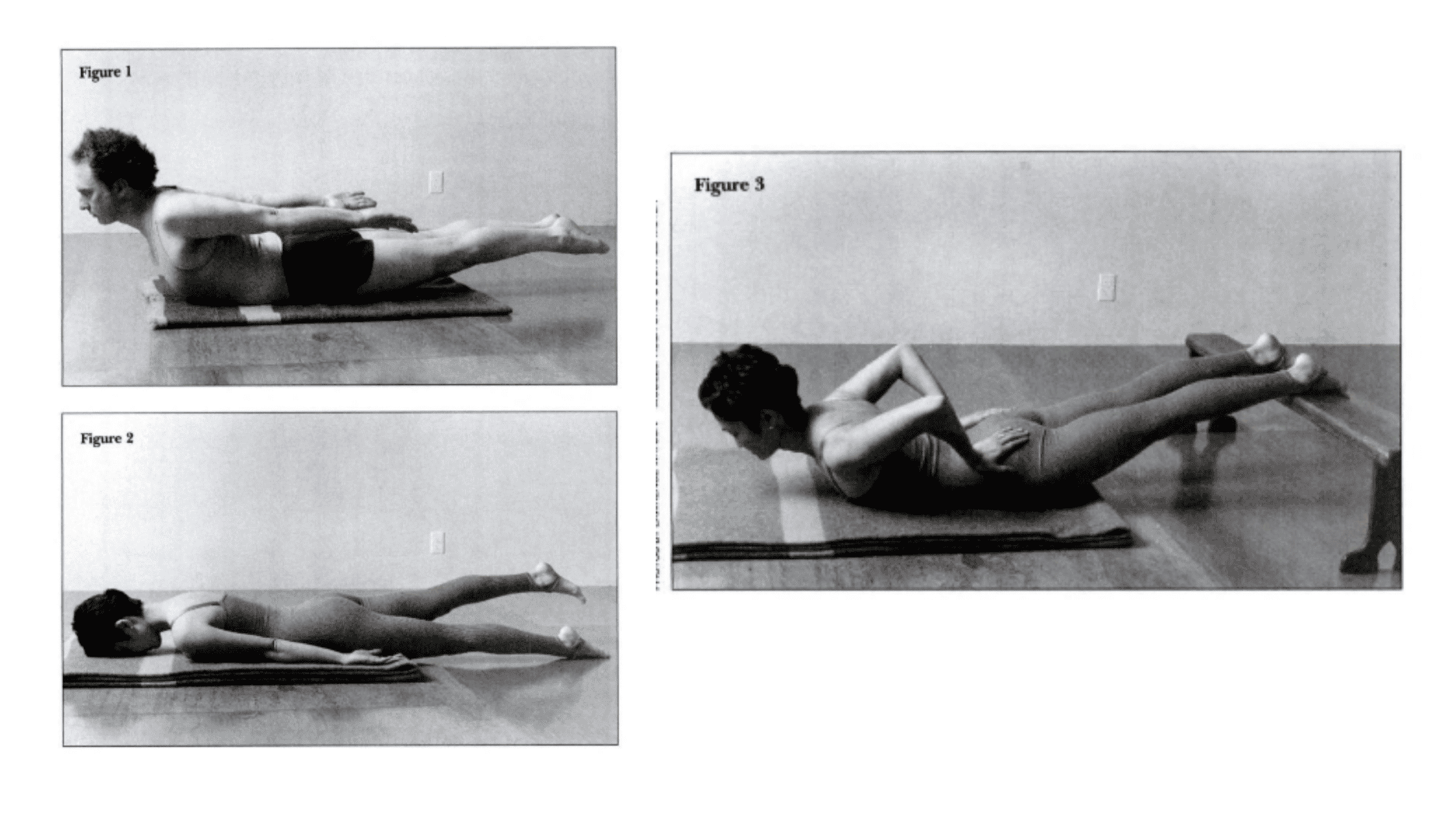
In our study of Salabhasana (Locust Pose), we will explore the basic elements of movement that make up the pose. In the process, we will discover how the buttocks and back thighs, the upper back and the backs of the arms, the abdomen and the inner thighs all contribute to the health and freedom of the spine (Figure 1).
How to Practice Locust Pose Variations
The first variation of Salabhasana helps to build the strength of the buttocks and back thighs by raising one leg at a time. Lie on your blanket face-down, with your legs together and your arms extended back along the sides of the body, the palms turned up. (Alternatively, you can fold your arms in front of you and rest your chin on your hands, if this feels more comfortable for the back.) Then press the tops of the feet into the floor and lengthen both legs strongly, as though trying to lift the knees off the floor. Keeping the left leg fully extended, raise the right leg a few inches, so the right hipbone stays in contact with the floor (Figure 2). Hold this position for several breaths, drawing the right thighbone out of the socket and opening the back of the right knee. Then release the leg and repeat to the other side. To stabilize the pelvis, remember to keep the right leg fully extended when you raise the left leg.
1. Tending to Lower Back Discomfort
The next variation of Salabhasana is helpful in relieving sacroiliac pain for those who feel discomfort after practicing forward bends.
Start by lying facedown on your mat or blanket with the tops of your feet resting on the edge of a bench or low platform (Figure 3). (If a bench or other support is not available, press the base of the toes into a wall about 10 or 12 inches from the floor.) Now place your hands on your lower back with the thumbs pressing on the sacroiliac joints near the top of the buttocks. Extend the backs of the legs from the sacroiliac joints toward the heels, so the backs of the thighs are active, and the backs of the knees open. The buttocks should be firm without being clenched. This action will bring the top of the sacrum deeper into the body and release any pressure on the sacroiliac joints caused by forward bends. Hold the position for several breaths, maintaining the strength of the legs and buttocks. Repeat two or three times if this seems to help your lower back.
2. Lifting the Legs Higher
Most students experience more difficulty in raising the legs than in lifting the upper body in Salabhasana.
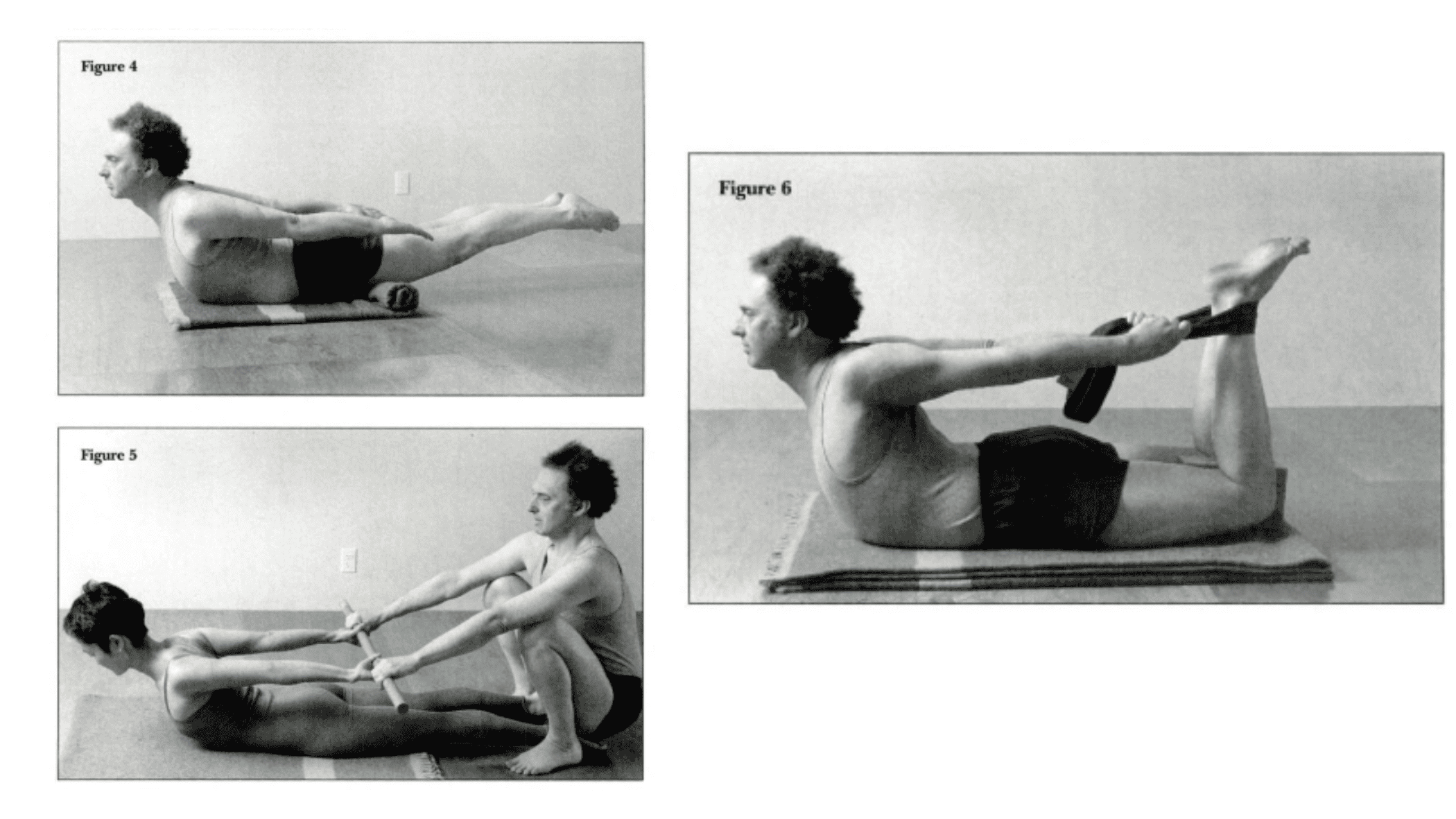
The next variation of the pose should help you to raise the legs higher, and to keep them raised longer, with greater freedom and ease. Make a firm roll about three or four inches in diameter, using a blanket or thick towel. Then lie facedown with the roll supporting the upper thighs just below the hip crease (Figure 4). Keep the legs fully extended. Now lift the shoulders off the floor and draw the arms back, either interlocking the fingers or turning the palms toward the ceiling. Press the front hipbones into the floor as you lift the thighbones away from the blanket roll, and simultaneously open the chest. Hold for several breaths, then release. Repeat two or three times.
3. Strengthening the Triceps
The following exercise demonstrates the need to strengthen the backs of the upper arms (the triceps muscles) as well as the backs of the thighs when practicing Salabhasana. First stand in Tadasana (Mountain Pose) with the forearms parallel to the floor and the biceps flexed.
Feel how the shoulders hunch forward and the shoulder blades lift away from the back rib cage, causing the upper back to round. Now release your arms and try the opposite action. Stand in Tadasana with your legs firmly extended and your arms hanging loosely by your sides. Then gently squeeze the back armpit skin and lengthen the backs of the arms down toward the little fingers so the triceps come into firm contact with the bones of the upper arms. As the triceps become firm, the broad muscles of the upper back (the trapezius and latissimus dorsi) are also called into play, drawing the shoulder blades down and allowing the front chest to open. The strength and stability of the upper back depends on the strength of the triceps.
Attention to the triceps is essential for a wide variety of poses. In standing poses such as Virabhadrasana I and I (Warrior Poses I and II), the firming and lengthening of the back arms helps to reduce tension in the shoulders and to open the chest. In Adho Mukha Svanasana (Downward-Facing Dog Pose), the backs of the arms should press up into the bones to stabilize the arms so the student is able to lift out of the shoulder joints. In Sirsasana (Headstand), the extension of the backs of the arms from the outer armpits toward the floor creates a lift of the shoulders and prevents the weight of the body from bearing down on the neck. In Sarvangasana (Shoulderstand), the lengthening of the triceps toward the elbow allows the shoulders to roll under and helps to lift the shoulder blades away from the floor.
The following variation develops our awareness of how to work the upper arms in Salabhasana.
Start by lying facedown on your blanket, with your arms extended along the sides of the torso, holding a pole with both hands so the arms are parallel to each other. Let your teacher or other helper kneel or squat by your feet as in Figure 5. Then draw your shoulders and upper chest away from the floor by lengthening the backs of the arms toward the elbows. Let the neck arch slightly in line with the curve of the upper back, as though extending through the crown of the head. When your upper body is in position, your helper can take hold of the pole to give you support. For the next few breaths, keep your legs active but allow the weight of the upper body to hang forward from the pole, so that the shoulder joints open and the thoracic spine releases. Then slowly begin to firm the triceps muscles and lengthen the upper arms. Feel how the broad muscles of the upper back begin to contract, drawing the shoulder blades down and opening the chest. Hold this position for several breaths, lengthening the arms back so the spine can lengthen forward, like the prow of a long, flat boat skimming through the water, sending ripples of current back along the sides.
4. Strengthening the Inner Thighs
For the next variation of Salabhasana, which focuses on the work of the inner thighs, you will need a long strap and a wooden block. Start by lying face-down on your blanket or mat. Place the block between your knees and loop the strap around your feet. Take hold of the strap near the ankles with both arms fully extended behind you. Then press the knees into the block and lengthen the inner thighs, moving the shinbones back into the strap as you lift the head and upper chest. The lower legs should remain perpendicular to the floor (as in Figure 6), but the knees and thighs may lift slightly off the blanket. Feel how the upper spine moves deeper into the back as you lengthen the inner thighs along the block. Hold this position for half a minute, breathing softly, then release.
Repeat two or three times.
5. Easing Shoulder Tension
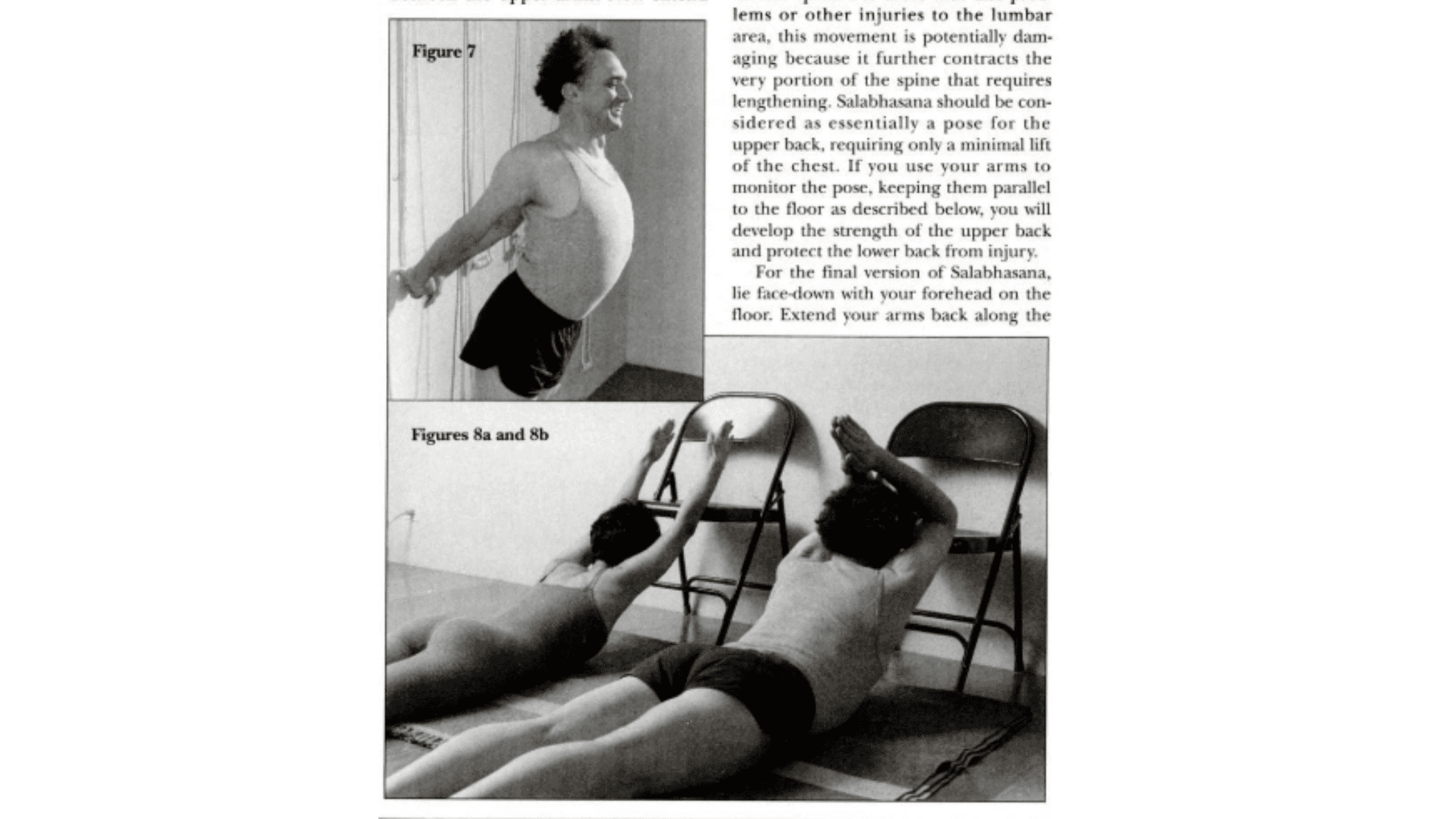
The following variation of Salabhasana helps to relieve shoulder tension, especially for those who have developed a thick ridge of muscle on the slope of the shoulders at the very base of the neck. For people who sit at a desk all day with their shoulders rounded forward, this exercise can be done easily and unobtrusively during a few moments break. Stand in Tadasana (Mountain Pose) with your back to the edge of an open door, and take hold of the doorknobs behind you. (If you are practicing at a yoga studio where wall-ropes are available, take hold of an iron ring at waist-level, as in Figure 7).
Step forward about four or five inches and, with your arms fully extended, let your whole body lean forward. Keep your thighs and buttocks firm, and bring the tailbone and sacrum deeper into the lower back as you lift the front of the spine. Now lengthen the backs of the arms, so the triceps make firm contact with the bones of the upper arms, and the shoulder blades press flat against the rib cage.
Hold this position for several breaths, integrating the movement of the arms and legs with the lift of the spine. Then release and return to Tadasana.
If your neck muscles are very tense, repeat this position, but this time drop the chin toward the chest, so that the head hangs forward and the back of the neck is stretched. However, if you hold tension mainly in the muscles between the shoulder blades, lift the rib cage and let your head drop back, feeling the stretch at the base of the throat. Then gently squeeze the shoulder blades together to massage the knots of muscular tension in the middle of the upper back. Remember to keep your legs active and your buttocks firm throughout the pose.
The next variation of Salabhasana, using a chair, helps to release tightness in the shoulder joints. First place your chair against a wall to prevent it from sliding. Then lie face-down on your blanket or mat in front of the chair, bringing your forearms onto the seat of the chair, with the arms fully extended and the palms facing each other, as in Figure 8a. (If the edge of the chair is sharp, you may need to place a blanket or towel over the seat of the chair.) Do not let the head drop forward, but keep the cars between the upper arms. Now extend your legs away from the chair, and think of lengthening the whole front spine.
Create space in the shoulder joints by firming the triceps into the bone and lengthening the backs of the arms from the outer armpits to the elbows. Hold this position for half a minute, breathing softly, then release. More flexible students can repeat the pose by resting the upper arms on the edge of the chair, with the elbows bent and the palms pressed together, as in Figure 8b.
Remember to lift up through the elbows by lengthening the backs of the arms.
6. Keeping the Lower Back Lengthened
In practicing Salabhasana, many students tend to push the abdomen into the floor in order to lift the rib cage as high as possible. This concentrates all the work in the lumbar area instead of the thoracic area and tightens the paraspinal muscles on either side of the lumbar spine. For those with disc problems or other injuries to the lumbar area, this movement is potentially damaging because it further contracts the very portion of the spine that requires lengthening. Salabhasana should be considered as essentially a pose for the upper back, requiring only a minimal lift of the chest. If you use your arms to monitor the pose, keeping them parallel to the floor as described below, you will develop the strength of the upper back and protect the lower back from injury.
For the final version of Salabhasana, lie face-down with your forehead on the floor. Extend your arms back along the sides of the body with the palms facing the ceiling.
Then without lifting the head off the floor, roll the shoulders back and raise the forearms just a few inches so the arms are parallel to the floor before you begin the pose. Now firm the triceps and draw the upper arms back to raise the head and shoulder girdle, simultaneously lifting the legs and firming the backs of the thighs. Let the spine lengthen forward as the arms and legs lengthen back. Do not throw the head back, which tightens the muscles at the base of the skull, but think of lengthening through the crown of the head.
Draw the lower abdomen slightly away from the floor and lift the legs even higher. Hold this position for several breaths, then rest and repeat two or three times (Figure 1).