
Published July 29, 2026 10:06AM
Yoga Journal’s archives series is a curated collection of articles originally published in past issues beginning in 1975. This article about Kurmasana (Tortoise Pose) first appeared in the September-October 1977 issue of Yoga Journal.
Many of the yoga asanas (poses) are dedicated to and are said to mimic the myriad creatures and life forms which inhabit the world. One such pose is Kurmasana, the tortoise. At first glance, it would seem incongruous for the yogi or yogini, thought of so often in poses of grace and flexibility, to be copying the slow, ponderous tortoise. Yet according to the teachings of yoga, the practitioner has much to learn from the tortoise as well as from the pose itself.
Mythologically, Kurmasana has deep roots in Indian literature. According to legend, Vishnu, the Protector of the Universe and one of the triad including Brahma, the Creator, and Shiva, the Destroyer, once became a tortoise in order to retrieve amrita, the nectar of eternal youth, for the gods. Another version states that Vishnu is borne by the tortoise.
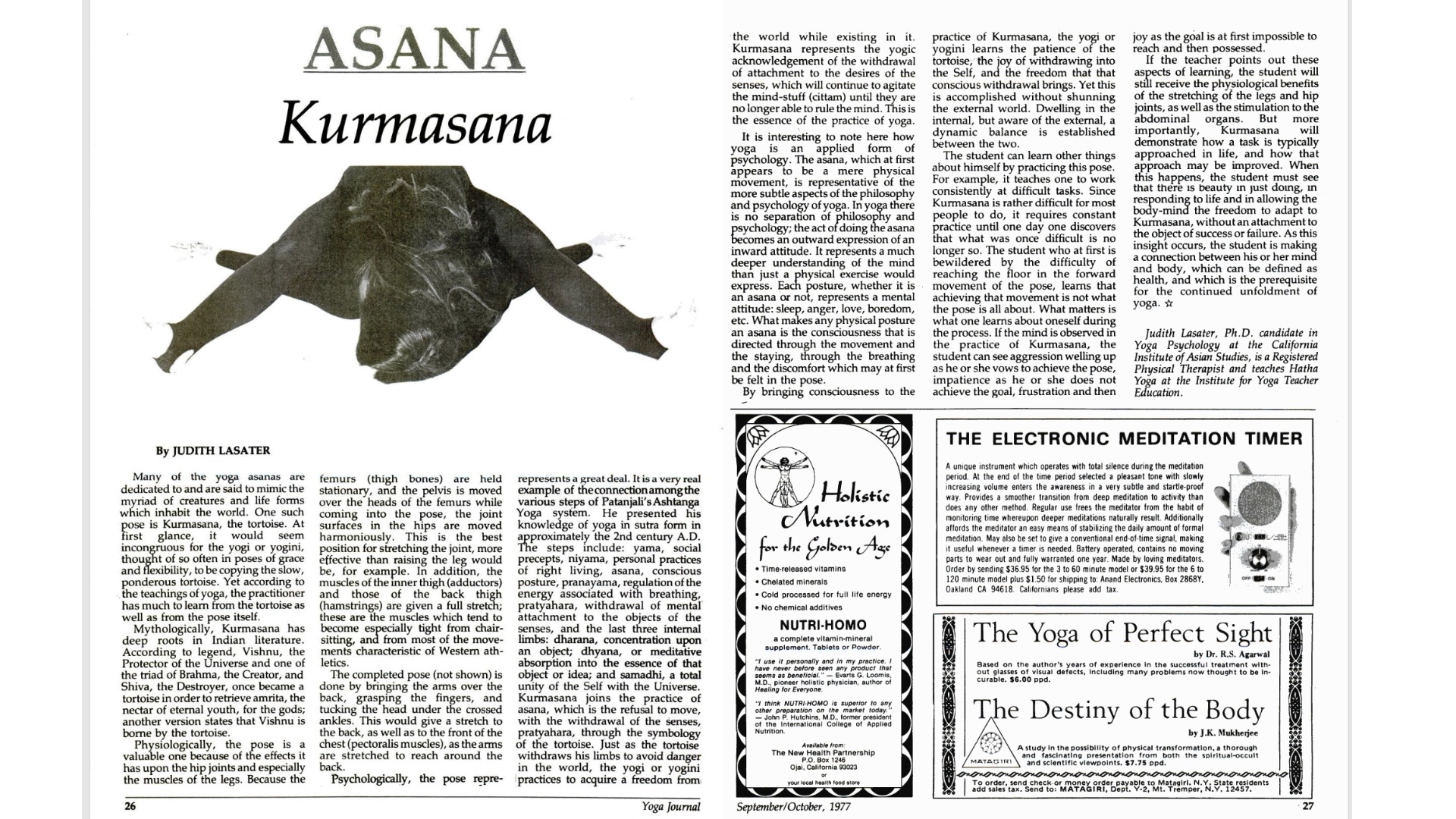
Physiologically, the pose is a valuable one because of the effects it has upon the hip joints and especially the muscles of the legs. Because the femurs (thigh bones) are held stationary, and the pelvis is moved over the heads of the femurs while coming into the pose, the joint surfaces in the hips are moved harmoniously. This is the best position for stretching the joint, more effective than raising the leg, for example. In addition, the muscles of the inner thigh (adductors) and those of the back thigh (hamstrings) are given a full stretch; these are the muscles which tend to become especially tight from chair-sitting, and from most of the movements characteristic of Western athletics.
The completed pose (not shown) is done by bringing the arms over the back, grasping the fingers, and tucking the head under the crossed ankles. This would give a stretch to the back, as well as to the front of the chest (pectoralis muscles), as the arms are stretched to reach around the back.
Benefits of Kurmasana or Tortoise Pose
Psychologically, the pose represents a great deal. It is a very real example of the connection among the various steps of Patanjali’s Ashtanga Yoga system. He presented his knowledge of yoga in sutra form in approximately the 2nd century A.D. The steps include:
- Yama (social precepts)
- Niyama (personal practices of right living)
- Asana (conscious posture)
- Pranayama (regulation of the energy associated with breathing)
- Pratyahara (withdrawal of mental attachment to the objects of the senses)
- Dharana (concentration upon an object)
- Dhyana (or meditative absorption into the essence of that object or idea)
- Samadhi (a total unity of the Self with the Universe)
Kurmasana joins the practice of asana, which is the refusal to move, with the withdrawal of the senses, pratyahara, through the symbology of the tortoise. Just as the tortoise withdraws his limbs to avoid danger in the world, the yogi or yogini practices to acquire a freedom from the world while existing in it. Kurmasana represents the yogic acknowledgement of the withdrawal of attachment to the desires of the senses, which will continue to agitate the mind-stuff (cittam) until they are no longer able to rule the mind. This is the essence of the practice of yoga.
By bringing consciousness to the practice of Kurmasana, the yogi or yogini learns the patience of the tortoise, the joy of withdrawing into the Self, and the freedom that that conscious withdrawal brings. Yet this is accomplished without shunning the external world. Dwelling in the internal, but aware of the external, a dynamic balance is established between the two.
It is interesting to note here how yoga is an applied form of psychology. The asana, which at first appears to be a mere physical movement, is representative of the more subtle aspects of the philosophy and psychology of yoga. In yoga, there is no separation of philosophy and psychology; the act of doing the asana becomes an outward expression of an inward attitude. It represents a much deeper understanding of the mind than just a physical exercise would express.
Each posture, whether it is an asana or not, represents a mental attitude: sleep, anger, love, boredom, etc. What makes any physical posture an asana is the consciousness that is directed through the movement and the staying, through the breathing and the discomfort which may at first be felt in the pose.
The student can learn other things about himself by practicing this pose. For example, it teaches one to work consistently at difficult tasks. Since Kurmasana is rather difficult for most people to do, it requires constant practice until one day one discovers that what was once difficult is no longer so. The student who at first is bewildered by the difficulty of reaching the floor in the forward movement of the pose, learns that achieving that movement is not what the pose is all about. What matters is what one learns about oneself during the process. If the mind is observed in the practice of Kurmasana, the student can see aggression welling up as he or she vows to achieve the pose, impatience as he or she does not achieve the goal, frustration and then joy as the goal is at first impossible to reach and then possessed.
If the teacher points out these aspects of learning, the student will still receive the physiological benefits of the stretching of the legs and hip joints, as well as the stimulation to the abdominal organs. But more importantly, Kurmasana will demonstrate how a task is typically approached in life, and how that approach may be improved. When this happens, the student must see that there is beauty in just doing, in responding to life and in allowing the body-mind the freedom to adapt to Kurmasana, without an attachment to the object of success or failure. As this insight occurs, the student is making a connection between his or her mind and body, which can be defined as health, and which is the prerequisite for the continued unfoldment of yoga.