
Yin yoga poses stretch your body while extending the bounds of your mind. Just a few minutes in this shape lengthens your side body.
(Photo: Katie McGrath; Design in Canva)
Published October 2, 2026 05:55AM
Katie McGrath is a certified yin yoga instructor. She leads classes on her YouTube channel, Yin Yoga with Katie, and offers invaluable advice on YJ as well. Here, she shares the side-opening power of one her favorite yin yoga poses.
Think about how your body has moved today. You’ve probably hunched over a desk, a phone, a steering wheel, a sink. You’ve also likely twisted once or twice, reaching for something behind you. But, have you leaned properly to one side at a time?
Most people haven’t. Not once, not in weeks.
The spine moves in four directions: forward, backward, rotation or twisting, and side to side. The latter, lateral flexion, is the only movement that’s rarely performed ordinary life. It also tends to disappear from yoga classes, which lean heavily on forward folds, the same shape we’re already stuck in all day.
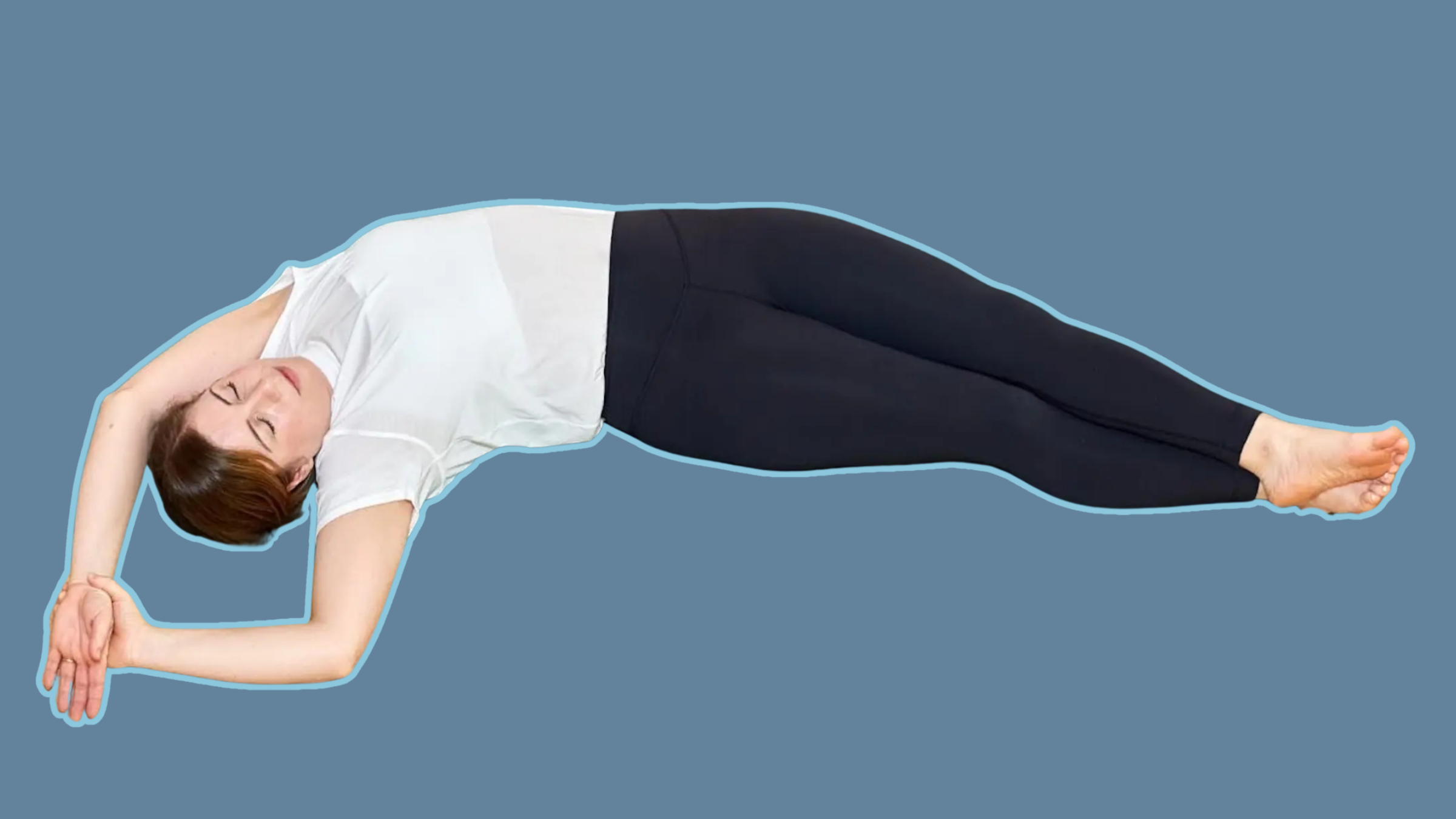
Practicing the yin yoga pose known as Banana Pose (Bananasana) is the easiest correction available. You lie down, scooch your hands and feet to one side in the shape of the pose’s namesake, and wait. Just 3 minutes on each side is enough to make your ribs feel more open and your breathe feel even deeper.
The Benefits of Banana Pose
Lying on your back in Banana Pose with your body curved to one side lengthens the entire outer line of the torso: your obliques, your quadratus lumborum in your lower back, your latissimus dorsi running from your arm down to your spine, and your intercostal tissue between the ribs. If you cross your ankles, the outer hip and IT band come into play, too.
This pose asks nothing of you in terms of strength or balance. Yin yoga poses are held long and passively so the load reaches connective tissue rather than muscle. This pose in particular requires only that you stay reasonably still.
How to Practice Banana Pose
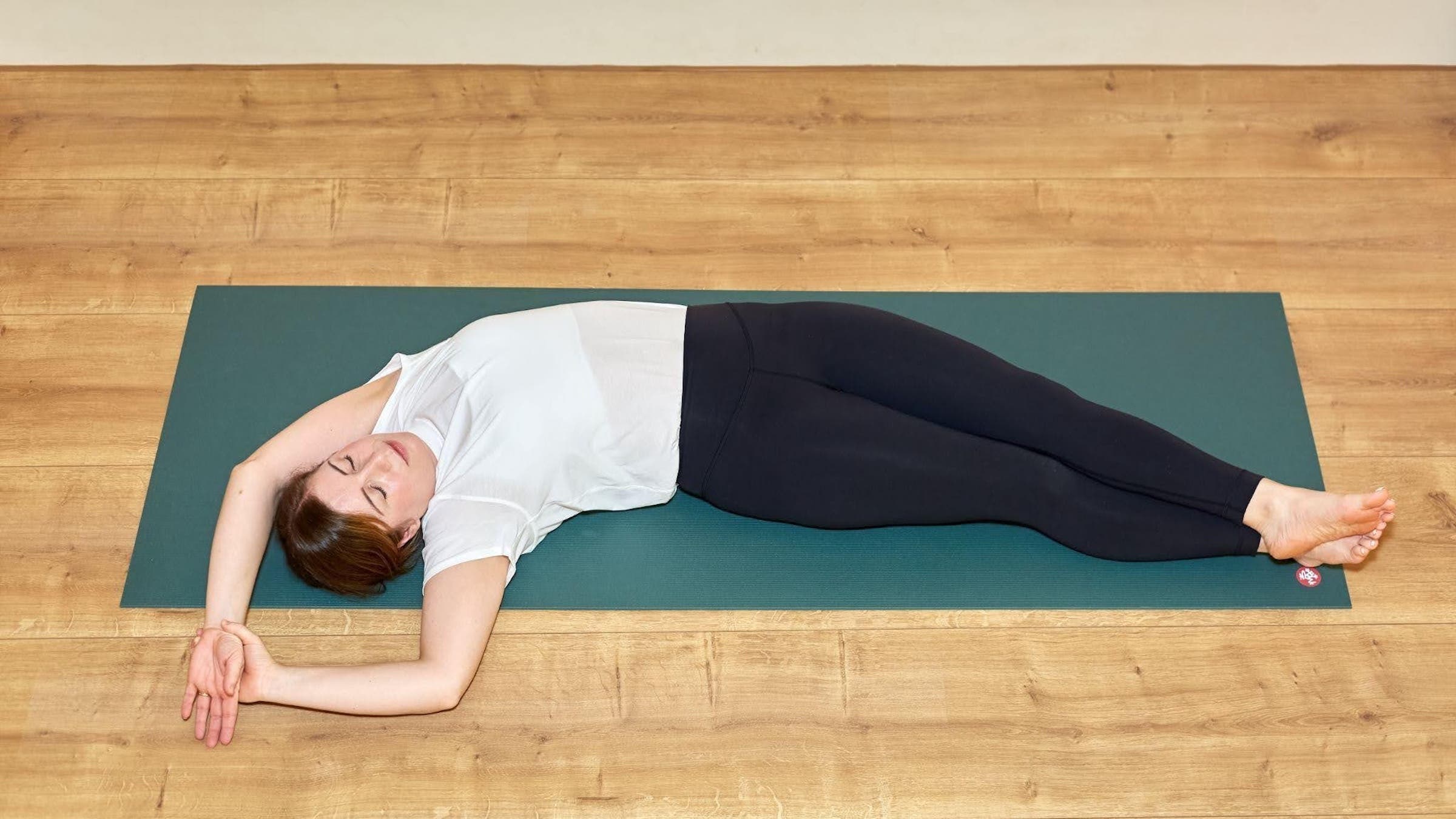
The shape should look like a shallow crescent, not a dramatic one.
- Lie on your back with your legs long.
- Before you move anything, notice that both hips are level. Try to keep your hips in the center of the mat.
- Walk both feet toward the right, as far as they’ll go without your left hip lifting.
- If available, reach your arms over your head and walk them toward the right. If it’s comfortable, take hold of your left wrist with your right hand.
- If you want to intensify the stretch along your lower body, cross your left ankle over your right to increase the stretch along the left side.
- Soften your jaw. Let the breath move into the long side of your body. If your hips have rolled toward one side or your lower back has lifted away from the mat, you’ve gone too far. Walk it back a little for a less curved shape.
- Breathe deeply for at least 3 minutes on each side. If you have the time and physical ability, extend your hold to 5 minutes.
Come out slowly, and then do nothing for a full minute before you change sides. Lie flat and let the two halves of your body feel different from each other for a moment. That pause is part of the practice, not a gap between the real bits.
3 Things to Keep in Mind When Practicing Banana Pose
Banana is a low impact, incredibly powerful pose. Here are some things to keep in mind as you practice.
1. Breathe Deeply
Your diaphragm attaches around the lower ribs. When you breathe in, the ribs need to move up, out, and sideways for the diaphragm to do its job well. If the tissues along one side of your rib cage is habitually shortened, the ribs don’t travel as far. The breath goes somewhere else instead, usually up into the chest and shoulders.
Lengthening your side body doesn’t increase your lung capacity. What it does is take a restriction off the rib cage so the movement that’s already available to you becomes available again. You’ll often notice it most in the moment after you come out. Lie flat, breathe, and see whether one side of the ribcage feels more willing to expand than the other.
2. Props and Adjustments
The following tips can help guarantee that Banana Pose is adding to your yoga practice, rather than subtly straining your body.
- If your shoulder or low back lifts off the mat or feels like it needs additional support, slide a bolster, pillow, or folded blanket beneath your knees.
- Unhook your ankles if your outer hip is the loudest thing in the pose. The cross is optional, always.
- If your shoulders object, unclasp your hands and let your arms rest in a wide V overhead. You lose nothing.
- If you feel a pulling on your back, bring your legs back to center, bend your knees. and keep your feet on the mat.
- For a more supported version, roll a blanket and place it under your lower back.
When to Modify—or Skip
Sometimes, a pose just isn’t for you. Pay attention to these cues before practicing Banana Pose.
- If you have shoulder pain or impingement, don’t clasp overhead, rest the arms wherever they’re comfortable instead.
- If your sacroiliac joint is irritable, keep your legs closer to centre and skip the ankle cross.
- If you’re pregnant, or recovering from a rib or back injury, check with someone who knows your situation before holding this pose for three minutes.
- And the general rule for any yoga practice, if you experience a sensation that is sharp, pinching, or radiating down a limb, that means slowly come out of the pose rather than try to push through. Dull and broad stretching sensations are fine. Sharp and specific pain is not.