
Published October 19, 2026 11:17AM
In Yoga Journal’s Archives series, we share a curated collection of articles originally published in past issues beginning in 1975. This article about the benefits of Salamba Sarvangasana (Supported Shoulderstand) first appeared in the May-June 1978 issue of Yoga Journal. You can find more of our Archives here.
Perhaps one of the best known and most beneficial of the yoga asanas is Salamba Sarvangasana. “Salamba” means with support and “Sarvangasana” means whole body pose. Thus the pose is beneficial to the entire system.
According to B.K.S. Iyengar, author of Light on Yoga, Shoulderstand has a positive effect on the thyroid and parathyroid glands at the base of the throat. This region receives special pressure and increased blood supply during the asana. In addition, the pose is said to be good for those suffering from respiratory problems of all types.
Physiologically, the pose is unique. Since the body is upside down, there is a profound effect on the circulatory system. In the normal standing position, blood must be pumped back to the heart from the lower extremities against the force of gravity. In Shoulderstand, however, blood flows back toward the heart with no muscular effort because gravity is now assisting it. It is this particular effect on blood flow which gives the pose its fatigue-relieving properties.
Shoulderstand contributes to neck health by stretching the muscles and ligaments of the neck and back and giving the neck the opportunity to move freely. During the day, muscular tensions build up in the body, often in the upper shoulders and neck. Circulation to the area may be slightly reduced if this tension is allowed to stay and become part of a habitual pattern of behavior. Continued over time, the intervertebral discs in the area no longer receive their needed supply of blood, leading to a premature drying out. (The discs do dry out with age, but lack of mobility can accelerate the process.) As the discs dry out, they shrink and thus have more room to move out of place.
In addition, the vertebrae in the neck move closer together and can even approximate, and possibly create, pressure on a nerve as it exits the spinal cord through the neck region. This pressure can cause pain and loss of function in the muscles of the arms and hands. By keeping the neck region freely moving, the student is helping to prevent this sequence of events which leads to neck problems associated with aging.
The mental benefits of the pose are also great. In asana, the mind is often drawn to the excitement of movement; the student enjoys “doing” something and moving into and out of a pose. Learning to hold Sarvangasana, therefore, can be a real discipline. There is nothing to look at except one’s own chest, and there is nothing to do but learn to be constant and enduring. The pose has a quieting effect upon the brain and, according to Iyengar, is beneficial for those who are hypersensitive and nervous. Learning to be constant is the first step to meditation, as quietness of mind must first come from the experience of quietness of body. Without the latter, the former is impossible. And interestingly enough, with quietness of the body quietness of the mind comes automatically.
Sarvangasana uses most of the muscles of the body, it stretches the neck, back, and the shoulder joints, and it causes significant and beneficial changes in the dynamics of the blood flow. The change in physical position of the body teaches the student poise in all new positions as well as reminding the student of the need for stillness and discipline in the midst of the desire for movement and excitement. These benefits, among many others, make Salamba Sarvangasana an outstanding and important part of the daily yoga practice.
Sarvangasana is said to be the companion pose to Sirsasana, the Headstand, with Sarvangasana compared to the Mother and headstand to the Father. Shoulderstand is therefore said to impart the virtues of the Mother: patience, humility, and constancy. It represents the feminine aspect of yoga, as does the syllable “tha,” meaning moon, in hatha yoga. Practice of Sarvangasana is like entering the temple of the Self. The asana becomes like a prayer, as the heart is uplifted with the opening of the chest.
Salamba Sarvangasana not only promotes neck health, but by stretching the muscles and ligaments of the neck and back, it prepares the student for Jalandhara bandha, or chin lock. This is imperative in the practice of pranayama, the conscious control of breathing and the energy associated with breathing.
How to (Safely) Practice Salamba Sarvangasana
Many people feel that Sarvangasana can be harmful to the neck. If poorly practiced, it can be.
Mr. Iyengar has devised an ingenious use of a blanket in order to take the weight of the pose off the neck while enhancing the benefits of the pose. The blanket is folded in a square mat so that it is approximately two inches thick. It is then placed under the student’s shoulders so that the shoulders rest on the blanket. It is important that the seventh cervical vertebra, usually the large one at the base of the neck, is in a comfortable position.
As the pose is practiced, the shoulders are on the edge of the blanket and the normal curve of the neck is maintained. There is no weight on the neck and, although it is not recommended, the student could move the head from side to side freely. This method of practicing Sarvangasana will allow the benefits of the pose without causing any added trauma to even an injured neck.
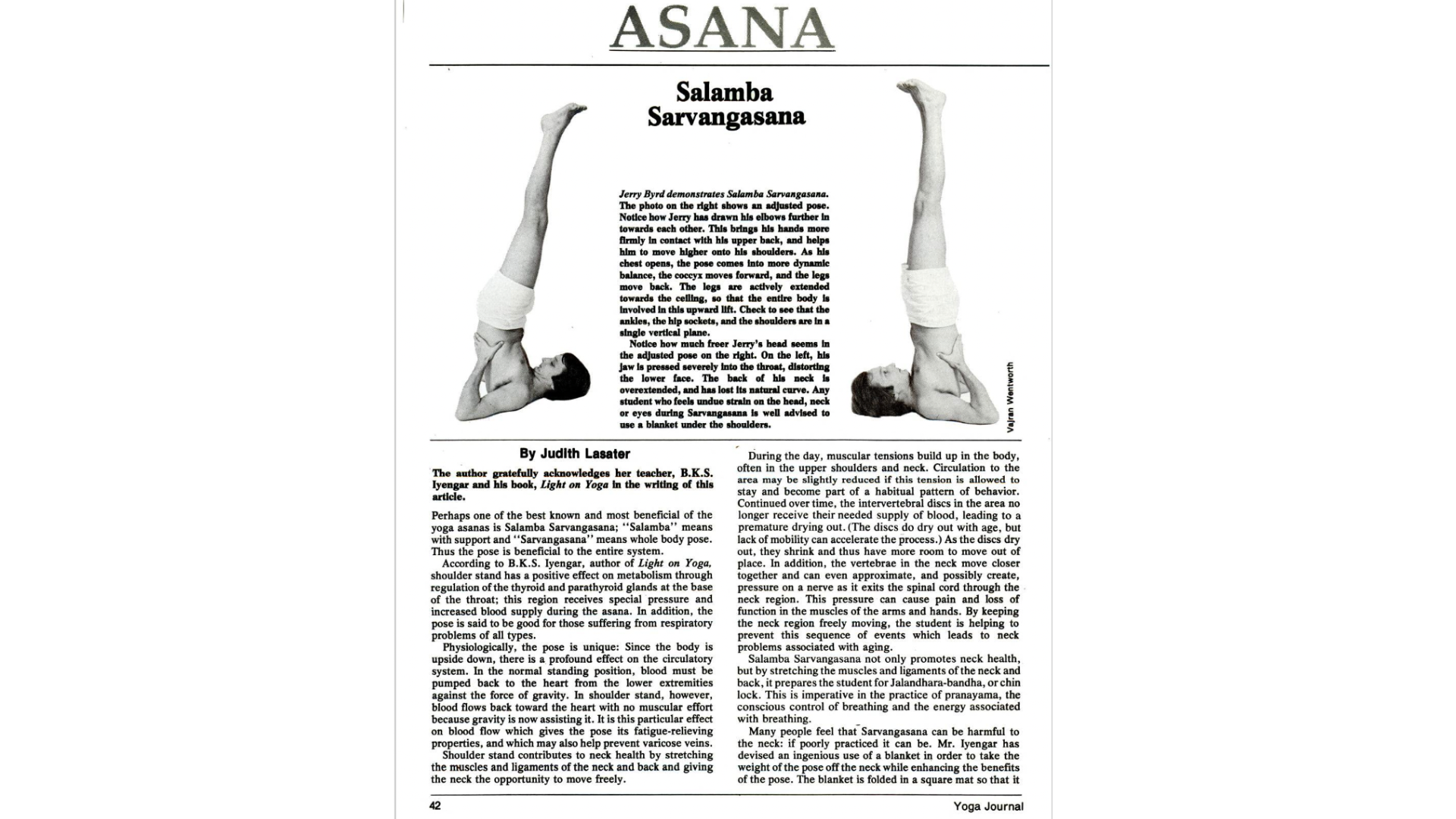
The photo on the right shows an adjusted pose. Notice how the elbows are drawn further in toward each other. This brings the hands more firmly in contact with the upper back and helps the student move higher onto the shoulders. As the chest opens, the pose comes into more dynamic balance, the coccyx moves forward, and the legs move back. The legs are actively extended towards the ceiling, so that the entire body is involved in this upward lift. Check to see that the ankles, the hip sockets, and the shoulders are in a single vertical plane.
Notice how much freer the head seems in the adjusted pose on the right. On the left, the jaw is pressed severely into the throat, distorting the lower face. Also, the back of his neck is overextended, and has lost its natural curve. Any student who feels undue strain on the head, neck or eyes during Sarvangasana is well advised to use a blanket under the shoulders.
Looking for step-by-step instructions on how to practice Supported Shoulderstand? View our Pose Library Shoulderstand explainer for additional insights.
The author gratefully acknowledges her teacher B.K.S. Iyengar and his book Light on Yoga in the writing of this article.