
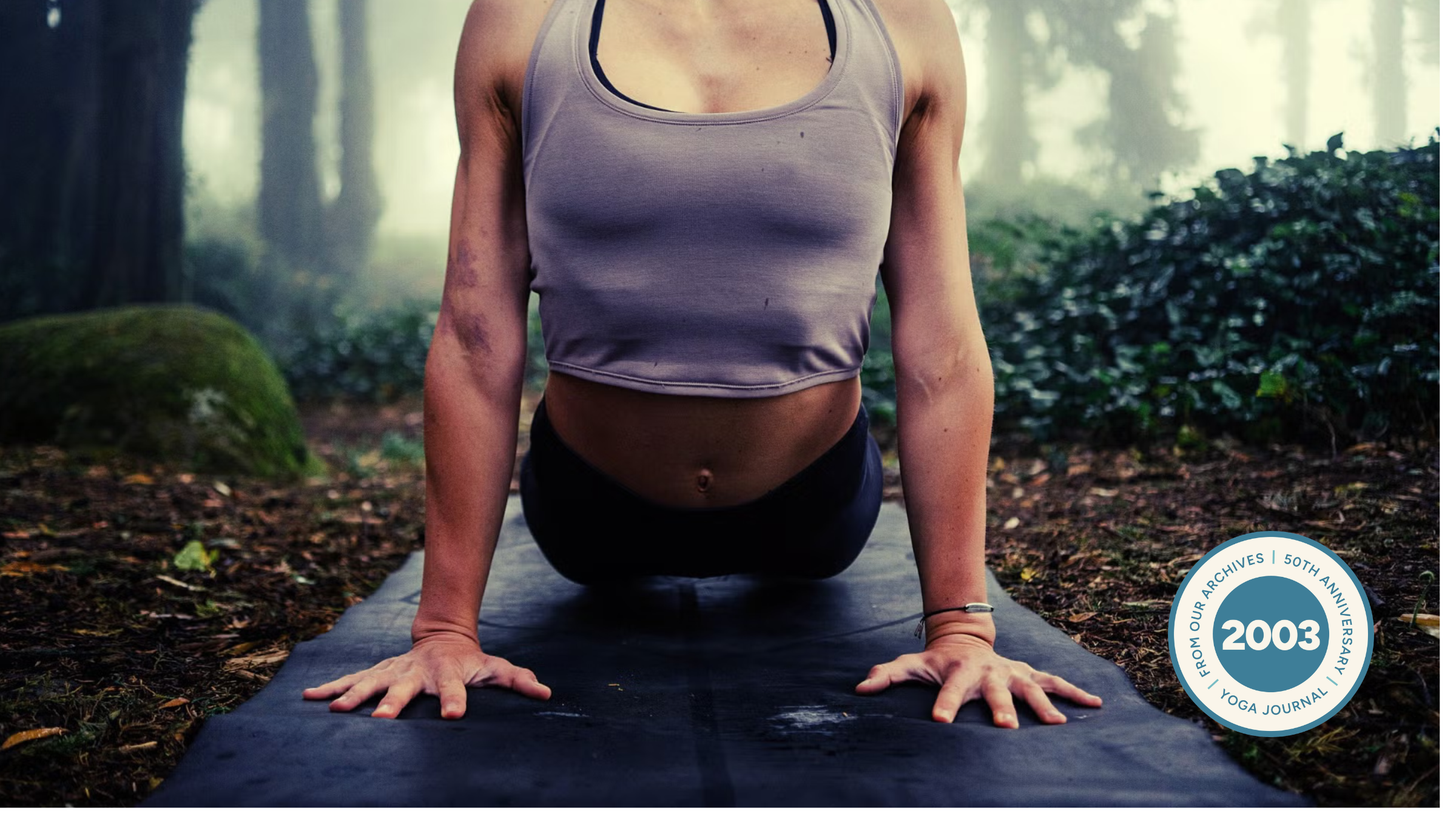
Tips to help unlock your safest, strongest backbends.
(Photo: doraklimova | Pexels)
Published October 27, 2026 02:45PM
In Yoga Journal’s Archives series, we share a curated collection of articles originally published in past issues beginning in 1975. This article about how to do Upward-Facing Dog Pose first appeared in the May-June 2003 issue of Yoga Journal. You can find more of our Archives here.
Before doing Urdhva Mukha Svanasana, it is wise to prepare your body for the intense spinal bending this pose requires. One way to prepare for the intensity of the backbend in is to first progress through somewhat easier versions of backbends. In each of the following poses, you must engage your quadriceps to straighten the legs, which energizes the pelvis. To lengthen and protect the back of the lumbar spine in these poses, you must also draw your tailbone away from the lower spine and lift the pit of your abdomen toward your sternum. (The pit of the abdomen is at the bottom of the belly, just above the pubic bone.) And you must draw your kidney energy through the body into your upper chest to create a lift and an opening in your lungs, ribs, and diaphragm.
In such poses, the lumbar spine becomes crunched because we fail to use the buttocks and the pit of the abdomen correctly. Although contraction of the buttocks pulls the back side of the pelvis away from the lumbar spine, helping to prevent crunching or collapsing in the lower back, contracting the buttocks also compresses the sacroiliac joints and causes external rotation in the thighs, which are undesirable actions in Bhujangasana and Urdhva Mukha Svanasana. What to do?
My solution is first to press the outer edge of the feet into the floor and only then, maintaining this action, to contract the buttocks. Doing these actions in this order creates the pelvic tilt required to prevent compression in the lumbar spine, without compressing the sacroiliac joints or causing external rotation in the thighs.
How to Prepare for Urdhva Mukha Svanasana
1. Bhujangasana (Cobra)
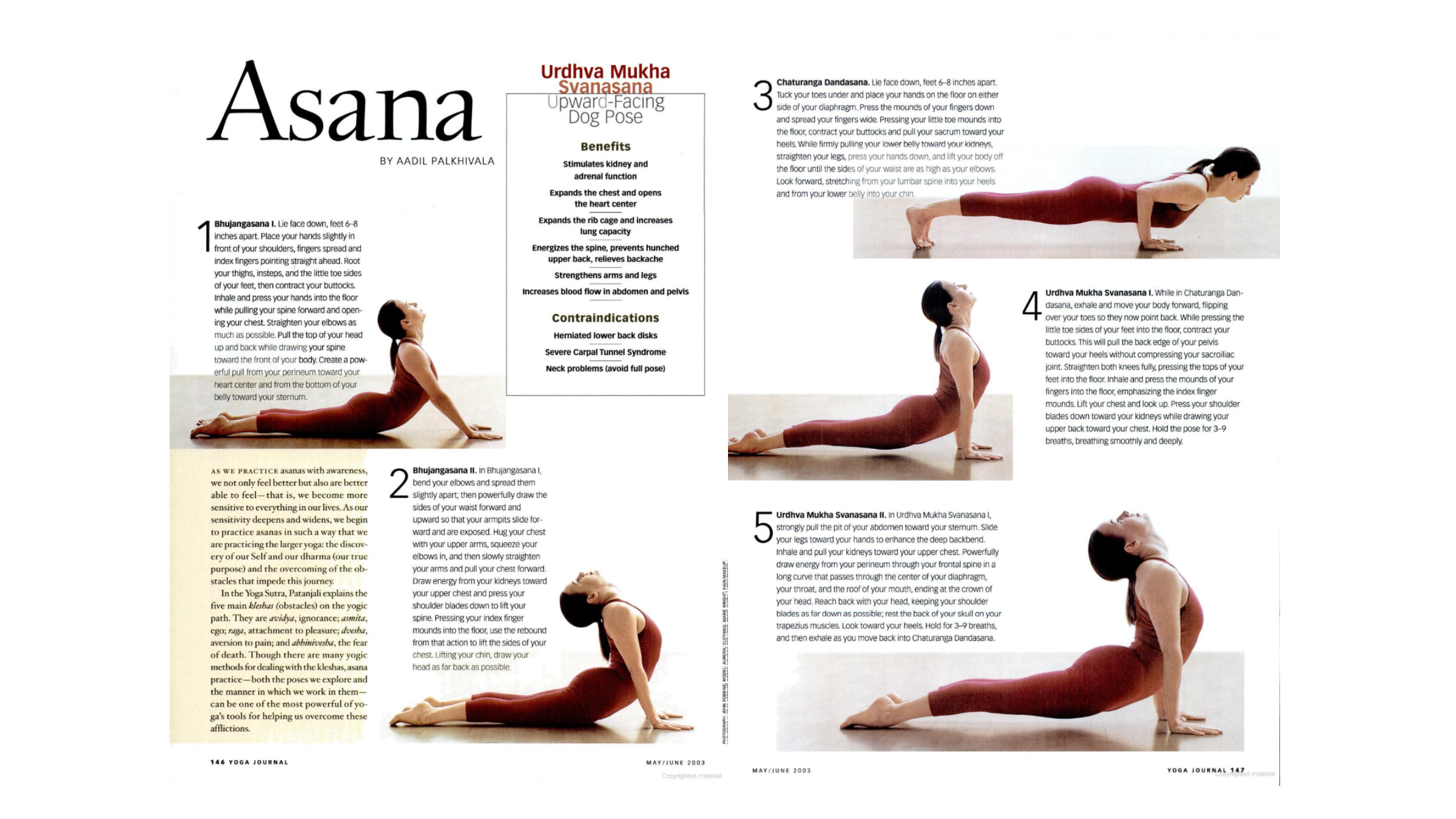
Lie face down, feet 6-8 inches apart. Place your hands slightly in front of your shoulders, fingers spread and index fingers pointing straight ahead. Root your thighs, insteps, and the little toe sides of your feet, then contract your buttocks. Keep your feet six to eight inches apart, toes pointing straight back. Inhale and press your hands into the floor while pulling your spine forward and opening your chest. Straighten your elbows as much as possible. Pull the top of your head up and slightly back while drawing your spine toward the front of your body in Bhujangasana 1 (Cobra). Create a powerful pull from your perineum toward your heart center and from the bottom of your belly toward your sternum.
Also try to press your pubis and thighs fully into the floor. Your weight should be borne by your legs and hands, not your belly. Keep your elbows slightly bent while you press your shoulder blades down. Contract your quadriceps strongly, and create the lift of the perineum called mula bandha (root lock) by pulling energy from your pelvic floor toward your diaphragm. Lift your chin toward the ceiling unless you have neck problems; if that is the case, keep your neck in line with your spine. Firmly straighten your elbows (Figure 1).
You can also practice a variation of Cobra in which you simply lift your head and chest without putting weight on your hands. This prepares your back muscles for the deeper work ahead.
2. Bhujangasana II (Cobra 2)
From Bhujangasana I (above), bend your elbows and move them away from each other. Then powerfully draw the sides of your waist forward and upward so that your armpits slide forward and are exposed. Hug your chest with your upper arms, squeeze your elbows in, and then slowly straighten your arms and pull your chest forward. Draw energy from your kidneys toward your upper chest and press your shoulder blades down to lift your spine. Lift your sternum as far as it will go, moving its energy into your chin. Pressing your index finger mounds into the floor, use the rebound from that action to lift the sides of your chest. Lifting your chin, draw your head as far back as possible. Draw your gaze toward the “third eye” (about an inch above the bridge of the nose) while opening your throat, lungs, and belly (Figure 2).
3. Chaturanga Dandasana
Lie face down, feet 6-8 inches apart. Tuck your toes under and place your hands on the floor on either side of your diaphragm. Press the mounds of your fingers down and spread your fingers wide. Pressing your little toe mounds into the floor, contract your buttocks and pull your sacrum toward your heels. While firmly pulling your lower belly toward your kidneys, straighten your legs, press your hands down, and lift your body off the floor until the sides of your waist are as high as your elbows. Look forward, stretching from your lumbar spine into your heels and from your lower belly into your chin, in Chaturanga Dandasana (Figure 3).
How to Practice Urdhva Mukha Svanasana
4. Urdhva Mukha Svanasana I
While in Chaturanga Dandasana, exhale and move your body forward, flipping over your toes so they now point back. While pressing the little toe sides of your feet into the floor, contract your buttocks. This will pull the back edge of your pelvis toward your heels without compressing your sacroiliac joint. Straighten both knees, fully pressing the tops of your feet into the floor. Inhale and press the mounds of your fingers into the floor, emphasizing the index finger mounds. Lift your chest and look up. Press your shoulder blades down toward your kidneys while drawing your upper back toward your chest in Urdhva Mukha Svanasana (Upward-Facing Dog) (Figure 4). Hold the pose for 3-9 breaths, breathing smoothly and deeply.
5. Urdhva Mukha Svanasana II
From Urdhva Mukha Svanasana I, strongly pull the pit of your abdomen toward your sternum. Slide your legs toward your hands to enhance the deep backbend. Inhale and pull your kidneys toward your upper chest. Powerfully draw energy from your perineum through your frontal spine in a long curve that passes through the center of your diaphragm, your throat, and the roof of your mouth, ending at the crown of your head. Reach back with your head, keeping your shoulder blades as far down as possible; rest the back of your skull on your trapezius muscles (Figure 5). Hold for 3-9 breaths, and then exhale as you move back into Chaturanga Dandasana.
Benefits of Urdhva Mukha Svanasana
- Expands the chest and opens the heart center
- Expands the rib cage
- Energizes the spine, prevents hunched upper back, relieves backache
- Strengthens arms and legs
Contraindications for Urdhva Mukha Svanasana
- Herniated lower back disks
- Severe Carpal Tunnel Syndrome
- Neck problems (avoid dropping your head back)
Preparatory Poses for Urdhva Mukha Svanasana
- Bhujangasana I and II (Cobra Pose)
- Sphinx Pose (a modified Cobra with forearms as well as hands on the floor)
- Ustrasana (Camel Pose)