
Published September 17, 2026 11:24AM
Amber Burke is a longtime yoga teacher who trained at YogaWorks and has taught yoga for 16 years. She is also a graduate of the Yale and the Johns Hopkins Writing Seminars. Her approach to teaching is to support students in creating a practice that is sustainable and sustained, and experience has taught her that mirroring students can be a valuable tool for everyone in class.
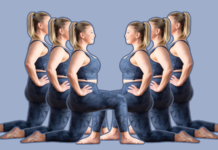
Watching an experienced yoga teacher mirror their students during class can feel like watching a superhero yield a special power. The seemingly illusive technique, which involves the teacher practicing movements on the opposite side as the students facing them, is one that new and not-so-new instructors alike tend to find daunting. How, exactly, do you cue students to lift their left arms while you lift your right arm without mixing things up?
“Mirroring is one of the hardest things to master,” says Brett Larkin, yoga teacher and founder of Uplifted Yoga. It can feel disorienting, especially at first. And chances are you will confront confusion, doubt, and more than a few mistakes while learning to hone this teaching style.
Yet mirroring has less to do with you as a teacher and everything to do with your students. Think of mirroring as an act of consideration. It’s intended to help students more easily translate a movement from a teacher’s body to their own. “If I lift my left arm to cue students to lift their right, they can simply match what they see, the way you’d follow someone across from you in a dance,” says teacher trainer Nam Chanterrwyn of the American Yoga Council. That way, students don’t have to “mentally flip everything,” he says.
By doing something that’s difficult, teachers make it a lot easier for some students to come into the pose. “The fewer mental gymnastics students have to do to figure out which arm or leg to move, the more they can stay connected to their breath, their body, and their own inner experience,” says Larkin.
Mirroring can be especially beneficial in beginner classes where students are less familiar with the poses. They’re already navigating a lot of unfamiliar sensations, and mirroring makes finding the basic shape of a pose possible without the additional burden of “reverse-engineering right and left,” says Chaterrwyn. He adds that mirroring can also be valuable in faster-paced vinyasa classes in which there is not much time for verbal instruction.
How Yoga Teachers Can Learn Mirroring
Getting more comfortable mirroring is a matter of practice. “The only way it becomes natural is repetition,” says Larkin. “Over time, it becomes muscle memory.” There are several techniques that experienced yoga teachers swear by when it comes to making it feel less confusing.
1. Start Small
Begin outside of class with a single movement. Chanterrwyn suggests that you practice simply raising your left arm while saying out loud that you are lifting your right arm, and vice versa. “Doing this away from a live class, with no poses to think about, isolates the actual skill you’re building,” he says. You can even use a mirror—that way, what you see actually matches what a student will see.
Work your way up from a single movement to cueing a full pose. From a pose, work toward a short sequence. And when you’re finally ready to try mirroring in class, you still might want to teach shorter or slower sequences. “Mirroring under time pressure is much harder than mirroring at a relaxed pace,” says Chanterrwyn. “It’s fine to teach more static classes for a while as the skill solidifies, and pick up speed later.”
2. Use Tricks to Determine Right Versus Left
Find a small way to remind yourself that your right side is the students’ left side and vice versa. That could mean drawing a small “R” on your left hand or “L” on your right, or even marking the front corners of your yoga mat with those letters so you know where to begin as you start a sequence or pose.
“My favorite trick is to wear a watch, bracelet, or ring on one side of my body,” says Larkin. “If you wear a bracelet on your left wrist, then when you cue your students’ right arm, you know you’re moving your bracelet arm. You can do the same thing with an anklet if you’re working on leg cues.”
3. Be Mindful of Your Position in the Room
“Mirroring makes the most sense when you’re facing your students and they can clearly see you,” says Larkin. She explains that sometimes teachers need to move to another location in the room so students can see the demonstration more easily. For instance, it might work well to show Tree Pose at the front of the room, but when it’s time for Extended Side Angle, going to the side of the room that students are facing means they don’t need to twist or crane their necks to see.
“The point is always, what will help the student understand this fastest and stay safest?” says Larkin. Sometimes as you move around the room, mirroring might not make sense, so you’ll need to stay open to adjusting to non-mirroing when necessary.
4. Ditch “Left” and “Right” Cues
In the Reddit thread aptly titled “Why Is Mirroring So Hard?” several commenters suggest swapping left and right with location-specific cues. For instance, a couple teachers noticed the windows of the studio are to their students’ right. “Instead of ‘reach to the right,’ you can say ‘reach to the window,’” wrote one teacher.
“I also say things like ‘front’ and ‘back’ foot or leg in poses like Warrior 1 and 2, [and] ‘top’ and ‘bottom’ arm in Side Angle,” said another teacher.
5. Focus on Your Students
When it comes to verbal cues, mirroring might become easier when you look at students’ bodies for reference and not your own, says Amy Ippoliti, yoga teacher trainer and author. Instead of lifting your right leg and having to “translate” your cue to address students’ left legs, she suggests you “identify which side is their left or right and then speak to that.” This approach can also help you view students as if they’re your mirror, which might make mirroring feel more collaborative and less like something you have to perfectly perform.
When Mirroring Doesn’t Work
Mirroring isn’t always necessary and can sometimes work against you and your students, such as if you’re teaching a class that involves mostly reclining postures and no one can see you. Also, if students’ mats or chairs are set up in a circle, it’s usually better to practice on the same side as students since many of them will be facing the same direction as you.
You might also find it’s more helpful to drop the mirroring when there’s a detail you can better demonstrate in profile or by facing away from students, such as interlacing your hands or practicing an arm bind.
In addition, in studios in which there’s an actual mirror at the front of the room, mirroring can be more confusing for students, making it more helpful to face the mirror along with your students.
For some students, mirroring is more confusing than not. “I remember taking a class [in which] the teacher was mirroring, [and] struggling to figure out if I was supposed to twist right or left. It scrambled my brain,” says Kirstie MacDonald Scott, PhD, neurodivergent yoga teacher and author of the forthcoming book Somatic Touch: An Integrative Approach to Physical and Psychosomatic Trauma. Because of its potential to bewilder some students, Scott intentionally avoids mirroring. Her preference in slower-paced classes is to encourage students to choose which side they want to practice first by saying, for example, “Lift one arm,” and then “Switch sides.”
Other yoga teachers choose to honor their preference not to engage in the practice. “I personally do not mirror,” says yoga instructor Malaika DosRemedios. If students seem confused while she’s facing them and doing the opposite side in a pose, she faces away from them and says, “I’m turning my back to you for a few moments just so we can get our lefts and rights as clear as possible as we go into the next series.”
To Mirror or Not? It’s Up to You.
So is mirroring really worth it? It isn’t necessary for all students and situations, and a teacher can certainly lead a happy and productive yoga life without mirroring. But that doesn’t mean you need to ditch it if it feels awkward at first. Chanterrwyn suggests finding patience with yourself. “Every teacher who mirrors smoothly today once struggled to work it out in real time. Eventually the calculation stops being conscious,” he says. “Just try to mirror one pose more cleanly than you did the class before.”