
Published June 25, 2026 07:36AM
Yoga Journal’s archives series is a curated collection of articles originally published in past issues beginning in 1975. This article about Headstand (Urdhva Dandasana) first appeared in the May-June 1995 issue of Yoga Journal.
Yogis have developed various techniques—asanas and pranayamas among them—that work to release the accumulated stress of day-to-day living and purify and cultivate the subtle circuits of the body. The posture I’ve chosen for this article presents an especially interesting challenge for the spinal circuit, which I like to think is hinted at by its name, Raised Staff Pose (Urdhva Dandasana). Urdhva means “raised, elevated, high,” and danda is the “staff” (the spine) that props us up as we make our way through the world. It is one step in the long dance of variations that ornament the Headstand (Sirsasana).
The posture looks like an upside-down L: The inverted head and torso, with the brace of the bent arms against the floor, make up the vertical stem, while the legs, extended parallel to the floor, halfway between heaven and earth, are the horizontal beam.
In order to work with the full posture, you’ll need to have some experience with Headstand and preferably Shoulderstand (Sarvangasana) and Plow Pose (Halasana) also. While there are many good books and videos that demonstrate this posture, it’s my feeling that Headstand should be learned from, or at least periodically checked by, a competent teacher.
Raised Staff has many of the same benefits of Headstand. For example, it rejuvenates the brain and the important glands inside the skull; it increases bodily energy and overall health; it strengthens the shoulders, spine, and lower back.
Warming Up for Raised Staff
We’ll first look at a simple version of the “up-the-front, down-the-back” energy flow, which focuses on the vestigial tailbone (coccyx) at the bottom tip of the spine and the top of the breastbone (sternum). If you’re interested in a more detailed account of this work, read The Thinking Body by Mabel Todd or Inside Motion by John Rolland.
We’ll also work here with the inner thighs, to get them ready for their command performance in the Raised Staff. To help contact and animate this area, you’ll need a yoga block (or a sturdy book about six inches thick).
Prepping Your Lower Body
Stand in Mountain Pose (Tadasana) with the block between your thighs. Leave a small space between the top of the block and the bottom of the pelvis. Bring your index fingers onto those bony knobs at the front of your pelvis and reach your thumbs around to the back. Gently squeeze those muscles near the top rim of the pelvis: If they seem resistant, dig your thumbs encouragingly around in the flesh until they decide to be more agreeable.
Then with your hands in place again, push the muscles away from the back of the pelvis and press the bony knobs in toward each other. Consciously firm the inner thighs against the block, rolling it back slightly as if pushing it out behind you. Next, slide your thumbs together at the back of the pelvis. Move them around until you find a flat bony area shaped like a V: this is the sacrum. Work your thumbs down to the apex of the V, where you’ll find the coccyx.
Coccyx is Greek for “cuckoo.” I haven’t been able to find out who named this little bone, but it must have been some whimsical old anatomist who saw a resemblance to its namesake’s hooked beak. The coccyx is near the yogi’s root chakra, the cave of the serpent power, which represents, in the words of Carl Jung, “the hidden or underground divinity concealed in the recesses of physical nature.” When I started yoga, during the Dark Ages, we were told in certain postures to “tuck the tail,” which today would be sufficient cause for a yogic court martial, since this action tends (among other things) to flatten the natural curve of the lower back. Instead, lengthen the coccyx down toward the floor as you firm the inner buttocks, which are just below and outside the thumbs. Picture the bone lengthening downward, and then, as Todd describes it, out along the floor behind you like a kangaroo’s tail.
Now move your attention quickly up to the sternum. The sternum has the appearance of a downward-stabbing knife, so the top of the bone is called the manubrium or “handle,” and the sharp bottom point the xiphoid process, from xiphos, Greek for “sword.” We’re primarily interested in the manubrium, which is found just below the notch of the throat. Rest a finger or two on this notch and, as you drag the kangaroo tail behind you, raise the manubrium up toward the center of the head.
I want to emphasize that you’re raising the top of the sternum, not the bottom. Most beginners, when asked to open the chest, will poke the bottom of the sternum and the lower front ribs forward, which actually compresses both the chest and the lower back. Spread the collar bones (clavicles) away from the sternum, and think of suspending the ribs from here like a shirt on a hanger.
Now, remember the block between your thighs? Find the inner thighs just above the block, and imagine that you’re drawing them up and channeling them toward the top of the sternum. At the same time, drive the heels forcefully into the floor. Stay for a few minutes. Be careful not to grip the abdomen as you work the legs against the block.
Remember that this is the preliminary exercise for finding the spinal circuit. It concentrates on the movement between two points, the coccyx and the top sternum, and so only approximates the experience of the integrated circuit, which flows along the entire length of the front and back spine. The spinal circuit stabilizes the core of the body. It also “fuels” the legs and arms, which the yogis call the karma-indriya, the “action organs.” A beginner should support Headstand mostly with the arms and touch the head very lightly on the floor. Only when the posture is steady and comfortable should more weight be shifted onto the head.
Prepping Arms and Shoulders
To learn about the arms and shoulders in Raised Staff, we’ll work with a modified Downward-Facing Dog (Adho Mukha Svanasana). This exercise, incidentally, is also a good preparation for the Peacock Pose (Pincha Mayurasana), also called elbow or forearm balance, which builds the arm strength necessary for Headstand.
Come into a tilted-table position with your knees and forearms on the floor, shoulders over the elbows. Interlock your fingers and curl whichever pinky is closest to the floor into the palm of the opposite hand. The forearms and hands will now form a V shape, with the knuckles at the point of the V.
By the way, notice which hand is “superior,” in other words, the hand with its index finger uppermost. Everyone has a habitual way of clasping the hands, and this is probably yours. When you work with Headstand variations, be sure to alternate the hands in the superior position, to keep the two sides of the body balanced.
Now, keeping the fingers locked as much as possible, roll onto the backs of the hands and open the palms to the ceiling. This action promotes the outward rotation of the upper arms, which in turn will help “fan” the shoulder blades (scapulas) away from the spine. Stretch the area between the inner borders of the scapulas, but be sure not to flatten the natural convexity of the upper spine.
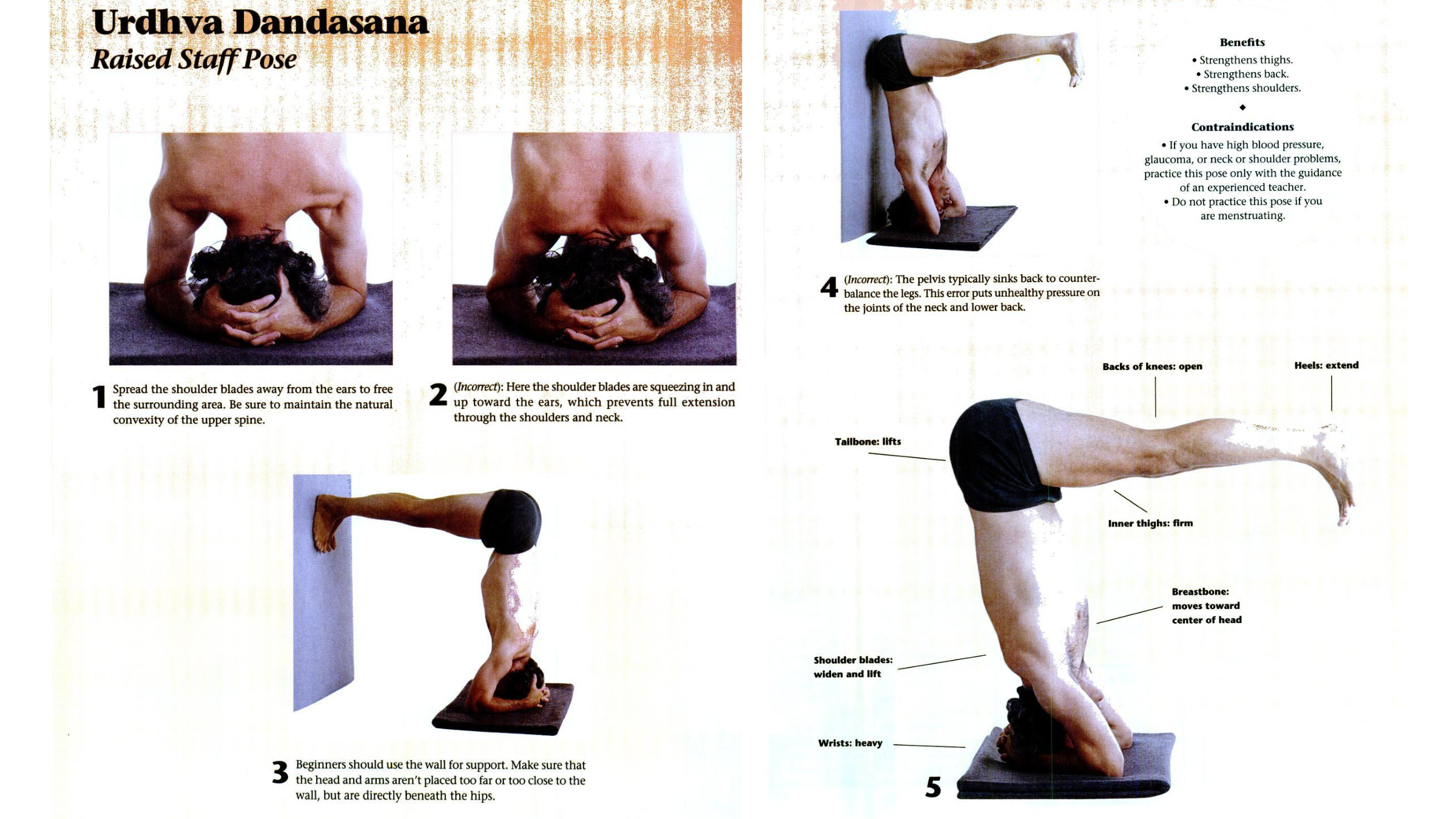
Now hold this space in the upper back and return the palms to perpendicular, pressing down firmly through the inner wrists and forearms. Place the crown of the head on the floor in Headstand position. Exhale and slowly straighten the legs as much as possible by firming the inner thighs and pulling the inner groins into the pelvis. The torso should be vertical with the shoulder blades spreading away from the spine (Figure 1).
If you’re tighter in the shoulders, you might find that your scapulas pinch in toward the spine and up toward the ears (Figure 2: Incorrect). Bend the knees just enough to reopen the scapulas, soften the tops of the shoulders, and breathe into the back. Don’t try to “muscle” your way through this position—or any position for that matter. Just be patient until the muscles enthusiastically ask for more.
But if you’re reasonably relaxed with the shoulders over the elbows and the legs straight, then see if you can go a little farther: Exhale, and imagine that your shoulders are being hoisted diagonally away from the elbows by the spinal energy streaming through the kangaroo tail.
Play with the movements of the hands, upper arms, and shoulders until you find a position both strong and light. Stay for two or three minutes, letting yourself be carried along by the lift of the inner thighs and the current of the spinal energy.
Beginner Headstand Variation
Sit facing a wall with legs extended and soles pressing into the wall. Make a mark on the floor beside one hip, then turn around and kneel, facing out into the room, with the feet by the wall. Set the crown of your head on the floor at the mark, position your hands and forearms, exhale, and carefully walk the feet up the wall until you form a right angle (Figure 3). If the forearms and elbows feel hard against the floor, pad them with a folded blanket or sticky mat.
If you’re relatively new to Headstand be sure to clasp your hands with the base of the palms touching, and bear most of the weight of the body with the arms, not the neck. The crown of the head is hardly touching the floor: Whenever you feel it getting heavier, either recharge the arms to take up the load again or, if the arms cry “uncle,” come out of the posture.
Switch on the spinal circuit: Shoot the kangaroo tail straight up to the ceiling and the top of the sternum into the center of the head. Firm the inner thighs and roll an imaginary block between them upward. Push the heels into the wall while you pull the upper inner thighs into the pelvis and widen across the sacrum.
Recreate the “strong and light” experience of the modified Dog exercise. If the neck still feels compressed, you’ll need some additional support: You could make more room for the neck by elevating the forearms (but not the head) a few inches off the floor on a blanket folded into a V, or ask a mystified housemate to stand behind you and lift your top thighs, just at the imaginary block, upward. If none of this helps, then you’re probably not ready for this preparation, so return to the modified Dog for a while.
Intermediate Raised Staff
If you’re a more experienced headstander but haven’t yet practiced much with Raised Staff, you might begin your work with the posture near the yoga wall. Put the knuckles of your laced fingers right up against the wall, so there’s only an inch or two between the back of your body and the wall when you’re in Headstand. Once in Headstand, press the backs of your heels into and up the wall, and use this contact to help elevate the coccyx.
Move into Raised Staff on an exhalation. Until the spinal circuit is well established, along with the dynamic contributions of the arms, shoulders, and inner thighs, the pelvis tends to fall backward—crowding the lower back and neck—to counterbalance the weight of the descending legs (Figure 4: Incorrect). Lower the legs slowly, stopping each time the back of the pelvis sinks onto the wall. Wait, readjust the spinal circuit, arms and shoulders, and inner thighs, then see if you can take the pelvis off the wall without toppling forward in a quivering heap.
You don’t need to bring the legs to 90 degrees right away: Hold them anywhere, even if only a few inches away from the wall, until you feel steady and comfortable enough to move on. Stay for 10 seconds at first, and gradually work up to a minute or so.
For the full posture, of course, you’ll need to come away from the wall. I like to start by bending my knees, taking the heels toward the sitting bones, and recreating the entire experience of my right-side-up Mountain Posture. I then imagine there’s a string attached from my coccyx to my heels: As I straighten the legs, I feel the tailbone drawn upward by the heels (Figure 5). Again, guard against the tendency to sink the pelvis back as the legs descend—it’s an unhealthy movement, especially for the neck.
The spinal circuit serves as a kind of barometer by which we can gauge the moment-to-moment fluctuations of our “skillfulness,” not only in our daily yoga practice, but in our daily lives as well. It is a constant reminder of our intrinsic relationship to the planet we inhabit and the subtle unseen forces that create, preserve, and ultimately reclaim the Universe as their own. “What is here,” teaches the Vishvasara Tantra, “is there. What is not here is nowhere.”