
Published June 30, 2026 09:30AM
Yoga Journal’s archives series is a curated collection of articles originally published in past issues beginning in 1975. This article about Upward-Facing Dog Pose first appeared in the May-June 1991 issue of Yoga Journal.
An introductory backbend, Upward-Facing Dog Pose (Urdhva Mukha Svanasana) can teach us basic principles that may then be applied to more advanced poses. In probing for the essence of an asana, we often ignore an obvious source of information, the name, which is the primary key to practice left for us by the ancient masters. The next time your dog or cat stretches, let it teach you to perform Upward-Facing Dog.
Our four-legged friends live with a 90-degree angle between their torso and back legs. For them, Upward-Facing Dog Pose is not a backbend, but a means to stretch the juncture between torso and legs, bringing the two into line with one another. A proficient animal practitioner of this pose will stretch its back legs so strongly that they vibrate dynamically with energy and appear to grow several inches. By contrast, human practitioners tend to be distracted by the movement of chest and spine, forgetting about the legs.
I believe that the key to safe practice of backbends lies in the work of the legs. When the work of the legs is inadequate, the lower spine becomes inert. Like a rubber band being pulled from one end (the chest) without being anchored on the other end (the legs), the spine moves in space but does not truly extend.
How To Practice Upward-Facing Dog
Upward-Facing Dog combines two equal, dynamic, and opposing extensions: legs backward, chest forward. Obviously this action will stretch the area which lies between the two: the lumbar spine. However, the primary backbending movement should come from the middle and upper back, not from the lower back.
Beginning Variation
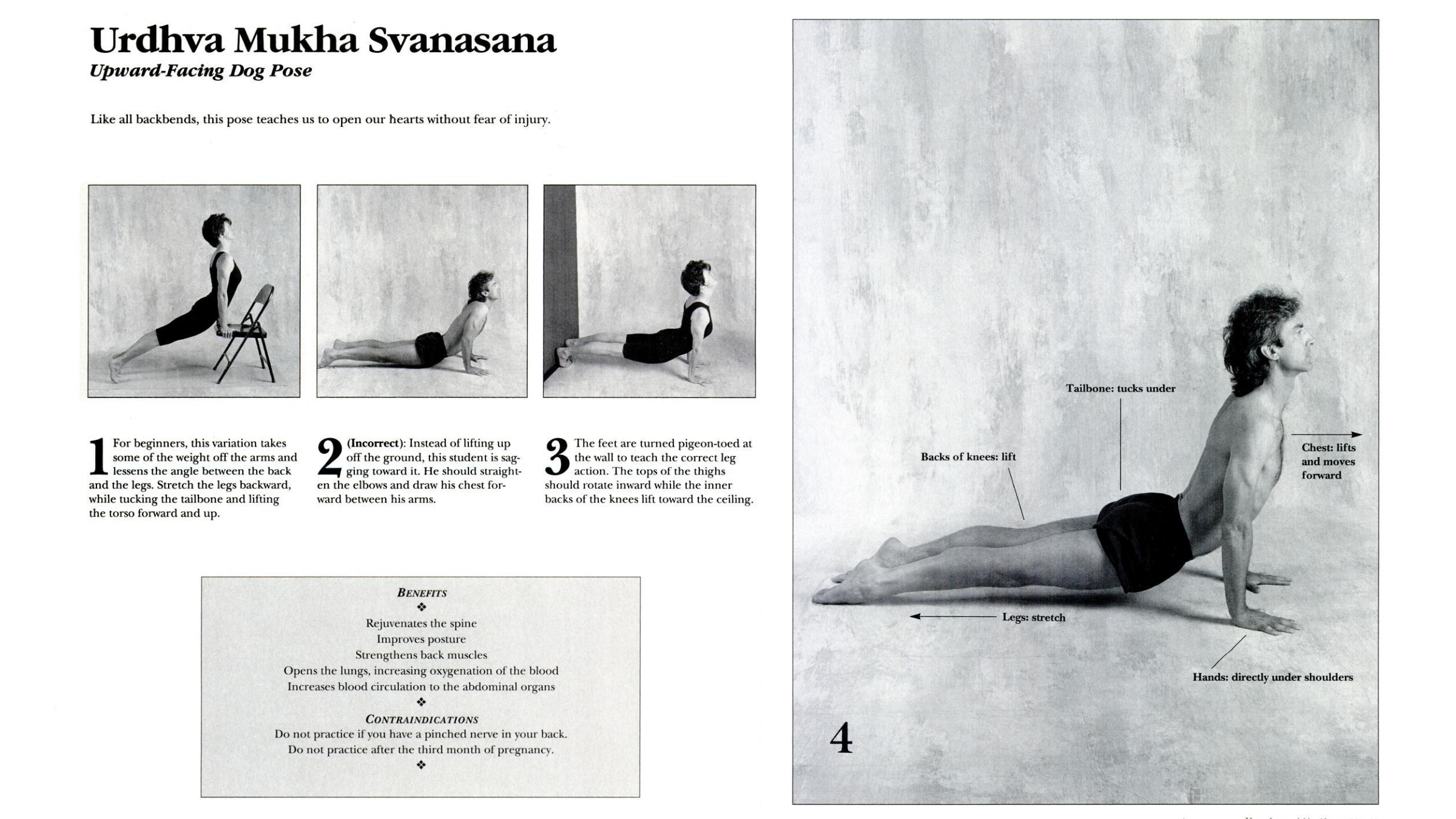
To train the spine and legs to work properly in Upward-Facing Dog, practice the pose with the hands on a chair seat instead of on the ground (Figure 1). This variation makes the angle between the spine and legs less acute, thus decreasing compression of the lower back. Furthermore, the elevation of the body allows the feet to continue to support some of the weight. Practiced with the hands on the ground, the pose can challenge upper body strength so much that the beginner is distracted from creating subtler actions. This variation will allow you to build some upper body strength, while you learn to open the chest and stretch the legs.
Set up your chair with the backrest against a wall so the chair can’t slide. Place your hands on the chair so your wrists face one another and your fingers curl over the sides of the chair seat. Now walk your feet back, letting your pelvis swing down and forward into the pose.
As you straighten your knees, your shoulders should come directly over your hands. If necessary, adjust your position by walking your feet closer to or farther from the chair, until your arms are perpendicular to the floor.
Now stretch your legs out behind you until they vibrate and feel like they’ve grown three inches! The current of extension through the legs should be so strong that the knees would not bend if a 25-pound weight were placed on the back of the legs. See if you can work the legs this actively, lifting the inner backs of the knees toward the ceiling.
Through this leg action, you have created half the stretch of the pose. To create a forward movement of the torso that opposes the backward motion of the legs, visualize a dog tucking its tail between its legs. While extending the legs as just described, see if the tailbone can create an equal and opposite movement. The legs move away from the chair and the knees lift up toward the ceiling, while the tailbone moves forward toward the chair and down toward the ground. Thus, from its very base, the spinal column is sucked into the body.
Now let the mid-thoracic area continue what the tailbone has begun, by allowing the area between your shoulder blades to move in and up. This action will cause the breastbone to lift up and move forward. As you create this action, don’t wedge the arms so tightly against the body that the skin of the torso can’t move. Rather, the skin under the back of the armpit should roll toward the front armpit, as the torso is dragged forward to be at least in line with the arms, or even in front of them.
Pain in your lower back may indicate that you need to stretch your legs much more strongly, or that your torso is sagging as shown in Figure 2: Instead of lifting off from the ground, this poor student is sagging down into it. Pressing the hands dynamically down into the chair (or the ground, if your hands are on the floor), feel your body lifting up as though you were being raised by your armpits. If, after careful work with all the instructions in this section, you still experience lower back pain in the pose, seek the help of an experienced teacher.
Intermediate Practice
More experienced students should perform this pose with the hands on the ground, fingers pointing forward, as shown in Figure 4. Turn the feet so the tops of the feet, rather than the balls of the toes, are touching the ground. Maintain all of the actions described in the beginner’s version: extending the legs, lifting the backs of the knees, tucking the tailbone, freeing the skin under the armpits, and moving the breastbone forward.
In addition, intermediate students may use this pose to investigate the correct rotation of the legs in backbends. To begin this exploration, stand in Mountain Pose (Tadasana), the basic standing posture. With your fingertips, lightly touch the inner top back thigh of each leg (the flesh that lies just below the crease of the buttock, at the back of the thigh, close to the midline of the body). Now contract the buttocks, making them very hard. Many of you will perceive that (1) the inner top back thighs also move toward one another and (2) the tops of the thighbones thrust forward. If you continue to pay attention as you tighten the buttocks, you may also find that (3) the kneecaps tend to rotate outward and (4) the weight rocks forward and shifts to the outer borders of the feet.
Making the buttocks solid in backbends is healthy. However, none of these four concomitant actions is useful. If these four actions occurred in an advanced backbend, the knees would splay out, the weight would roll to the sides of the feet, and there might well be pain around the lumbosacral or sacroiliac joints. For this reason, some teachers tell students not to tighten the buttocks in backbends.
However, I suggest that the key to painless practice of backbends lies in making the buttocks firm, but dispensing with the four unneeded actions described above. To do so, we must learn to transform movements made without thought into subtle, sophisticated, and conscious actions. Through this process, we learn not only about the legs in backbends, but about the possibility for precision in all our actions.
Try squeezing the buttocks in Mountain again, but this time turn your feet so you become pigeon-toed (the big toes touching and the heels about eight inches apart). Observe that, with the feet in this position, the weight stays on the inner borders of the feet, and the knees roll toward each other. The forward thrust of the thighbones is also minimized, and the inner top back thighs remain well separated. By turning your feet inward, you have created a strong internal rotation of the heads of the femurs (thighbones). Whereas the front thighbones are now moving toward each other, the back thighbones are actually drawn apart at the top, creating freedom in the sacral area.
Now try performing Upward-Facing Dog with the legs in this position. Turn your feet pigeon-toed and press them into a wall (Figure 3). Notice that the buttocks become firm, yet the inner top back thighbones can resist the tendency to squash together.
For the duration of the pose, you should feel a continuous rotation of the thighs, with the right thigh rotating counterclockwise and the left thigh rotating clockwise. As you develop this action, you will feel the knees rolling toward each other, with the inner knees ascending toward the ceiling while the outer knees descend toward the floor.
Thus we have seen again and again that the legs are the anchor of the backbends. They extend backward when everything else moves forward; they become firm as the spine becomes flexible; they turn inward when everything else in the body is opening outward.