
Stand up straighter and energize your mind.
(Photo: Andrew Clark)
Published July 1, 2026 04:00PM
Yoga Journal’s archives series is a curated collection of articles originally published in past issues beginning in 1975. This article about Bow Pose first appeared in the January-February 1984 issue of Yoga Journal.
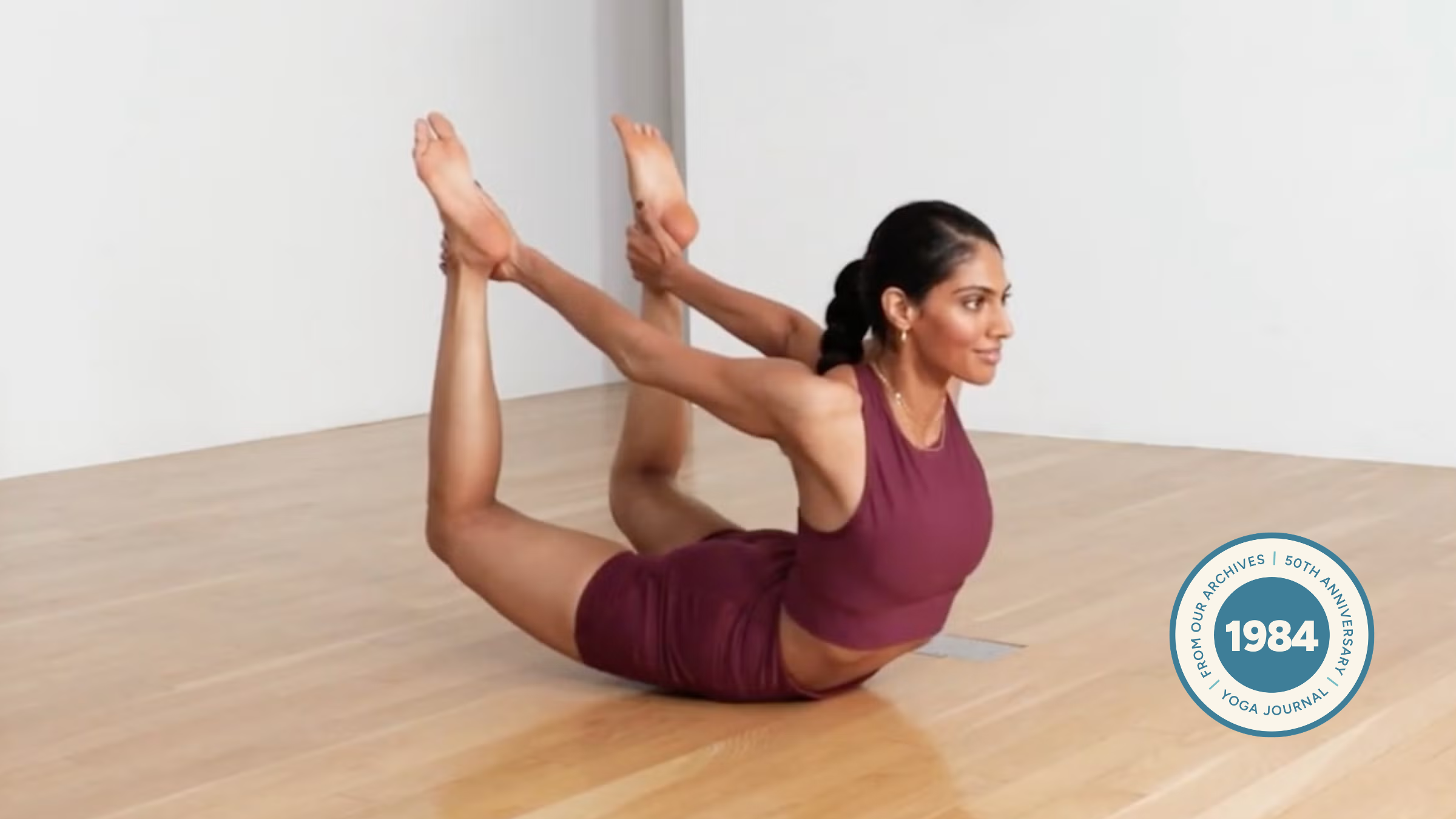
Bow Pose (Dhanurasana), is one of the best known of the classical poses, both for the beauty it expresses and for the benefits it brings to the vertebral column. The vertebral column consists of a series of curves: the cervical (neck) and lumbar (lower) spine have a posterior curve, while the thoracic (mid-back) and sacral areas curve the opposite way. Gravity, stress, poor sitting and standing postures, and the effects of age displace these curves, causing the cervical and lumbar curves to decrease and the thoracic curve to increase.
Bow Pose counteracts these degenerative tendencies by strongly reversing the “flat” cervical and lumbar curves and by diminishing the increased thoracic curve. B.K.S. Iyengar in Light on Yoga states that this pose brings elasticity to the spine and is beneficial in treating disc problems.
Bow Pose is also valuable in strengthening the erector spinae muscles, the paravertebral muscles that hold the spine erect. Most articles and books about back health include myriad exercises for stretching the back, but this is only part of the therapy required. In cases of generalized back strain it is necessary to strengthen the muscles around the vertebral column. This occurs in Bow Pose.
Another benefit of Bow Pose is that it causes the spine to curve backward. Everyone bends forward in the course of the day, when picking things up from the floor, etc., but bending backward is an act that must be done deliberately. Bow Pose is a simple yet effective way to move the spine in a direction that is allowed by its anatomical structure but not encouraged by daily activities. Yoga teaches that in order to be healthy, one must move the spine in all directions.
By practicing Bow Pose, one can strengthen the paravertebral muscles, move the spinal joints in a way they rarely go, and help to stretch the front of the body, which can become tight from sitting and from most forms of traditional exercise.
Like all the many backbending poses in yoga, Bow Pose has a positive psychological effect—an energizing and activating of the mind. While forward bends create a feeling of surrender, backbends create a feeling of courage, will and individualization. A morning practice emphasizing backbends is especially helpful when one has difficult tasks in the day ahead. Bow Pose helps to increase one’s confidence and assurance. This may be because the pose opens the chest or because it stimulates the adrenal glands.
Paradoxically, after years of practice Bow Pose and other backbends will begin to create the feelings of inner calmness produced by forward bends. With continued yoga practice one becomes more aware of the calmness that one is, and the poses become merely a way of expressing this calmness and radiance. For this reason if for no other, one should include all sorts of poses in one’s practice, allowing the mind to learn the state of pratyahara (conscious withdrawal from the effects of the senses) in the midst of any asana, any situation, any crisis. This ability to maintain equanimity is the true test of the validity of yoga in daily life.
How to Practice Bow Pose
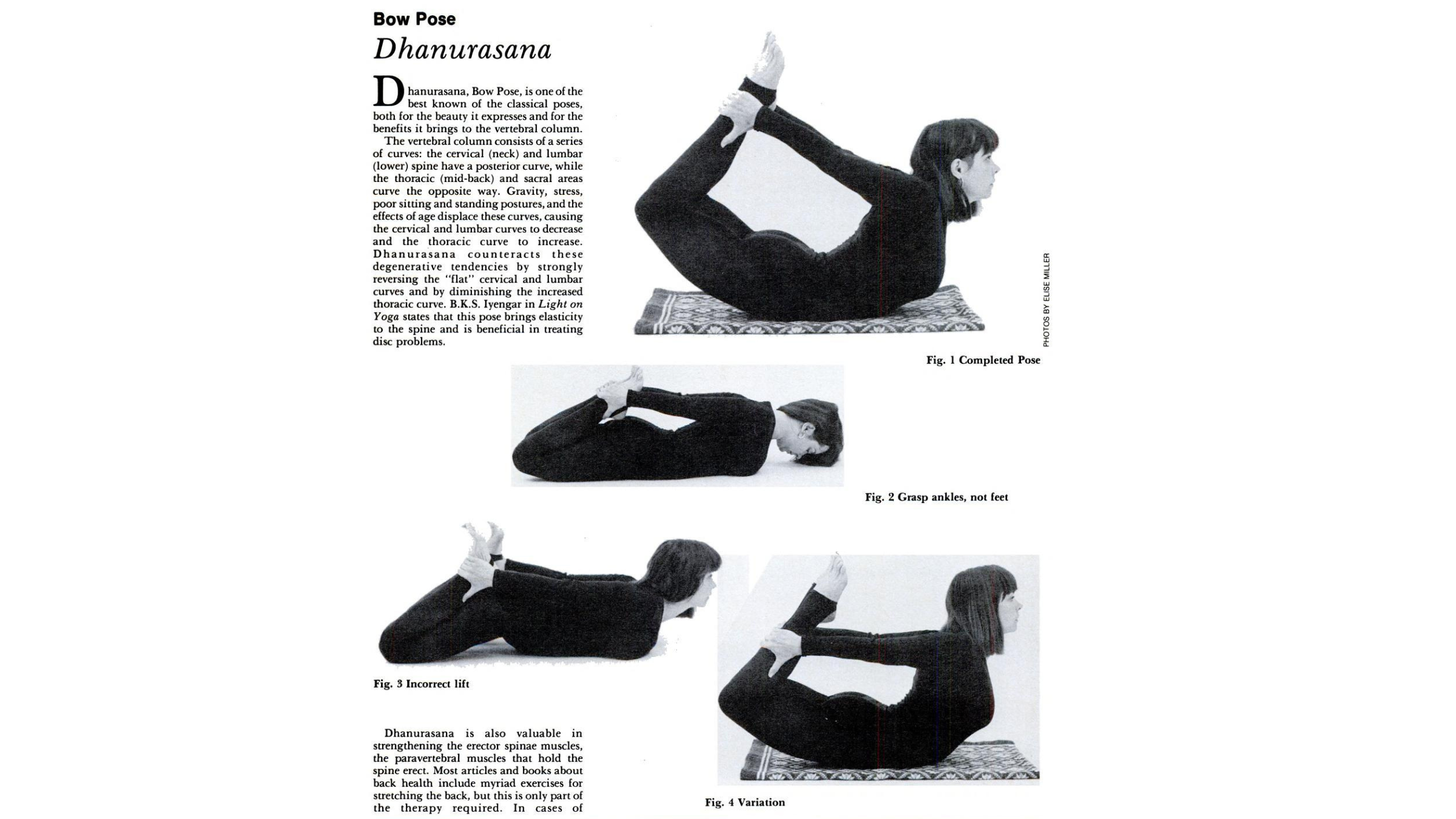
Lie face down on a folded mat placed under the lower abdomen to prevent the pubic and hip bones from pressing against the floor. Prepare for Bow Pose by lifting and then stretching back one leg at a time.
This will elongate the lower abdomen. Then use the arms to gently lift the upper body. Move the lower front ribs out and away from the pelvis. Lie down again and reach for the ankles. Try to hold the ankles and not the feet; using the feet will tend to pull the ankles out of alignment (Figure 2). Check to be sure that the lower abdomen and upper thighs are still pressing the floor. If this area lifts, it means the hip flexor muscles at the front of the hips are too tight, and the arch of Bow Pose will move too much into the lower back (Figure 3). If the front thighs lift, practice until this area can remain on the ground while the ankles are being held.
If the front thighs remain on the floor, inhale and lift the legs with the exhalation, being careful to raise the knees and the shoulders at the same speed. Concentrate on lifting up rather than back. Only the abdomen should rest on the floor. Grip the coccyx (tailbone) firmly between the buttocks. Breathe several times, taking care that the breath does not shake the pose.
Make sure that the knees are no farther apart than the width of the hips. To avoid cramps in the feet, turn the toes toward the shins. After completing the pose, lie on the stomach for a moment to rest, then repeat, making sure to begin with the preparatory movements. Remember to keep the neck active but not tense, and the abdomen soft.
Follow a series of backbends with a twist or two to relieve any tension that overzealous practicing may have created. To vary the pose, try holding the legs as shown in Figure 4.