
In this pose, you can’t help but self-reflect.
(Photo: Elly Fairytale | Pexels | Design in Canva by Laura Harold)
Published July 3, 2026 05:41AM
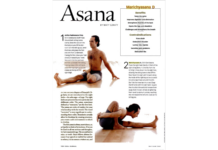
Yoga Journal’s archives series is a curated collection of articles originally published in past issues beginning in 1975. This article about Eka Pada Sarvangasana appeared in the September-October 1981 issue of Yoga Journal.
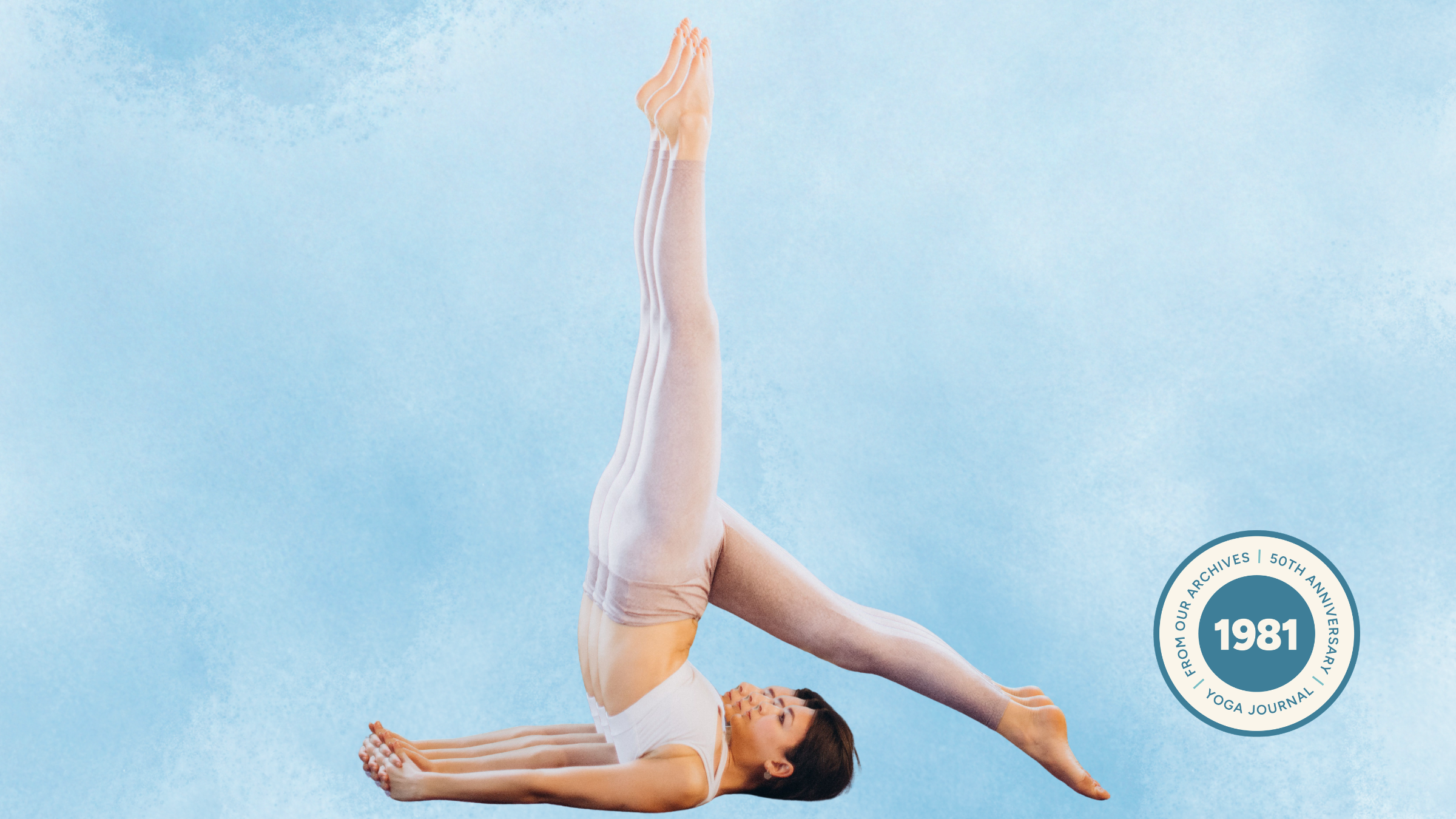
This pose (One Leg Shoulderstand), according to lyengar, “tones the kidneys and leg muscles.” To practice it well, one must first be able to do Shoulderstand with competence. Then, one learns to lower the legs one by one (the advanced beginner may use a chair, as in figure 2).
Often the student tries to place the foot on the floor prematurely which causes the leg to bend and spinal column to collapse. This is not desirable for several reasons. First, when one bends the moving leg, the stretch on the hamstring muscles is lost. Keeping the leg straight requires concentration, and concentration is an integral part of yoga. Without the ability to still the body, the mind can never become still; without mental stillness the equanimity of the self is never experienced.
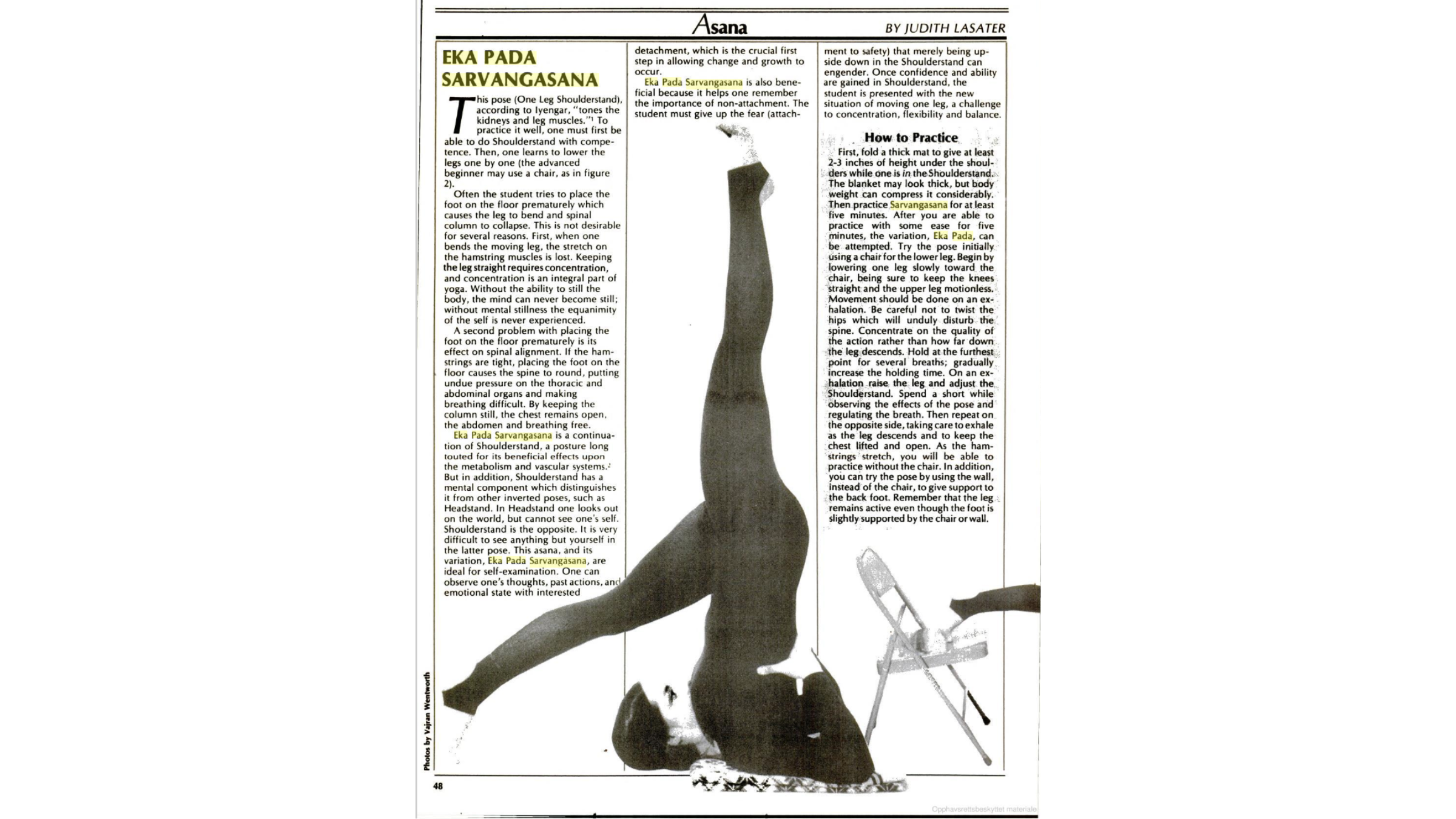
A second problem with placing the foot on the floor prematurely is its effect on spinal alignment. If the hamstrings are tight, placing the foot on the floor causes the spine to round, putting undue pressure on the thoracic and abdominal organs and making breathing difficult. By keeping the column still, the chest remains open, the abdomen and breathing free.
Eka Pada Sarvangasana is a continuation of Shoulderstand, a posture long touted for its beneficial effects upon the metabolism and vascular systems. But in addition, Shoulderstand has a mental component which distinguishes it from other inverted poses, such as Headstand. In Headstand one looks out on the world, but cannot see one’s self.
Shoulderstand is the opposite. It is very difficult to see anything but yourself in the latter pose. This asana, and its variation, Eka Pada Sarvangasana, are ideal for self-examination. One can observe one’s thoughts, past actions, and emotional state with interested detachment, which is the crucial first step in allowing change and growth to occur.
Eka Pada Sarvangasana is also beneficial because it helps one remember the importance of non-attachment. The student must give up the fear (attachment to safety) that merely being upside down in the Shoulderstand can engender. Once confidence and ability are gained in Shoulderstand, the student is presented with the new situation of moving one leg, a challenge to concentration, flexibility and balance.
How to Practice Eka Pada Sarvangasana
First, fold a thick mat to give at least 2-3 inches of height under the shoulders while one is in the Shoulderstand.
The blanket may look thick, but body weight can compress it considerably. Then practice Sarvangasana for at least five minutes. After you are able to practice with some ease for five minutes, the variation, Eka Pada, can be attempted. Try the pose initially using a chair for the lower leg. Begin by lowering one leg slowly toward the chair, being sure to keep the knees straight and the upper leg motionless.
Movement should be done on an exhalation. Be careful not to twist the hips which will unduly disturb the spine. Concentrate on the quality of the action rather than how far down the leg descends. Hold at the furthest point for several breaths; gradually increase the holding time. On an exhalation raise the leg and adjust the Shoulderstand. Spend a short while observing the effects of the pose and regulating the breath. Then repeat on the opposite side, taking care to exhale as the leg descends and to keep the chest lifted and open.
As the hamstrings stretch, you will be able to practice without the chair. In addition, you can try the pose by using the wall, instead of the chair, to give support to the back foot. Remember that the leg: remains active even though the foot is slightly supported by the chair or wall.
The student is thus constantly being asked to maintain inner equanimity while the body is being placed in more difficult and demanding positions. The importance of this is twofold: giving up attachment to a present position and yet maintaining poise in a new one.
These are important life lessons.
Learning to maintain inner peace no matter what position the body is in is akin to maintaining inner peace no matter what condition our life, relationships, finances, and career are in.
Freedom and flexibility in asana mean nothing if one does not carry these lessons into daily life.